Bank of Korea Revises Economic Outlook, Temporary Factors Affect Q1 Growth
Adjustment Expected in Q2, Recovery Anticipated in Second Half of Year
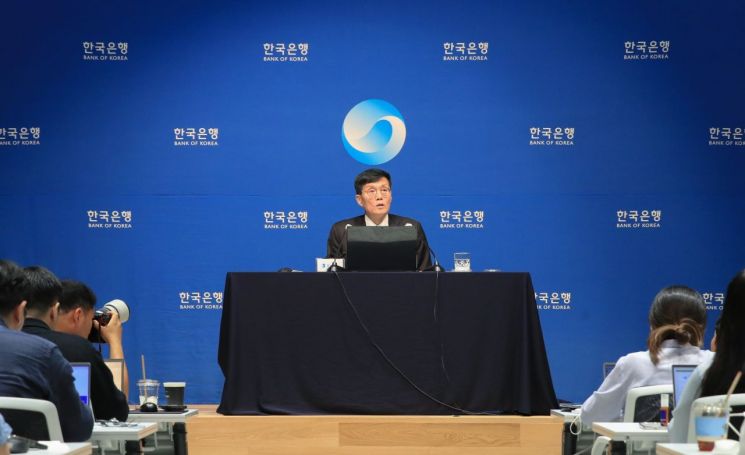 Bank of Korea Governor Lee Chang-yong is speaking at the monetary policy direction press conference held at the Bank of Korea in Jung-gu, Seoul, on the morning of the 23rd. (Photo by Bank of Korea)
South Korea's economic growth rate in the first quarter significantly exceeded expectations, prompting the Bank of Korea to sharply revise its growth forecast for this year upward. However, the Bank of Korea expects the economy to undergo an adjustment phase in the second quarter, as the surprise growth in the first quarter is attributed to temporary factors.
In the revised economic outlook announced on the 23rd, the Bank of Korea raised its forecast for South Korea's real Gross Domestic Product (GDP) growth rate this year from 2.1% to 2.5%.
The Bank explained that the growth forecast was raised by 0.4 percentage points due to strengthened export recovery momentum and better-than-expected consumption trends.
In particular, the rapid recovery of South Korean exports, driven by stronger-than-expected global IT demand fueled by artificial intelligence (AI) investment, was a major factor in the upward revision of the growth rate.
Lee Chang-yong, Governor of the Bank of Korea, explained at a press conference that "external factors such as the favorable global IT industry and strong growth in the U.S. economy contributed to raising the growth forecast by 0.3 percentage points." He added, "Domestic factors, including the easing of sluggish domestic demand, contributed to a 0.1 percentage point increase."
However, the Bank of Korea analyzed that one-off factors played a significant role in the surprise growth in the first quarter. Favorable weather in the first quarter increased outdoor activities (leading to higher consumption of clothing and vehicle fuel), large-scale construction projects progressed rapidly, early execution of previous expenditures, and the early release of new mobile phone models also contributed. Accordingly, the Bank expects the growth rate in the second quarter to fall short of the first quarter's performance.
Looking at the growth trend, construction investment is expected to decline in the second quarter, consumption is expected to slow, and the contribution of net exports will shrink, leading to an adjustment phase. However, growth is projected to recover again in the second half of the year. Consumption is predicted to gradually recover more clearly in the second half, supported by easing inflation and improved household income conditions due to increased corporate profits after the second quarter adjustment.
The contribution of net exports in the second quarter is expected to decrease compared to the previous quarter due to a sharp increase in imports, but steady export growth driven by improved external conditions is still expected to lead economic improvement.
The consumer price inflation rate for this year remains at the previous forecast of 2.6%, despite somewhat increased upward pressure from better-than-expected growth and a higher exchange rate level, as the consumption recovery is moderate and government measures are expected to alleviate inflationary pressures.
The current account surplus for this year is projected to exceed the initial forecast of $52 billion, reaching $60 billion. The surplus is expected to widen beyond initial expectations due to export strength supported by the recovery of the IT industry and strong growth in the U.S.
A Bank of Korea official said, "The domestic economy is expected to show solid growth as exports remain robust, supported by the IT industry upswing and recovery in major economies, and the consumption growth path has also been revised upward. Inflation is expected to gradually ease, but given the still significant uncertainties, it is necessary to monitor future trends more closely to gain confidence in achieving the inflation target."
© The Asia Business Daily(www.asiae.co.kr). All rights reserved.
![Clutching a Stolen Dior Bag, Saying "I Hate Being Poor but Real"... The Grotesque Con of a "Human Knockoff" [Slate]](https://cwcontent.asiae.co.kr/asiaresize/183/2026021902243444107_1771435474.jpg)















