When Business Is Slow, It's Hard to Pay Employees
Labor Costs Cut First When Store Conditions Worsen
Replacing Staff with Unmanned Order Machines and Serving Robots
University student Mr. O (22) recently experienced an embarrassing situation. He was notified by the restaurant owner, where he has been working for 8 months, to reduce his working hours.
The restaurant owner said that due to difficult business conditions, the previous schedule of working three times a week for 5 hours each would be cut down to three times a week for 3 hours each. Suddenly facing a halving of his income, Mr. O had to urgently find an additional job.
Mr. O said, “I heard that my friends around me have experienced similar situations,” adding, “It seems that the phenomenon of drastically reducing part-time hours or not hiring new part-timers at all due to difficult business conditions is continuing.”
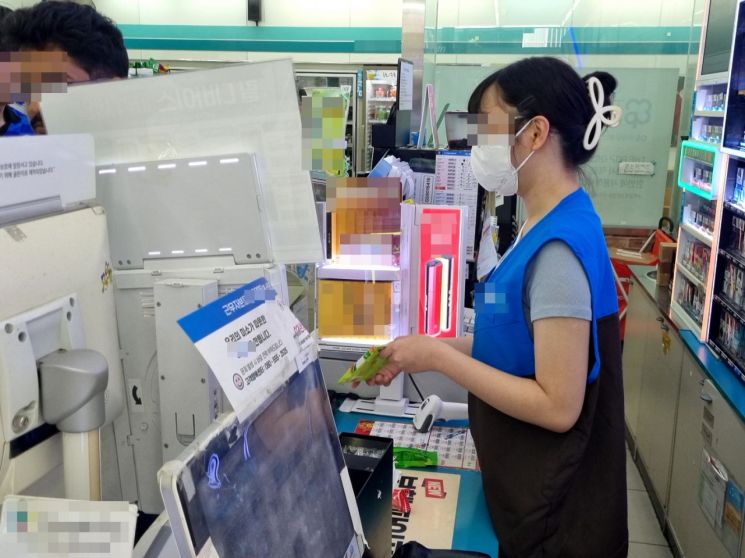 On the 23rd, an employee is attending to a customer at a convenience store in Gwanhun-dong, Jongno-gu, Seoul.
 [Photo by Seongah Sim]
In the midst of high inflation and slowing consumption, the minimum wage has been rising by around 6% annually, leading more self-employed business owners to reduce their staff. The concerns of young people who rely on part-time jobs to cover living expenses are deepening.
Ms. Lee Ji-young (36), the owner of a convenience store in Jegi-dong, Dongdaemun-gu, Seoul, said, “During times when business is slow, all the income goes to paying employee wages, leaving not a single penny,” adding, “If the minimum wage rises further next year, I think I will have to reduce part-timers’ working hours or find other solutions.”
Mr. Kim (71), who has been running a convenience store in Gwancheol-dong, Jongno-gu, Seoul for 5 years, also said, “Sales are decreasing, but the minimum wage has sharply increased over the past few years, which is burdensome,” and “I am most worried about labor costs and how much the hourly wage standard will rise next year.”
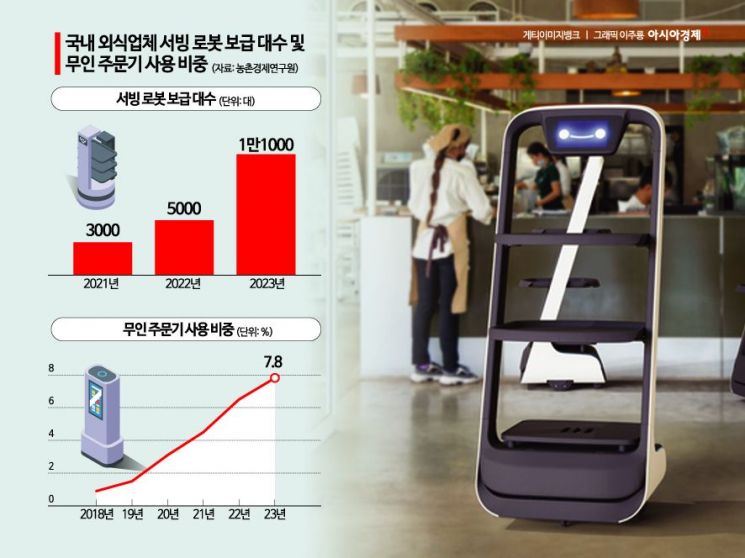
The number of stores replacing part-time workers with serving robots and unmanned ordering machines is also increasing. According to the Korea Rural Economic Institute, the proportion of unmanned ordering machine usage in domestic dining establishments last year was 7.8%. The usage rate was 0.9% in 2018, then rose to 1.5% in 2019, 3.1% in 2020, 4.5% in 2021, and 6.1% in 2022. Another survey by the Korea Rural Economic Institute showed that the number of serving robots in Korea increased from 3,000 units in 2021 to 5,000 units in 2022, and 11,000 units last year.
Mr. Kim Jung-woon (30), a restaurant owner in Hawangsimni-dong, Seongdong-gu, Seoul, also started using serving robots a year ago. Mr. Kim said, “While the robot is serving, other employees can handle delivery packaging or other tasks, which is very efficient,” adding, “The machine rental fee is about 500,000 to 600,000 KRW per month, which is cheaper compared to labor costs, and it’s convenient because it doesn’t require going through the difficult hiring process.”
This phenomenon poses a significant threat to young people who earn their living through part-time jobs. University student Lee Min-ji (21) said, “I have to work part-time because of rent, but there aren’t many options,” and lamented, “From what I hear from friends around me, it’s definitely become harder to find part-time jobs.” Convenience store part-timer Kim Sung-jin (24) also expressed anxiety, saying, “With prices so high these days, it would naturally be good if the minimum wage rises, but if store sales don’t increase accordingly, part-timers like me will probably be the first to be cut.”
There are also cases where workers receive less than the legal minimum wage. According to the Korea Employers Federation’s “2023 Minimum Wage Underpayment Rate Analysis Report,” about 3,011,000 workers did not receive the hourly wage of 9,620 KRW last year. Mr. Ahn (20), a part-time worker at a franchise cafe in Doseon-dong, Seongdong-gu, Seoul, had a similar experience. He said, “A few months ago, when I worked at a sandwich shop, the owner said, ‘There’s nowhere else to work these days,’ and paid me less than the minimum wage.”
Professor Kang Sung-jin of Korea University’s Department of Economics said, “Raising the minimum wage is the right direction, but attention should be paid to the fact that 3 million people are working for less than the minimum wage,” diagnosing, “The fact that many workers are willing to work for less than the minimum wage means that Korea’s economic development level has not yet reached the minimum wage standard.”
He continued, “People who cannot find jobs that pay the minimum wage are being deprived of work opportunities,” advising, “We should not focus solely on raising the standard amount but also consider how to reduce the number of people paid below the minimum wage and how to introduce flexibility into the minimum wage.”
© The Asia Business Daily(www.asiae.co.kr). All rights reserved.
![Clutching a Stolen Dior Bag, Saying "I Hate Being Poor but Real"... The Grotesque Con of a "Human Knockoff" [Slate]](https://cwcontent.asiae.co.kr/asiaresize/183/2026021902243444107_1771435474.jpg)
















