Gathering Diverse Opinions on 'Three-Dimensional Waterfront Spatial Planning'
Experts from Various Fields, Including Site Planning CEO Han Youngsook, Attend
Busan Urban Corporation (BMC, President Kim Yonghak) held the third meeting of the 'BMC Waterfront City Working Group' on the 23rd under the theme of 'Three-Dimensional Spatial Planning of Waterfront Areas.'
The working group, launched last March, holds regular monthly meetings to explore sustainable waterfront space creation strategies with resilience and adaptability and to practically apply them to development projects promoted by BMC.
This meeting featured a presentation by Han Youngsook, CEO of Site Planning, on 'Three-Dimensional Spatial Planning of Waterfront Areas,' followed by a free discussion among working group members, including BMC President Kim Yonghak, and other stakeholders.
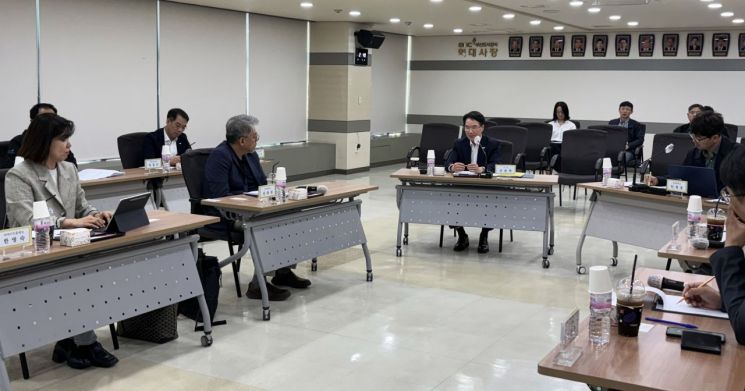
Han Youngsook introduced various projects she participated in, including: the Busan city landscape plan case that designated a belt-shaped key landscape management zone for East Busan coastal villages; the Tongyeong Shina Shipyard urban regeneration project, which incorporated diverse industrial functions beyond simple spatial planning; the Ocean Tech Bay project aimed at establishing a new marine industry ecosystem in Busan; and the Incheon Gyeyang New Town case, which emphasized the need to create living convenience spaces combining forest and station zones within a linear park.
She also stressed that spatial planning of waterfront areas is crucial in the re-urbanization phase of Busan, utilizing the city's unique locational potential and urban characteristics, and that strategies to maximize urban appeal are needed.
The working group members agreed on the need to shift waterfront landscape planning, and discussed various ideas related to three-dimensional spatial planning, such as constructing diverse industrial ecosystems, realizing pedestrian-centered living experiences, the economic value of green and park spaces, and ways to focus on design within limited floor area ratios.
Professor Ahn Byungcheol of the Department of Forest Landscape Architecture at Wonkwang University stated, "For three-dimensional spatial design of waterfront areas, the basic principle should be to place low-rise buildings along the waterfront and high-rise buildings further back," and argued, "New three-dimensional design principles should be established considering climate change and environmental factors."
Professor Kwon Taejung of the Department of Urban Engineering at Dong-A University said, "It is necessary to utilize waterfront spaces three-dimensionally, using them as water storage areas when needed, and planning the upper levels for various functions to vitalize the waterfront."
Various opinions from other experts participating in the working group followed.
Kim Junghwa, CEO of Kim Junghwa Architects, commented, "Waterfront design should prepare for the next 100 years, requiring long-term and safe strategies, including green axes connected to waterfronts and vertically integrated waterfront spaces."
Professor Ban Kwonsu of the Department of Landscape Architecture at Dong-A University added, "Landscape design should be proposed to enable harmonious coexistence between humans and nature through social-ecological systems, and nature-based solutions should be actively utilized to respond to climate change and create resilient spaces."
Kim Yonghak, President of Busan Urban Corporation and chair of the meeting, stated, "Waterfront space creation involves a financial structure in which the private sector bears costs, including compensation and land development expenses, so it is necessary to seek efficient solutions," and promised, "Through the operation of the working group, we will continue to discover innovative policies and ideas and do our best to realize the waterfront city that Busan citizens desire."
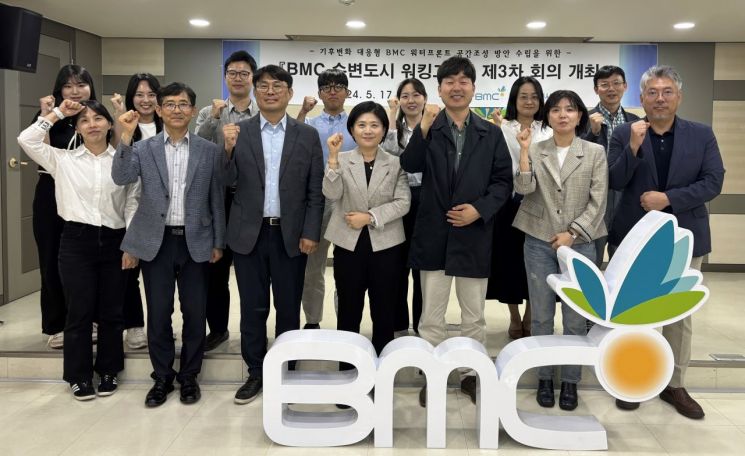 Busan Urban Corporation is holding the 3rd meeting of the 'BMC Waterfront City Working Group' and taking a commemorative photo.
© The Asia Business Daily(www.asiae.co.kr). All rights reserved.
![Clutching a Stolen Dior Bag, Saying "I Hate Being Poor but Real"... The Grotesque Con of a "Human Knockoff" [Slate]](https://cwcontent.asiae.co.kr/asiaresize/183/2026021902243444107_1771435474.jpg)
















