Next-Generation Growth Engines for Telecom and Display Industries Supported at National Level
Improved Weather Forecast Accuracy Expected with Meteorological Satellite Replacement
6G low Earth orbit satellite communication, iLED display business, and geostationary meteorological satellite have passed the preliminary feasibility study for national research and development (R&D). It is expected to serve as a catalyst for South Korea to continue leading the global communication and display industries.
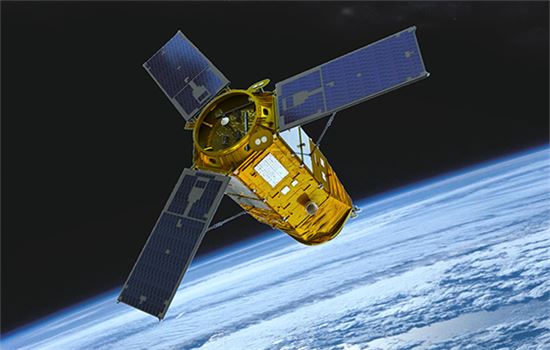 Satellite
 The Ministry of Science and ICT announced on the 23rd that it held the '4th National R&D Project Evaluation General Committee of 2024' chaired by Ryu Gwang-jun, Director of the Science and Technology Innovation Headquarters, and reviewed and approved the investigation results of three projects selected as the 2nd and 3rd R&D preliminary feasibility studies in 2023.
The projects that passed the preliminary feasibility study this time are ▲ the geostationary meteorological and space weather satellite (Chollian Satellite 5) development project (Korea Meteorological Administration and Ministry of Science and ICT) ▲ the technology development project to secure competitiveness in the low Earth orbit satellite communication industry (Ministry of Science and ICT) ▲ and the iLED display technology development and ecosystem establishment project (Ministry of Trade, Industry and Energy), totaling three projects.
The low Earth orbit satellite communication technology development project, which will invest 319.9 billion KRW over six years from 2025 to 2030, aims to secure core technologies for 6G standard-based low Earth orbit satellite communication by launching a communication satellite (in 2030) and establishing a pilot network for the low Earth orbit satellite communication system, thereby acquiring related technologies and verification records. Linked with the 6G standard to be announced in 2028, it is expected to provide a foundation for South Korea to lead in securing related low Earth orbit satellite communication technologies, achieving technological independence, and gaining an advantage in standard-based technology competition. Although this project passed the preliminary feasibility study after three attempts following two failures, its scale was reduced to about one-third of the initially requested 479.7 billion KRW.
The Ministry of Trade, Industry and Energy will invest a total of 484 billion KRW over eight years from 2025 to 2032 in the iLED display technology development and ecosystem establishment project, which focuses on securing leadership in iLED displays, a next-generation display with superior performance and lifespan compared to currently mainly used LCD and OLED. The project supports the development of iLED pixels and panel technologies centered on microLED and plans to build a Smart Modular Center in Tangjeong-myeon, Asan-si, Chungnam, to provide infrastructure necessary for full-process demonstration. This project also saw its initially expected scale of 950 billion KRW reduced by half through the preliminary feasibility study process.
The geostationary meteorological and space weather satellite project, which will invest a total of 600.8 billion KRW over seven years from 2025 to 2031, involves private companies developing the Chollian Satellite 5, which will be launched in 2031 to replace the existing Chollian Satellite 2A. The Korea Aerospace Research Institute is expected to enhance private companies' satellite development capabilities through technology transfer and reduce overseas dependence on satellite development components, thereby increasing the localization rate of satellites. Additionally, it is anticipated that ultra-short-term weather forecasts at the neighborhood level and localized detection of wildfires and heavy rainfall will become possible, improving weather forecast accuracy.
Ryu Gwang-jun, Director of the Science and Technology Innovation Headquarters, stated, "We plan to support the immediate commencement of the three projects that passed the R&D preliminary feasibility study from next year," and urged, "The ministries, institutions, and companies participating in the projects should strive for rapid technology development and commercialization so that South Korea can secure a leading position in global technology competition."
© The Asia Business Daily(www.asiae.co.kr). All rights reserved.
![Clutching a Stolen Dior Bag, Saying "I Hate Being Poor but Real"... The Grotesque Con of a "Human Knockoff" [Slate]](https://cwcontent.asiae.co.kr/asiaresize/183/2026021902243444107_1771435474.jpg)














