Analyzing Curiosities with 5 Indicators Including Exchange Rates and Interest Rates
"The Key to Economic Recovery is Real Wage Growth"
"Prolonged Yen Depreciation Will Weaken Export Competitiveness of Han Companies"
There is growing interest in whether the Japanese economy will emerge from the long-term stagnation tunnel after the "lost 30 years." This is because the stock market continues to boom, and consumer prices are expected to grow by more than 2% for three consecutive years. On the other hand, the Bank of Japan still maintains an expansionary monetary policy, leading some to argue that it is difficult to view this as a structural economic recovery trend.
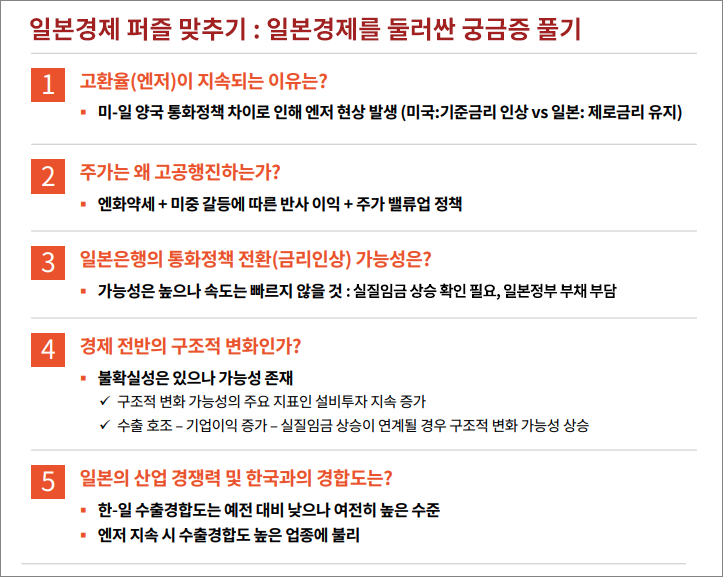
Samil PwC announced on the 23rd that it has published a report titled "Solving the Japanese Economic Puzzle: Addressing Questions Surrounding the Japanese Economy," which examines the current status and outlook of the Japanese economy and presents its impact and implications for the Korean economy.
The report focused on the fact that the movements of five economic indicators?exchange rate, interest rate, stock prices, inflation rate, and gross domestic product (GDP) growth rate?differ from the past. It views real wages as the core of Japan's structural transition. In other words, although the current economic recovery is limited to the corporate sector, if it leads to an increase in real wages in the future, it is expected to establish a virtuous cycle of "real wage increase → demand growth and escape from deflation → increased investment and expansion of growth base," which could bring structural changes to the overall Japanese economy.
According to the report, the competition between Korea and Japan in manufacturing has decreased compared to the past but remains high. The report stated, "Given Japan's strong manufacturing competitiveness as a beneficiary of the weak yen and the US-China trade dispute, careful attention is needed for industries with high Korea-Japan export competition," and suggested, "To maintain competitiveness in Korean exports despite the weak yen, improving comparative advantage is important."
Choi Jaeyoung, head of the Samil PwC Management Research Institute, who published the report, said, "Japan has strengths in automobiles and parts, machinery, semiconductors, and robot-related materials and equipment, but is weak in digital transformation (DX)." He added, "While securing manufacturing competitiveness in areas competing with Japan is important, it is necessary to leverage technological strengths to build a digital super-gap." He also advised that comprehensive collaboration is required, including not only corporate technology investment but also government deregulation, tax benefits, and industry-academia cooperation for talent development.
© The Asia Business Daily(www.asiae.co.kr). All rights reserved.
![Clutching a Stolen Dior Bag, Saying "I Hate Being Poor but Real"... The Grotesque Con of a "Human Knockoff" [Slate]](https://cwcontent.asiae.co.kr/asiaresize/183/2026021902243444107_1771435474.jpg)















