"AI Development Must Consider Universal Values Such as Human Shared Prosperity"
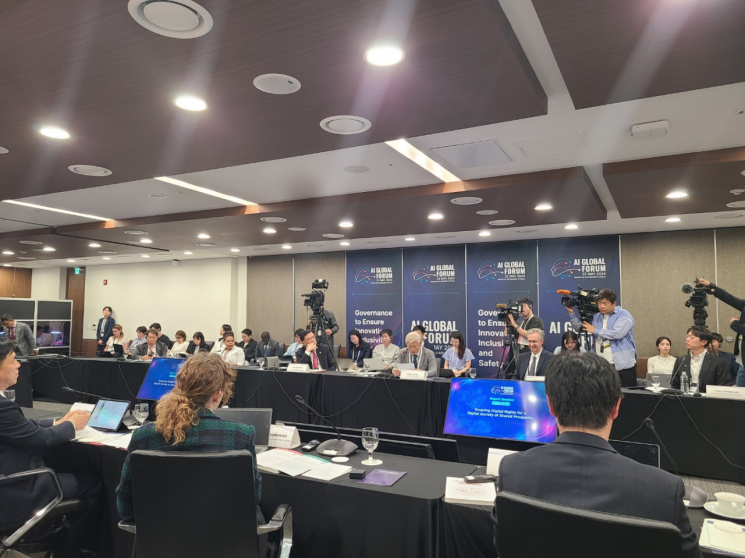
Global big tech companies, governments, and institutional officials gathered to brainstorm ways to ensure sustainable AI development and guarantee digital rights.
At the first expert session of the 'AI Global Forum' held on the 22nd at the Korea Institute of Science and Technology (KIST) in Seoul, experts from various fields discussed the theme of 'Guaranteeing Digital Rights for a Digitally Inclusive Society.'
Chairman Yeom Jae-ho, President of Taejae University, stated, "As we enter a new AI era, we face significant challenges," adding, "Just as when Gutenberg invented the printing press, education, law, healthcare, and social systems are all expected to undergo major changes. It is also time to consider how to solve the various problems arising from this."
Kang Do-hyun, Second Vice Minister of the Ministry of Science and ICT, emphasized in his keynote speech, "Korea announced the Digital Rights Charter in September 2023 to propose a new digital order for the AI era, and on the 21st, presented 20 specific policy tasks," adding, "We have been advancing new digital society initiatives together with Korea and the OECD, and international cooperation is needed moving forward."
Experts from various sectors predicted that AI technology will impact not only citizens' rights and freedoms and social systems but also mental health, and unanimously agreed that governments and companies must prepare proactively.
Cho Jun-hee, Chairman of the Korea Software Industry Association, said, “The Digital Rights Charter announced by the government ensures that universal values such as equity and human common prosperity are considered amid deepening digital transformation. Technology must not threaten social safety,” while emphasizing, "Adopting flexible legal systems and balancing innovation and safety through social consultative bodies involving diverse stakeholders is necessary."
Pamela Krilipkowska, Head of Poland’s Digital Sector, argued, "In Poland, teenagers use their phones for more than six hours a day. We must guarantee a safe environment for them." She added, "Since various content is being generated through AI, watermarking to identify such content is necessary."
Lee Sung-woong, AI & ML Policy Lead at Amazon Web Services Korea (AWS), evaluated, "The Digital Rights Charter acts as a kind of guardrail and can play an important role in responsible and safe AI development," and stated, “Digital inclusion must be prioritized when introducing new technologies like AI.”
He said, "Rights of specific individuals must not be infringed upon due to AI use," and added, "AWS is also working to prevent the negative use of AI and to ensure children are not targets of online exploitation."
Ha Jung-woo, Head of the AI Innovation Center at Naver Cloud, introduced Naver’s efforts to address personal privacy issues. Ha said, "Naver has formed a dedicated team to respond to privacy issues, and the research team is conducting integrated privacy research," adding, "While utilizing the diverse data accumulated by Naver can improve models for users, user consent and approval are always obtained when using such data."
© The Asia Business Daily(www.asiae.co.kr). All rights reserved.
![Clutching a Stolen Dior Bag, Saying "I Hate Being Poor but Real"... The Grotesque Con of a "Human Knockoff" [Slate]](https://cwcontent.asiae.co.kr/asiaresize/183/2026021902243444107_1771435474.jpg)















