April's consumer price inflation in the UK exceeded market expectations, dampening hopes for a 'June interest rate cut.'
According to the UK Office for National Statistics (ONS) on the 22nd (local time), the April consumer price inflation rate recorded 2.3%, down from 3.2% in March. Although it is the lowest since July 2021 (2.0%), it was higher than the major financial institutions' expert forecast of 2.1%.
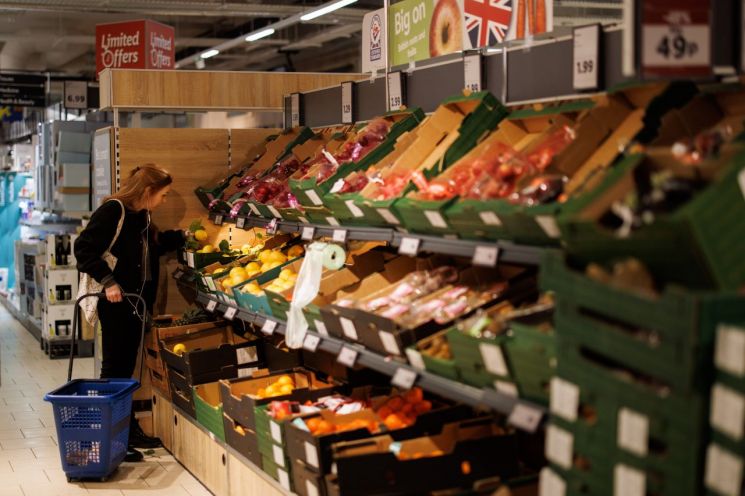 On February 27th (local time), a consumer is shopping at a supermarket in London, UK. [Image source=EPA Yonhap News]
The slowdown in inflation in April was mainly due to energy costs. The energy regulator Ofgem recently lowered the cap on electricity and gas charges that energy suppliers can impose on consumers. Grant Fitzner, the chief economist at the ONS, pointed out, "The easing of the energy price cap led to lower electricity and gas charges, which drove the decline in the inflation rate," adding, "Food price inflation also fell further."
Market experts noted that the higher-than-expected inflation rate in April reduced the likelihood of an interest rate cut in June. A local market analyst said, "Although inflation is sharply declining, investors expecting the Bank of England (BOE) to cut rates in June must be disappointed," adding, "It has become difficult for the BOE to be confident that inflationary pressures have eased sufficiently."
The UK base interest rate stands at 5.25%, the highest level in 16 years. Initially, as inflation approached the BOE's target of 2%, there were expectations that the BOE would begin cutting rates this summer.
© The Asia Business Daily(www.asiae.co.kr). All rights reserved.
![Clutching a Stolen Dior Bag, Saying "I Hate Being Poor but Real"... The Grotesque Con of a "Human Knockoff" [Slate]](https://cwcontent.asiae.co.kr/asiaresize/183/2026021902243444107_1771435474.jpg)















