Prof. Eung's Keynote Speech at AI Global Forum
"Education Needed to Use AI Safely and Responsibly"
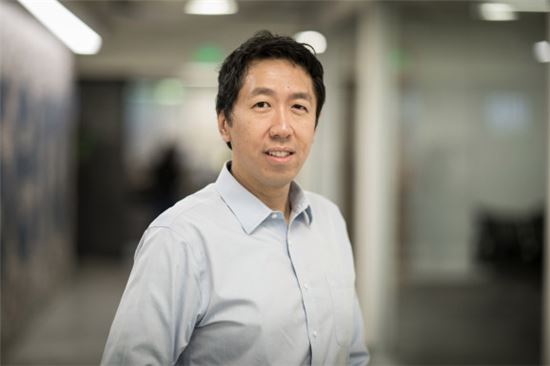 Andrew Ng
"Regulating artificial intelligence (AI) technology will slow down its development. To achieve both innovation and safety, we need to regulate applications (services) rather than the technology itself."
Andrew Ng, a global AI scholar and professor at Stanford University in the United States, made these remarks on the 22nd at the 'AI Global Forum' held at the Korea Institute of Science and Technology (KIST) in Seongbuk-gu, Seoul, regarding AI regulation.
Professor Ng emphasized, "We must distinguish between AI technology and its applications, and manage the application areas rather than the technology. We should enhance the safety of tools applying AI in a way that does not hinder development." He explained that regulation should identify and address risks based on application cases, not the technology itself.
He added, "If we focus on how to make electric motors safe, their size inevitably becomes very small. In fact, there are good and bad application cases of the technology, but these should all be viewed at the application level, not the technology level. There is a need to distinguish between applications and technology," he elaborated.
He also stated, "All knowledge workers are using generative AI as a tool to improve productivity. Education is necessary so that workers can use AI safely and responsibly," urging governments worldwide to focus on AI re-education and related efforts.
Professor Ng said, "Most workers lack training to use AI safely and responsibly," and added, "Open-source software (SW) activities to improve AI accessibility should be further encouraged." He continued, "Some lobby against open source to protect their investment value, but if such regulations occur, everyone will ultimately lose."
During his speech, he captured the audience's attention by playing music he composed himself using AI, reflecting the atmosphere in Korea. Professor Ng said, "Generative AI has captivated the world for several years. Previously, AI was limited to images and text, but now it can compose music," and predicted, "Generative AI will have a profound impact on various industries such as education, business, and law."
He noted, "One reason AI is difficult to understand is its universality," and forecasted, "While AI technology applied to semiconductors, cloud, and technical tools is attracting public attention, more revenue will be generated at the application layer above these."
Following Professor Ng, Mark Raibert, founder of Boston Dynamics, took the stage to deliver a keynote speech. Raibert asserted, "AI and robots can liberate people from dirty and dangerous tasks and help solve various problems facing humanity."
However, he added, "Although about 100 companies are expected to engage in humanoid robot manufacturing by the end of this year, it seems none are yet capable of performing useful tasks," and said, "In this exciting time full of passion, investment, and opportunity, what we need to do is make them work properly."
Raibert also shared his outlook on how much robots can develop in the future. He said, "Not only the creativity of engineers who design, test, and build systems where AI and robotics can drive creativity, but also robots and AI themselves will eventually be able to possess creativity."
He added, "Robots are currently used mainly in factories, but in the future, there will be an era where robots assist the elderly and disabled and are used in homes," and said, "I hope engineers continuously demonstrate creativity so that a society where robots and humans dance together will come."
© The Asia Business Daily(www.asiae.co.kr). All rights reserved.
![Clutching a Stolen Dior Bag, Saying "I Hate Being Poor but Real"... The Grotesque Con of a "Human Knockoff" [Slate]](https://cwcontent.asiae.co.kr/asiaresize/183/2026021902243444107_1771435474.jpg)














