As the United States and the European Union (EU) accelerate trade pressure against China, reports have emerged that China is considering raising tariffs on some imported automobiles.
On the 22nd, Hong Kong's South China Morning Post (SCMP) cited a statement released the previous day by the China Chamber of Commerce in the EU, reporting that "insiders have informed that Chinese authorities may consider increasing tariff rates on imported cars equipped with large-displacement engines." The Chamber explained, "This potential measure is being reviewed amid the US announcement of tariff hikes on Chinese electric vehicles and the EU's investigation into subsidies for Chinese electric vehicles," adding that "it would affect European and American automobile manufacturers."
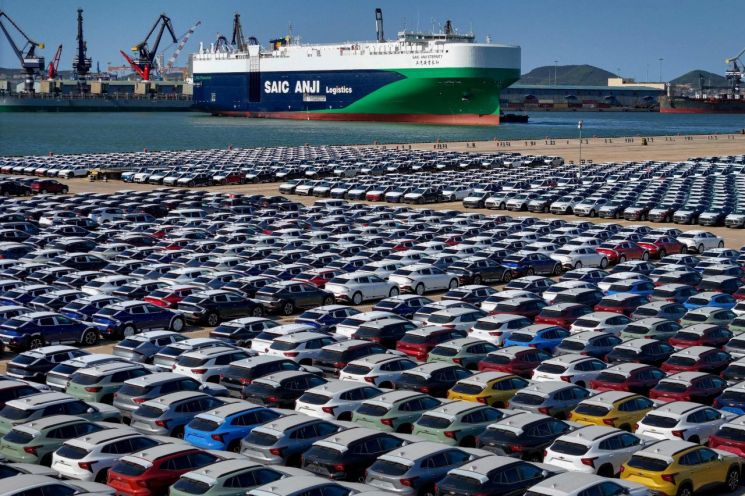
One day earlier, on the 21st, China's state-run Global Times (GT) published an interview supporting this. GT reported that Liu Bin, Deputy Director of the China Automotive Technology and Research Center, proposed a temporary tariff increase on imported cars with engines larger than 2.5 liters, stating, "China can raise tariffs on imported cars up to 25% in accordance with World Trade Organization (WTO) regulations."
However, GT framed this not as a response to recent US trade pressure such as tariff hikes, but rather as aligned with China's green development philosophy and climate change efforts. GT emphasized, "China's electric vehicle sector has rapidly developed and gained global recognition," adding, "this aligns with the world's efforts to reduce carbon dioxide emissions to address climate change under China's green development philosophy." It further pointed out, "However, China's electric vehicle industry has also become a target of the US campaign to suppress China," and noted, "the EU has also launched an investigation opposing subsidies for Chinese electric vehicles."
According to China's General Administration of Customs, China imported 250,000 vehicles with engines larger than 2.5 liters last year, accounting for 32% of total imported cars. Deputy Director Liu explained, "To further promote energy conservation, imports of passenger cars equipped with large-displacement engines should be reduced," and stated, "temporary tariff increases should be applied to imported gasoline sedans and SUVs with engines larger than 2.5 liters." He repeatedly emphasized that this measure can be implemented within WTO regulations.
Earlier, on the 19th, China's Ministry of Commerce announced it would launch an anti-dumping investigation into polyoxymethylene (POM) copolymers imported from Taiwan, the US, the EU, and Japan. The following day, on the 20th, it designated Boeing Defense, Space & Security (BDS) as an "unreliable entity" for participating in arms sales to the Taiwan region. The Ministry of Commerce explained that BDS is banned from export-import activities related to China, new investments within China, and entry of senior executives into China, and that future work permits and residence qualifications for BDS personnel will also be revoked.
These moves by China began amid intensifying trade pressure from Western countries such as the US and the EU. On the 14th, the US announced tariff increases on Chinese electric vehicles, computer chips, and medical products, and on the 17th, the EU initiated a trade investigation into Chinese tin-plated steel. The EU is also conducting an investigation into subsidies for Chinese electric vehicles.
© The Asia Business Daily(www.asiae.co.kr). All rights reserved.
![Clutching a Stolen Dior Bag, Saying "I Hate Being Poor but Real"... The Grotesque Con of a "Human Knockoff" [Slate]](https://cwcontent.asiae.co.kr/asiaresize/183/2026021902243444107_1771435474.jpg)















