Strategic Support Considering Export Scale and Industry
Customized Response to Carbon Border Adjustment Mechanism
Strengthening Carbon Reduction Capabilities through Facility Conversion, Loans, and Guarantees
The government will directly support small and medium-sized enterprises (SMEs) that export above a certain level to the EU in calculating product-level carbon emissions and issuing verification reports. This is to prepare for the full-scale implementation of the EU Carbon Border Adjustment Mechanism (CBAM) scheduled for 2026. CBAM is a system that mandates the purchase of certificates corresponding to the amount of carbon emitted during the production process when exporting six carbon-intensive products?steel, aluminum, fertilizer, hydrogen, cement, and electricity?to the EU. Currently, it is in a transition period with only reporting obligations.
On the 22nd, the Ministry of SMEs and Startups held a 'Briefing Session on Support Measures for SMEs Responding to EU CBAM' at the Korea Chamber of Commerce and Industry in Seoul. This session was organized to announce the support measures prepared by the Ministry for SMEs responding to CBAM and to gather opinions from exporting SMEs, related associations, and experts regarding these support measures.
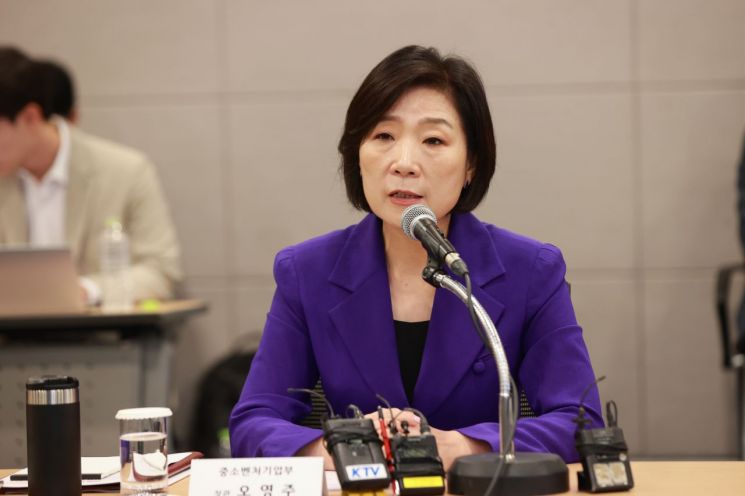 Oh Young-joo, Minister of SMEs and Startups, is giving a greeting at the "EU CBAM Response Support Measures for SMEs Announcement Meeting" held on the 22nd at the Korea Chamber of Commerce and Industry in Jung-gu, Seoul.
The 'Support Measures for SMEs Responding to CBAM' focus on enabling SMEs subject to CBAM, based on export scale, industry, and product type, as well as EU requirements, to effectively respond to CBAM. First, three projects, including a dedicated CBAM project, will be utilized to directly support the carbon emission calculation and verification process, primarily targeting SMEs with exports to the EU exceeding 100 million KRW. As of last year, there are 355 such companies, accounting for 98.3% of the total SME exports to the EU.
For all EU-exporting SMEs (1,358 companies as of last year), a CBAM-specialized course including carbon emission measurement and calculation methods will be operated through education and training programs to help them accurately understand and prepare for the CBAM system. A joint briefing session by related ministries' task forces and a help desk will also be operated to explain the CBAM system and respond to inquiries about carbon emission calculations.
Additionally, to alleviate the cost burden related to emission measurement and calculation for SMEs, a digital measurement, reporting, and verification solution will be developed, piloted, and expanded. Companies receiving direct support such as one-on-one carbon neutrality consulting this year will be linked to support for the introduction of carbon reduction facilities and the distribution of carbon emission management software on an annual basis. Policy fund loans for the introduction and operation of large-scale carbon neutrality facilities and additional guarantees for expected carbon reduction volumes will also be expanded.
The Ministry plans to expand and build a dedicated platform that comprehensively provides information related to global carbon regulations and support projects for carbon neutrality. It will also ensure that SME opinions, such as reducing the burden of emission calculation and verification, are reflected during national-level carbon regulation consultations, including EU trade negotiations and high-level meetings. They also plan to promote the enactment of a tentative 'SME Carbon Neutrality Promotion Act' to support voluntary carbon reduction by SMEs.
During the subsequent on-site opinion hearing and open discussion, SMEs expressed difficulties in obtaining carbon emission data from overseas raw material suppliers in countries such as China and Japan. They also conveyed various field voices felt during the CBAM response process, including cost support for carbon emission calculation and verification, and support for training and educational programs to cultivate carbon emission calculation experts for SMEs lacking specialized personnel.
Minister Oh Young-joo emphasized, “Global carbon neutrality is an irreversible trend and will become a core issue that companies must respond to for survival and growth,” adding, “I hope that companies recognize this trend as an opportunity for growth and actively respond together with the government.”
© The Asia Business Daily(www.asiae.co.kr). All rights reserved.
![Clutching a Stolen Dior Bag, Saying "I Hate Being Poor but Real"... The Grotesque Con of a "Human Knockoff" [Slate]](https://cwcontent.asiae.co.kr/asiaresize/183/2026021902243444107_1771435474.jpg)















