14 Days After Government Transfer... 10th Since Inauguration
Jung Jin-seok "Legislation Excessively Infringing on Executive Authority"
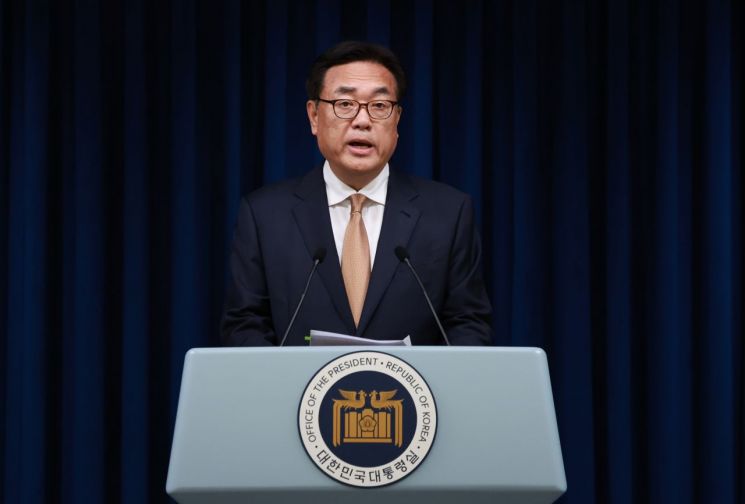 Jung Jin-seok, Chief of Staff to the President, is briefing on June 21 at the Yongsan Presidential Office building in Seoul regarding President Yoon Seok-yeol's exercise of the right to request reconsideration of the 'Special Prosecutor Act for Chae Sang-byeong.' [Image source=Yonhap News]
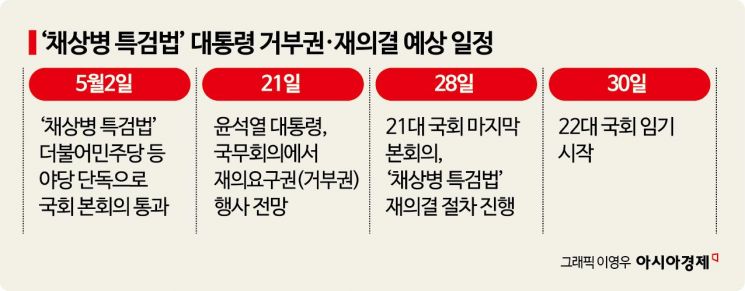
On the 21st, President Yoon Suk-yeol exercised his right to request reconsideration (veto) against the "Special Prosecutor Act on the Investigation of the Death of Marine Corporal Chae Sang-byeong" (Chae Sang-byeong Special Prosecutor Act).
The Special Prosecutor Act was forcibly passed solely by opposition parties including the Democratic Party of Korea at the National Assembly plenary session on the 2nd and was sent to the government on the 7th, making it 14 days since its transmission. President Yoon exercised his veto power for the 10th time since his inauguration.
Jung Jin-seok, Chief of Staff to the President, held a briefing at the Yongsan Presidential Office in the afternoon and stated, "Today, after the Cabinet meeting, the President requested reconsideration of the Special Prosecutor Act for the fallen marine to the National Assembly," adding, "This Special Prosecutor Act does not conform to the spirit of the Constitution."
Before the briefing, Chief Jung said, "First, before explaining the purpose and reasons for the reconsideration request, I would like to pray for the repose of the late Corporal Chae Su-geun and once again express my deepest condolences to the bereaved family." Regarding the Special Prosecutor Act, he pointed out, "It should be considered possible only when the ruling party, to which the head of the executive branch belongs, and the opposition parties reach an agreement," and added, "For this reason, the National Assembly has handled all 13 Special Prosecutor Acts over the past 25 years without exception based on bipartisan agreement."
Chief Jung emphasized, "This is a constitutional custom of the National Assembly to uphold the principle of separation of powers under our Constitution," and said, "The separation of powers is a fundamental principle forming the backbone of our Constitution." He continued, "Under the principle of separation of powers, investigation and prosecution are powers and functions belonging to the executive branch, and the special prosecutor system is a significant exception that can only be implemented when the ruling party, to which the head of the executive branch belongs, and the opposition parties agree," criticizing, "This Special Prosecutor Act, which was unilaterally passed by the opposition, destroys the precious constitutional custom that the ruling and opposition parties have upheld for decades."
He also raised his voice, saying, "Under the principle of separation of powers, the President's appointment authority over the special prosecutor must be practically guaranteed, but this Special Prosecutor Act exclusively grants the opposition party the right to recommend candidates, fundamentally depriving the President of the special prosecutor appointment authority," and added, "We cannot help but request reconsideration from the National Assembly regarding legislation that excessively infringes on the powers of the executive branch."
Presidential Office: "Cannot Guarantee Fairness and Neutrality of Investigation"
In particular, Chief Jung said that this Special Prosecutor Act does not align with the purpose of the special prosecutor system. He explained, "The special prosecutor system is a supplementary and exceptional system that can be introduced only when the investigation by investigative agencies is insufficient or when the fairness or objectivity of the investigation is in doubt," adding, "Regarding the death of Corporal Chae Sang-byeong, investigations are currently ongoing by the police and the High-ranking Officials' Crime Investigation Office (Gong-su-cheo)."
He said, "The High-ranking Officials' Crime Investigation Office was unilaterally established by the Democratic Party during the previous administration as a de facto permanent special prosecutor," and added, "Claiming the need for a special prosecutor now because the Gong-su-cheo investigation cannot be trusted is a self-contradiction and self-denial that negates the very reason for the existence of the Gong-su-cheo, which they created."
He also pointed out that the Special Prosecutor Act fails to guarantee the fairness and neutrality of the investigation, which is the fundamental purpose of the special prosecutor system. Chief Jung said, "According to the Special Prosecutor Act, the president of the Korean Bar Association recommends four candidates, the opposition party selects two from them, and the President must appoint one of the two as the special prosecutor," adding, "This means the opposition party wants to choose the investigating prosecutor for the case they reported."
Jung Jin-seok: "Hope the Tragic Death of Chae Sang-byeong Does Not Become a Political Battleground"
Chief Jung said, "The government will do its utmost to thoroughly investigate the substantive truth of the Chae Sang-byeong case and resolve the public's suspicions without any negligence," adding, "We hope that the tragic death of Chae Sang-byeong will not become a subject of further political strife and request the National Assembly's careful reconsideration."
Earlier, the government held a Cabinet meeting chaired by Prime Minister Han Duck-soo in the morning and resolved to request reconsideration of the Special Prosecutor Act. Since President Yoon approved the reconsideration request on the same day, the Chae Sang-byeong Special Prosecutor Act will return to the National Assembly for the reconsideration procedure.
On the same day, a senior official from the Presidential Office told reporters that President Yoon's exercise of the veto on the Chae Sang-byeong Special Prosecutor Act was a natural step. The official said, "In our constitutional history, there has never been a case where a Special Prosecutor Act was forcibly passed without bipartisan agreement, and no such Special Prosecutor Act has been adopted," adding, "The President had no choice but to request reconsideration of this bill, which does not conform to the legislative intent of the Special Prosecutor Act and the spirit of the Constitution, and in fact, failing to request reconsideration would be neglect of duty."
Furthermore, the official emphasized, "The President is the guardian of the Constitution," and said, "The President must fulfill the responsibility of being the guardian of the Constitution, and since this is the President's duty and responsibility, the exercise of the right to request reconsideration is necessary."
© The Asia Business Daily(www.asiae.co.kr). All rights reserved.


















