Resolution Rally Scheduled for the 22nd of Next Month
Contacting Lawmakers for Legislation
The Mart Industry Labor Union under the Service Federation of the Korean Confederation of Trade Unions is launching a 'Distribution Industry Act Amendment Struggle' to enforce mandatory closure days for large supermarkets as public holidays. As cases increase where local governments convert mandatory closure on public holidays to weekdays following government policies, the union aims to fundamentally block this through legislation. The Mart Union plans to actively communicate its views to lawmakers once the 22nd National Assembly convenes, signaling potential labor-management conflicts in the distribution industry.
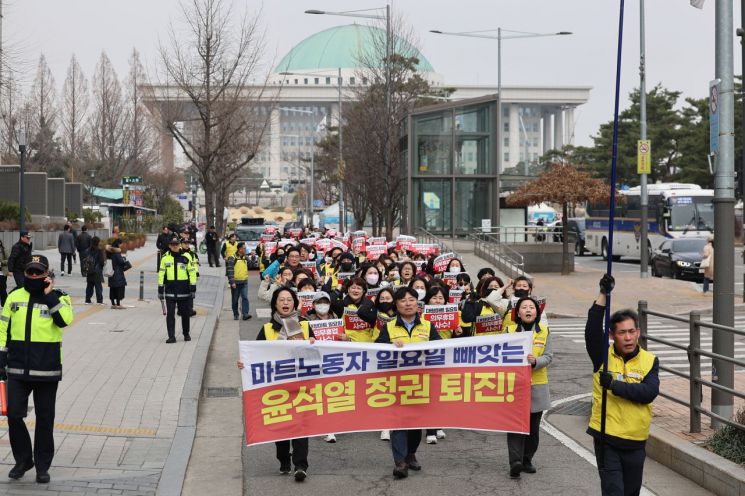 Members of the Mart Industry Labor Union under the Korean Confederation of Trade Unions Service Federation are marching in front of the National Assembly Station in Yeongdeungpo-gu, Seoul, after holding the "Press Conference of 300 Mart Workers to Defend Mandatory Sunday Closures" last March. Photo by Yonhap News
According to labor sources on the 21st, the Mart Union will hold a rally in front of the National Assembly on the 22nd of next month to convey these demands. This rally will be part of the Korean Confederation of Trade Unions' nationwide workers' assembly. The Confederation had previously announced this gathering in relation to minimum wage increases.
After holding the rally together with the Service Federation, the Mart Union is planning various methods such as delivering legislative demands to the National Assembly. They are also expanding contacts with the National Assembly to amend the Distribution Industry Act. A Mart Union official stated, "Once the 22nd National Assembly opens, we are contacting elected officials to push for related legislative amendments."
Some political circles are also responding positively to the Mart Union's claims. Elected lawmaker Jeong Hye-kyung said during the Progressive Party elected officials' general meeting on the 7th, "Weekend rest with family is essential for workers," adding, "We must minimize holiday labor and ensure stable alternative weekend rest for workers who must work on weekends. Instead of reducing or abolishing mandatory closure days for marts, we should expand them to other distribution sectors."
The current Distribution Industry Development Act allows local heads such as mayors, county governors, and district chiefs to designate two public holidays per month as mandatory closure days for large supermarkets and, through agreement with stakeholders, to designate weekdays as mandatory closure days. Additionally, supermarkets cannot operate from midnight to 10 a.m., making early morning deliveries impossible.
However, starting with Daegu City, Chungbuk Cheongju City, Seoul's Seocho-gu and Dongdaemun-gu districts, and Busan City have changed mandatory closure days to weekdays through ordinances and local government notices. Alongside this, the Seoul Metropolitan Council recently passed an ordinance amendment excluding online delivery from large supermarket operating restrictions and allowing two mandatory closure days per month to be designated on weekdays.
The Mart Union strongly opposes these moves. On the 14th, the Mart Union held a press conference in front of Daejeon City Hall, stating, "The government and Daejeon City must stop discussions on changing mandatory closure days for large supermarkets that threaten mart workers' rights to rest and health." Daejeon City and its districts are currently discussing changing mandatory closure days to weekdays. The Mart Union has also held press conferences opposing the Seoul Metropolitan Council's ordinance amendment.
However, the Korea Chamber of Commerce and Industry released the results of a satisfaction survey conducted on 520 consumers in Seoul's Seocho-gu and Dongdaemun-gu districts and Chungbuk Cheongju City, where mandatory closure days were changed to weekdays, on the 9th. The survey showed 81% satisfaction with the weekday change, only 1.2% dissatisfaction, and 53.8% support for expanding the weekday mandatory closure to other regions. The Chamber argued that "a policy shift is necessary from the perspective of consumer convenience and choice."
© The Asia Business Daily(www.asiae.co.kr). All rights reserved.
![Clutching a Stolen Dior Bag, Saying "I Hate Being Poor but Real"... The Grotesque Con of a "Human Knockoff" [Slate]](https://cwcontent.asiae.co.kr/asiaresize/183/2026021902243444107_1771435474.jpg)
















