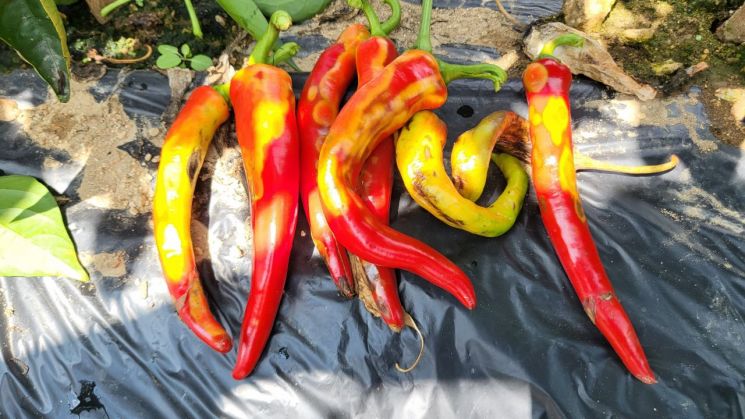
 As the full-scale farming season begins, Cheonan City in Chungnam Province has urged special attention to the management of insect vectors that transmit plant viruses. A pepper infected with Tomato spotted wilt virus (TSWV)
Cheonan City in Chungnam Province has urged special attention to the management of plant virus vectors as the full-scale farming season begins.
Plant viral diseases are mainly transmitted by vectors such as thrips, aphids, and whiteflies, causing symptoms like rot, mosaic, chlorosis, leaf curling, leaf deformities, and spots.
In the Cheonan area, damage from plant viral diseases has been confirmed annually in crops such as cucumber, melon, and chili pepper.
Representative viruses include Tomato spotted wilt virus (TSWV), Cucurbit aphid-borne yellows virus (CABYV), Melon necrotic spot virus (MNSV), Cucurbit chlorotic yellows virus (CCYV), and Watermelon mosaic virus (WMV).
In particular, since there is no direct cure for plant viral diseases, proactive prevention is crucial. Damage can be reduced through rapid diagnosis using diagnostic kits and vector control using registered pesticides.
An official from the city stated, “Since there is no cure once infected with plant viral diseases, vectors must be controlled proactively. If crops show the above virus symptoms, contact the center or nearby branch for a quick diagnosis to enable timely response.”
© The Asia Business Daily(www.asiae.co.kr). All rights reserved.
![Clutching a Stolen Dior Bag, Saying "I Hate Being Poor but Real"... The Grotesque Con of a "Human Knockoff" [Slate]](https://cwcontent.asiae.co.kr/asiaresize/183/2026021902243444107_1771435474.jpg)















