Party Member Defection Flow, Sharp Decline in Approval Ratings
① Expansion of Party Member Participation vs Crisis of Representative System
② Need for Strong Opposition vs Growing Distance from Public Sentiment
Lee Jae-myung, Utilizing as an Opportunity to Strengthen 'Pro-Myung' Faction
After the parliamentary speaker candidate primary, which was called an "upset," aftershocks continue within the Democratic Party of Korea. Party members are continuing to leave, and the party's approval rating has dropped. The number of resignation applicants has already exceeded 10,000. Some have been approved, while others are on hold. As resignations continue, Lee Jae-myung, the leader of the Democratic Party, intervened to dissuade them, saying, "The party is moving toward a mass party centered on party members, and I think it should be that way. I will double the authority of party members."
The approval rating also dropped significantly. According to a public opinion poll released on the 20th by Realmeter (a wireless 97%, wired 3% automated response survey conducted on 1,001 voters aged 18 and over nationwide from the 16th to 17th, commissioned by Energy Economy Newspaper), the Democratic Party's approval rating was 34.5%, down 6.1 percentage points from the previous week. The People Power Party's approval rating rose 2.1 percentage points to 35.0%. The gap between the two parties' approval ratings, which last week had the Democratic Party ahead of the People Power Party beyond the margin of error, changed to a close race within the margin of error in this survey. (For detailed poll results, refer to the Central Election Poll Deliberation Commission website)
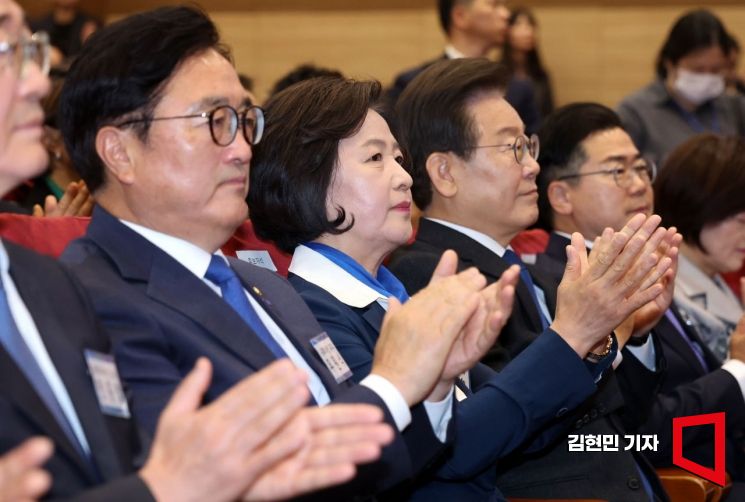 Choo Mi-ae and Woo Won-shik, candidates running for the Speaker of the National Assembly, are applauding at the elected members' general meeting held on the 16th at the National Assembly Members' Office Building to select the candidates for the 22nd National Assembly's first half Speaker team. Photo by Hyunmin Kim kimhyun81@
Regarding the sharp decline in the Democratic Party's approval rating, Kim Bong-shin, director of Metavoice, explained, "The drop in approval rating is partly due to those who supported candidate Chu withdrawing their support for the Democratic Party." However, Kim added that besides the loss of supporters due to candidate Chu's primary defeat, "it seems that the departure of supporters who are tired of conflicts among senior lawmakers over the primary results and controversies about rooting out opponents is also reflected." In other words, some centrist supporters felt repulsed by the backlash from hardline supporters and withdrew their support. He also pointed out that the fact that this poll was conducted via automated response system (ARS) should not be overlooked. Kim said, "(ARS surveys, which have low response rates) tend to have many highly engaged supporters participating," adding, "It is likely that the voices of politically highly engaged citizens were more reflected than those of the general public."
The political circle interprets that the primary results provide two implications.
Expansion of Party Members' Participation vs Crisis of Representative Democracy
The first is a problem concerning the party's operational method. Party members are actively taking action against the current political structure based on representative democracy. Within the Democratic Party, in addition to the commonly used terms party sentiment (party members' feelings) and public sentiment (public feelings) regarding the speaker election, a new term legislator sentiment (lawmakers' feelings) has emerged. This term was created to point out that the thoughts of party members and lawmakers are diverging. Related to this, Jeong Cheong-rae, a Supreme Council member of the Democratic Party, said, "The gap between party sentiment and legislator sentiment was too wide. Efforts are needed to comfort disappointed and angry party members and bridge the gap."
There was even a claim that the will of party members should be reflected in the parliamentary speaker election. On the 19th, Kim Min-seok, a Democratic Party lawmaker, proposed on social media (SNS) the party sovereignty innovation No. 1, which reflects the general election public sentiment, stating, "I propose the 10% rule, which in principle reflects at least one-tenth of the opinions of party members with voting rights," and suggested, "Let's introduce it from the preliminary and main elections of the parliamentary speaker candidate, floor leader, and party leadership primaries." The idea is to ensure that the will of party members is reflected in the actual decision-making process in any way in speaker elections and others.
Professor Shin Yul of Myongji University strongly criticized this trend. In a phone interview with Asia Economy, Professor Shin said, "The parliamentary speaker is not a party position," and questioned, "It is doubtful whether it is logically valid for party members to vote in the parliamentary speaker election." Moreover, he warned that this controversy itself could lead to populism. Professor Shin said, "Populism is often understood as just distributing money, but one of the biggest characteristics of populism is denying representative democracy." He pointed out, "This does not end as a party issue. Since the National Assembly operates on representative democracy, if such thinking exists within the party, it could be reflected in the operation of the National Assembly." This means that decision-making in the National Assembly, which operates on representative democracy, is at risk of being swayed by party members, especially hardline factions within the party. However, political commentator Park Sang-byeong evaluated, "This is not a crisis of representative democracy but a problem of politicians," adding, "They are trying to stimulate party sentiment to pursue their political interests."
Must Oppose the Current Government More Strongly vs Alienation from Public Sentiment
Another point is that this controversy reflects concerns about the Democratic Party's future direction. The concentration of party members' support for candidate Chu does not simply mean support for the individual candidate but reflects the opinion that the 22nd National Assembly should strongly oppose the current government. The general interpretation in the political circle regarding candidate Chu's defeat is that it reflects rejection of his autocratic behavior, such as blocking his own party lawmakers' access during the handling of labor-related laws when he was the chair of the Environment and Labor Committee. Although the party leadership seemed to support leader Chu, lawmakers did not follow, indicating significant doubts about candidate Chu personally. Nevertheless, party members' sensitive reaction to candidate Chu's speaker election issue is analyzed as being linked to the 22nd National Assembly's operation and the will to confront the government.
Commentator Park explained, "Among Democratic Party members, there is a strong voice wishing for the Democratic Party to unite and end the Yoon Seok-youl administration," adding, "To them, candidate Chu appeared as the 'answer.'" The support for candidate Chu among party members contains support for a hardline faction within the party. However, he said, "This is the opinion of Democratic Party members, and from the public's perspective, the parliamentary speaker position is not a weapon for opposition political attacks," adding, "The difference between public opinion and party members' opinions is why the People Power Party lost the last general election, and the same could apply to the Democratic Party. While hardline party members want candidate Chu to push strongly, public sentiment is different, so the Democratic Party's choice is not a bad one."
There is also an interpretation that the dilemma of the Democratic Party is embedded behind this controversy. To regain power, the party needs to attract centrist voters, but the backlash from hardline factions within the party could widen the gap between party sentiment and public sentiment. Moreover, with the emergence of the 'alternative' party called the National Innovation Party, the Democratic Party inevitably faces the limitation of having to compete in innovation. In fact, party members who declared their resignation also declared their intention to join the National Innovation Party, which is another pressure factor on the Democratic Party.
Leader Lee is using this series of situations as both a crisis and an opportunity. He aims to transform the Democratic Party's structure to be more 'party member'-centered, using the dissatisfaction of party members as a catalyst. Especially, ahead of the party convention scheduled for August, the Democratic Party is promoting itself as a 'party member-centered party' and plans to significantly weaken the authority of delegates in the provincial party primaries while expanding the authority of party members with voting rights. Currently, the Democratic Party's provincial party primaries reflect votes from delegates and party members with voting rights at a 50-50 ratio, but the delegates' voting rights are expected to be greatly reduced. At the current party convention, the vote weight of delegates compared to party members with voting rights has already dropped to less than 20 to 1. Additionally, Leader Lee stated, "It would be better if provincial party chairpersons are elected by party members through elections rather than being selected by consultation." This means electing provincial party chairpersons by party members' votes instead of the existing consensus nomination method. In this case, the provincial party chairpersons who exercise nomination rights in the next local elections are likely to be overwhelmingly pro-Lee Jae-myung.
© The Asia Business Daily(www.asiae.co.kr). All rights reserved.
![Clutching a Stolen Dior Bag, Saying "I Hate Being Poor but Real"... The Grotesque Con of a "Human Knockoff" [Slate]](https://cwcontent.asiae.co.kr/asiaresize/183/2026021902243444107_1771435474.jpg)











