AI Learning Copyright Fee to Be Determined by Year-End
Non-Face-to-Face Medical Care Also Institutionalized... Medical Service Act Amendment Underway
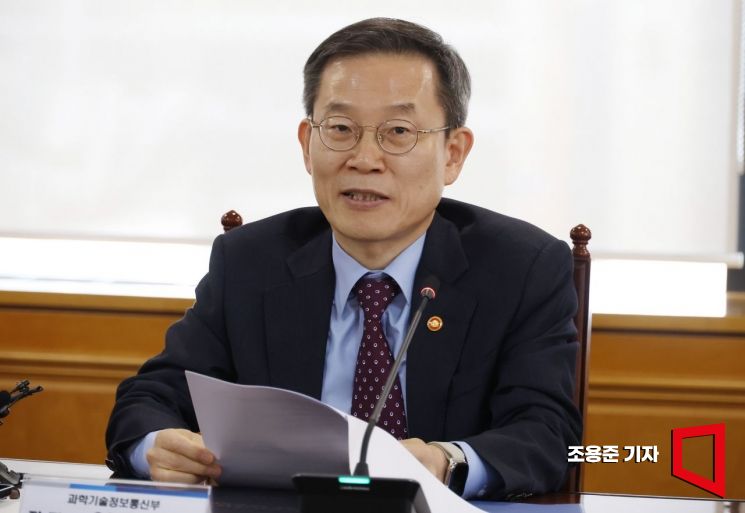 Minister Lee Jong-ho of the Ministry of Science and ICT is delivering a greeting at the ceremony for the business agreement between the telecommunications and financial sectors to strengthen response and cooperation against financial crimes infringing on people's livelihood, held on the 5th at the Korea Federation of Banks in Jung-gu, Seoul. Photo by Jo Yong-jun jun21@
On the 21st, the government unveiled a master plan for establishing a digital order, focusing on institutionalizing non-face-to-face medical consultations and establishing copyright norms suitable for the era of generative artificial intelligence (AI). Previously, the government had announced the Digital Rights Charter, the world's first charter specifying the basic rights and freedoms people should have in the digital age. Through this master plan, the fundamental principles have been further specified. This move is interpreted as a determination to lead global governance by presenting a new digital order ahead of the ‘AI Seoul Summit’ held on the same day.
The Ministry of Science and ICT reported the government ministries' joint ‘New Digital Order Establishment Promotion Plan’ containing these details at the Cabinet meeting held that day. The promotion plan includes 20 policy tasks aimed at resolving 52 issues based on the philosophy and five principles of the ‘Digital Rights Charter.’ The Digital Rights Charter is a charter prepared by the Ministry of Science and ICT last September to establish universal digital order norms suitable for the digital age.
The Ministry of Science and ICT stated, "At the AI Seoul Summit held today (21st), we will discuss ways to share AI benefits and bridge gaps, as well as the roles of the government and companies in ensuring AI safety." They added, "In line with this, our government has announced a master plan to implement the ‘Digital Rights Charter,’ which contains President Yoon Suk-yeol’s digital vision, into concrete policies."
The government plans to institutionalize non-face-to-face medical consultations in earnest with the goal of contributing to public health improvement. Previously, as the government downgraded the COVID-19 crisis level, it had ‘temporarily’ allowed non-face-to-face medical consultations, which were converted into a pilot project starting in June last year. Initially, the pilot project strictly limited first visits and focused on clinics and follow-up visits. In December of the same year, the scope of the non-face-to-face medical consultation pilot project was expanded to include both first and follow-up visits, and the range of holiday and nighttime non-face-to-face consultations, previously limited to counseling for children and adolescents under 18, was extended to all ages. However, since it is still at the ‘pilot project’ stage, revising the Medical Service Act is necessary to fully establish the system.
The government plans to establish the legal basis for non-face-to-face medical consultations through amendments to the Medical Service Act and strengthen the linkage between non-face-to-face medical consultations and digital innovative technologies and services that have received regulatory exemptions. While working on improving management systems such as personal health information protection and prevention of prescription forgery and alteration, the government also plans to maintain close communication with stakeholders.
The government will also reorganize the copyright system related to AI development and utilization. Recently, the European Union agreed on the final draft of the AI Act, and the United States has instructed the establishment of countermeasures through executive orders, reflecting the global active response to copyright issues in the AI era.
The Ministry of Culture, Sports and Tourism has been operating the ‘AI-Copyright System Improvement Working Group.’ The working group has discussed ▲ securing lawful usage rights for AI training materials ▲ whether to disclose lists of AI training data ▲ protection of AI outputs ▲ methods for indicating AI outputs and requirements and scope for copyright registration of AI outputs ▲ criteria for judging copyright infringement, among other topics.
Based on the research results on appropriate compensation for the use of copyrighted works for AI training obtained through the working group’s operation, the government plans to prepare measures to reorganize the copyright system, including the ‘Copyright Act,’ by the end of the year.
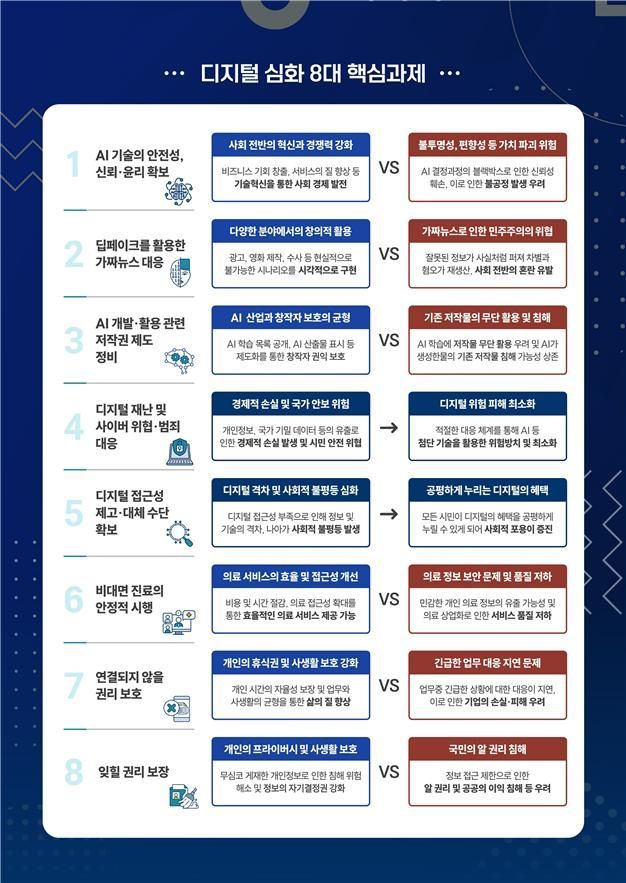
Additionally, the government has designated eight core tasks: ▲ ensuring AI technology safety, trust, and ethics ▲ responding to fake news using deepfakes ▲ responding to digital disasters and cyber threats and crimes ▲ enhancing digital accessibility and securing alternative means ▲ protecting the right not to be connected ▲ guaranteeing the right to be forgotten, and plans to focus on managing these to produce visible results.
Lee Jong-ho, Minister of Science and ICT, said, "We will not merely stop at planning but will strive to produce tangible results that the public can feel. Moreover, all ministries will work together to contribute to establishing a global digital order as a model country in the deepening digital era."
© The Asia Business Daily(www.asiae.co.kr). All rights reserved.


















