2024 World Economic Outlook Report
The Korea Institute for International Economic Policy (KIEP), a government-funded research institute, forecasted the global economic growth rate at 3.0% for this year. Although this is an upward revision of 0.2 percentage points from the previous forecast, it represents a slight slowdown of 0.2 percentage points compared to last year. They projected that three factors?the spread of geopolitical risks, prolonged high interest rates, and the deepening of socio-political polarization and nationalism following a super election year?will collectively act as downward pressures on growth.
In its '2024 World Economic Outlook' report released on the 21st, KIEP stated, "While the strong recovery in the United States is expected to moderate, the economies of Europe and Japan will remain relatively sluggish," and forecasted that "the global economy will record a growth rate 0.2 percentage points lower than last year."
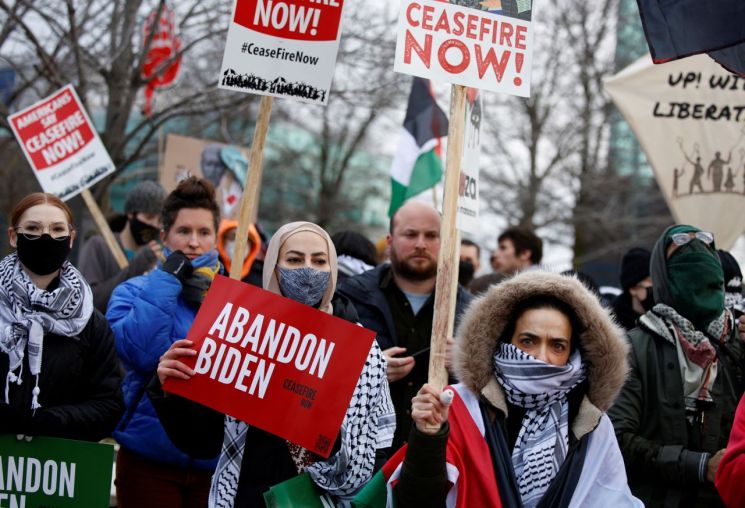 On the 1st (local time), when U.S. President Joe Biden visited Warren, Michigan, citizens outside the United Auto Workers (UAW) hall were urging an end to the war between Israel and Palestine. [Photo by Reuters Yonhap News]
Strong Recovery in the US... Relative Weakness in Europe and Japan
The growth rate forecast for the global economy this year released by KIEP is 0.2 percentage points higher than the previous forecast but remains lower than those of the Organisation for Economic Co-operation and Development (OECD, 3.1%) and the International Monetary Fund (IMF, 3.2%). According to KIEP’s forecast, the global economy will slow from 3.2% last year to 3.0% this year, then rebound to 3.2% next year.
KIEP’s upward revision reflects attention to the robust growth of the US economy. The US is expected to lead growth through stronger-than-anticipated consumer spending, recovery in private investment, and government expenditure, raising its growth forecast significantly by 0.9 percentage points to 2.4%. The Eurozone is expected to grow by only 0.7%, as the sluggish performance of Germany, the largest economy in the region, offsets overall growth. This is a 0.4 percentage point downward revision from the previous forecast. Japan is projected to grow by 0.9%, down 0.1 percentage points from the previous forecast, due to a decline in contributions from exports and imports despite a moderate recovery in domestic demand.
China, which has a significant impact on the global economy, is expected to grow by 4.8%, falling short of the government’s target of 5%. Meanwhile, India is forecasted to maintain a high growth rate of 6.8%, supported by expanded government and private investment and a recovery in private consumption. Russia, engaged in a prolonged conflict with Ukraine, is expected to sustain a growth rate similar to last year’s 3.2%. KIEP noted, "Russia will maintain positive growth driven by domestic demand, supported by a sharp increase in military spending, a decline in unemployment, and rising real wages, which will expand consumption capacity."
Oil Prices to Remain in the $70?90 Range
Regarding ongoing war risks, KIEP judged that it is unlikely that either conflict will end soon. Concerning the prolonged Russia-Ukraine war and the renewed possibility of conflict in the Middle East, they stated, "While the likelihood of geopolitical crises worsening beyond the current situation is not high, oil and commodity price shocks remain a burden on the global economy, and related uncertainties remain elevated."
Excluding Middle East risks, international oil prices are expected to stay within the $70?90 range this year. However, in a worst-case scenario such as a blockade of the Strait of Hormuz or sanctions on Iran, international oil prices could easily surpass $100. In such a case, the combined burden of high oil prices and a global oil supply shortage would deliver a significant shock to the world economy.
Furthermore, if the US economic growth continues to exert persistent upward pressure on inflation, the timing of interest rate cuts could be further delayed, and the widening interest rate gap between the US and other countries could cause economic shocks. KIEP also warned that this year, with elections scheduled in more than 60 countries worldwide, there is a risk of widespread adoption of populist economic policies depending on election outcomes.
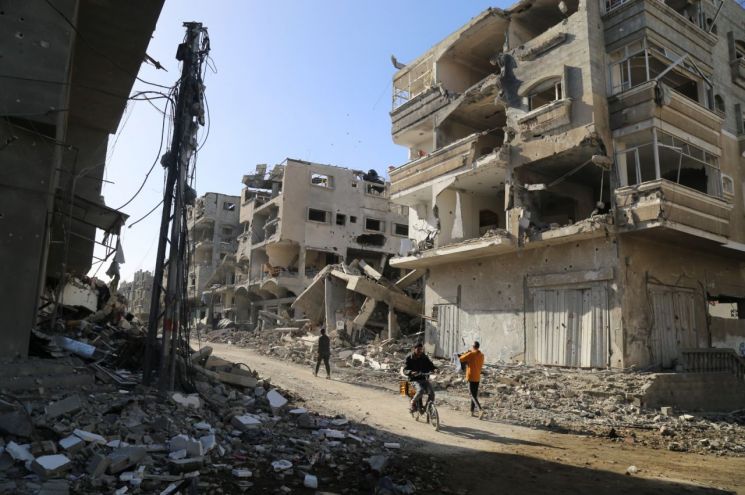 Residents of the Jabalia refugee camp in northern Gaza Strip, Palestine, are passing through the rubble of destroyed buildings. More than 23,000 Palestinian residents have died due to the war between the armed faction Hamas and the Israeli military. [Photo by Xinhua News Agency]
KIEP emphasized, "The most notable factor is the outcome of the US presidential election in November and the resulting dynamics of US-China relations," warning that "if former President Donald Trump is elected, it could deliver a major shock to the global economy." They noted that if Trump wins, the US may not only continue or expand the high tariffs on China imposed by President Joe Biden on the 14th but also strengthen America First policies by taking various measures regardless of alliances or non-alliances, which would have a significant impact on global trade, production, and the overall economy.
Meanwhile, KIEP expressed concern that "with Vladimir Putin securing a 30-year dictatorship and the expected rise of far-right forces in the European Parliament elections scheduled for June, major election outcomes are increasingly likely to lead to nationalism, which could act as a downside risk to the global economy."
For next year, KIEP forecasts that ▲the US will show a downward stabilization with a growth rate of 1.7% due to slowing consumption, ▲Europe will improve mainly through trade and investment, with the Eurozone and the UK recording growth rates of 1.6% and 1.5%, respectively, and ▲Japan will continue a similar growth trend of 1.0% supported by recovery in income and consumption. China is expected to achieve a 4.5% growth rate as market economic trends stabilize with government policy support, while India is anticipated to maintain a high growth rate of 6.5% driven by continued expansion in private consumption and investment.
© The Asia Business Daily(www.asiae.co.kr). All rights reserved.


















