Programs for Urban Development, Transportation, and Sewage Systems
Key Policies for Sustainable Cities Transferred
The Seoul Metropolitan Government announced on the 21st that it has successfully completed a program to transfer urban development policy know-how to Mongolian government officials and experts.
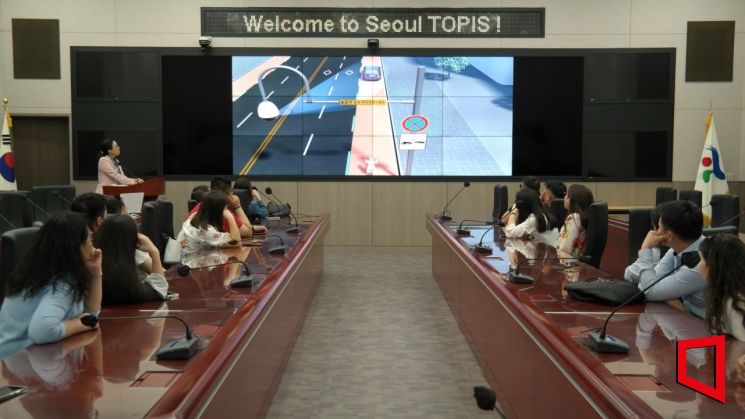 Seoul City conducted the "Mongolia Urban Development Field Practitioner Capacity Building Training Program" from the 12th to the 20th. Mongolian urban development experts and public officials are listening to explanations related to smart mobility.
From the 12th to the 20th of last month, Seoul conducted the "Capacity Building Training Program for Practitioners in the Field of Urban Development in Mongolia" targeting Mongolian urban development experts.
This invited training was carried out as part of the ‘Establishment of the Department of Urban Planning Engineering at the Mongolian University of Science and Technology and Capacity Building for Urban Development Professionals (S-Quad Project)’ supported by the Korea International Cooperation Agency (KOICA). It was promoted as a follow-up project to the ‘Memorandum of Understanding for Sharing Urban Planning Information and Cooperation’ signed in February between Seoul and the Seoul National University Korea-Mongolia Urban Cooperation Center.
The training involved 19 experts from five institutions in Mongolia, including the Ministry of Construction and Urban Development, Ulaanbaatar City Hall, and the Mongolian University of Science and Technology, specializing in urban development, land management, transportation, architecture, and other fields. Key policymakers such as E.Batbold, Director of the Urban Planning Bureau at the Ministry of Construction and Urban Development, and S.Dalanjargal, Head of the Urban Planning Department at Ulaanbaatar City Hall, also participated.
Since Mongolia transitioned from a socialist system to democracy and a market economy in the 1990s, it has experienced rapid urbanization. With population concentration in the capital city, Ulaanbaatar, urban problems such as traffic congestion, environmental pollution, and housing shortages have emerged. There is an urgent need to cultivate specialized personnel within Mongolia to address these issues.
Seoul structured the program to transfer its key policies and administrative systems related to sustainable urban management, smart cities, renewable energy, light rail transit, autonomous vehicles, and smart mobility to help solve Ulaanbaatar’s urban problems.
During the morning sessions, experts delivered lectures on Seoul’s redevelopment and reconstruction, advanced transportation systems, waste and sewage policies, among others. Field visits included Magok District, Seoul Botanic Park, Seonam Water Reclamation Center, Mapo Resource Recovery Facility, Hangang Park, the underground construction site of Sanggye Station, and riding the autonomous bus in Yeouido.
Mongolian urban development experts also had sessions to explore future policy directions and propose concrete policies to solve Mongolia’s urban issues based on Seoul’s urban development cases and advanced technologies.
Jo Nam-jun, Head of the Urban Space Headquarters of Seoul, said, “This program will serve as a foundation for nurturing human resources in Mongolia and an opportunity to lay the cornerstone for sustainable urban planning development. We will strive to share Seoul’s excellent urban development policies and experiences with various overseas cities in need, thereby providing practical assistance to urban development worldwide.”
© The Asia Business Daily(www.asiae.co.kr). All rights reserved.
![Clutching a Stolen Dior Bag, Saying "I Hate Being Poor but Real"... The Grotesque Con of a "Human Knockoff" [Slate]](https://cwcontent.asiae.co.kr/asiaresize/183/2026021902243444107_1771435474.jpg)















