Abolishing Financial Investment Tax and Passing Various Livelihood Bills Also Difficult
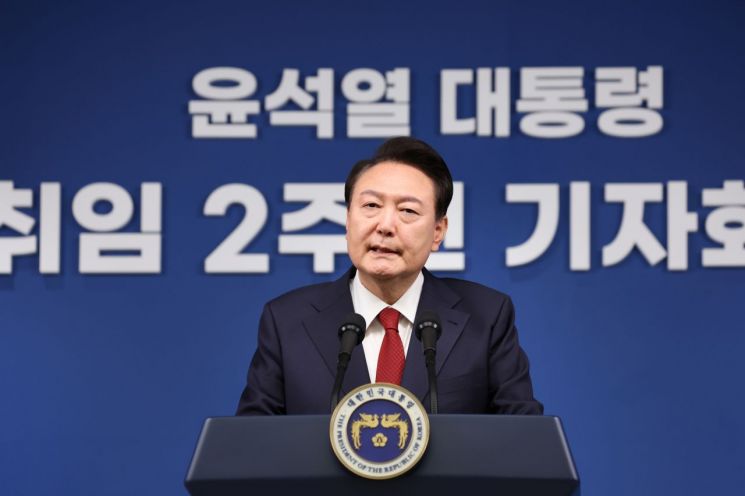
President Yoon Suk-yeol's request to the National Assembly to expand the benefits of the Individual Savings Account (ISA) during his 2nd anniversary press conference has ultimately failed to pass in the 21st National Assembly. This is because the possibility of convening the National Assembly's Strategy and Finance Committee (SFC) has disappeared.
According to the National Assembly on the 21st, the SFC is not expected to convene during the remaining term of the 21st National Assembly, which ends this month. Kim Sang-hoon, a member of the People Power Party and chair of the SFC, stated, "There is no possibility (of convening). Both the ruling and opposition party secretaries are passive." The last plenary session capable of passing the bills is scheduled for the 28th, so the SFC would need to convene this week.
On the 9th, President Yoon requested legislative cooperation from the National Assembly for amendments to the Restriction of Special Taxation Act (RSTA) to expand the tax-exempt limit of the ISA and to repeal the Financial Investment Income Tax (FIIT) through amendments to the Income Tax Act. Compared to the FIIT, which has significant differences in opinion between the ruling and opposition parties, expanding the ISA tax-exempt limit seemed more likely to reach an agreement. However, with the SFC not convening, the possibility of both bills being submitted to the plenary session has become slim.
The key points of the RSTA amendment include increasing the annual contribution limit for the ISA from 20 million KRW (total 100 million KRW) to 40 million KRW (total 200 million KRW), and raising the tax-exempt limit from 2 million KRW (4 million KRW for farmers and fishermen) to 5 million KRW (10 million KRW for farmers and fishermen).
Regarding the FIIT, which will be implemented from next year, the government and ruling party are urging its repeal, but the Democratic Party of Korea maintains its position to implement it. This is why confusion over the FIIT repeal is expected to continue in the 22nd National Assembly. The FIIT is a system that taxes 20% (25% for amounts exceeding 300 million KRW) on the excess profits earned by investors who make over 50 million KRW annually from financial investments such as stocks, bonds, and funds.
Additionally, other livelihood-related bills submitted to the SFC, such as △expanding income deductions for card usage in the first half of the year △raising the income deduction rate for credit card usage in traditional markets △reducing individual consumption tax when replacing vehicles older than 10 years, are also on track to be discarded.
© The Asia Business Daily(www.asiae.co.kr). All rights reserved.
![Clutching a Stolen Dior Bag, Saying "I Hate Being Poor but Real"... The Grotesque Con of a "Human Knockoff" [Slate]](https://cwcontent.asiae.co.kr/asiaresize/183/2026021902243444107_1771435474.jpg)















