Announcement of 'Foreign Resident Support Solution' for Global Talent
Attracting 1,000 Science and Engineering Master's and Doctoral Talents... Including Employment Support
Promotion of Introducing Semi-Professional Workers Such as Caregivers and Nursing Assistants
The Seoul Metropolitan Government will invest 250 billion KRW over the next five years to attract overseas talent and support the stable living of foreigners. In particular, it plans to attract 1,000 master's and doctoral-level talents in science and engineering in collaboration with major universities and establish support facilities to attract overseas startups. This is a proactive measure for Seoul's sustainable growth and a choice to strengthen its competitiveness as a global city.
On the morning of the 20th, Seoul Mayor Oh Se-hoon personally announced the 'Seoul Foreign Resident Policy Master Plan,' a comprehensive practical solution addressing the difficulties faced by foreigners living in Seoul, at Seoul City Hall, stating, "We will create a global city Seoul that grows together with foreign residents."
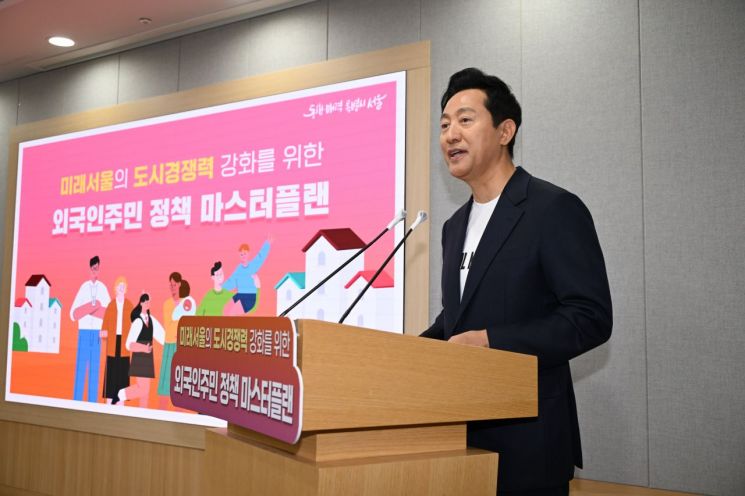 On the morning of the 20th, Seoul Mayor Oh Se-hoon announced the 'Seoul Foreign Resident Policy Master Plan,' a practical comprehensive solution addressing the difficulties faced by foreign residents living in Seoul, at Seoul City Hall.
 [Photo by Seoul City]
To formulate this plan, Seoul conducted surveys targeting foreigners, held meetings with foreign residents, and focus group interviews (FGI) related to international students and industrial talents to gather diverse voices from the field. It also held meetings and reviews with experts in various fields such as economy, outstanding talent, living conditions, and social integration.
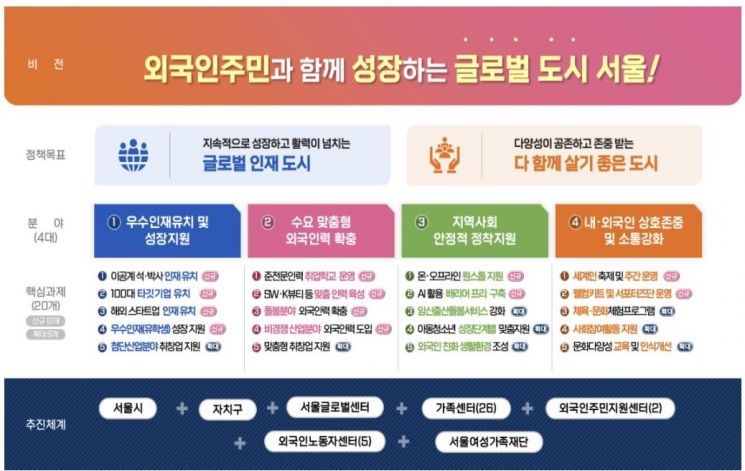
The core focus is on 'attracting outstanding talent' and 'creating an inclusive multicultural society.' With the number of foreigners residing in Seoul exceeding 440,000 and approaching 5% of the total population, the city has decided to regard foreigners as an important pillar to enhance Seoul's urban competitiveness.
First, Seoul will collaborate with major domestic universities to attract 1,000 master's and doctoral-level talents in science and engineering. The plan is to select 10 universities in Seoul specializing in advanced industries and provide up to 1.5 billion KRW annually for three years. Starting in July, Seoul will hold the 'Seoul Study Abroad Fair' twice a year locally, beginning in Jakarta, Indonesia, which has the largest school-age population (110 million) among ASEAN countries. Additionally, a new 'Seoul Tech Scholarship' program will be launched for outstanding science and engineering students recommended by ODA (Official Development Assistance) developing countries. This comprehensive talent attraction strategy covers everything from attracting global companies to education and employment/startup support.
To attract overseas startups, Seoul will also establish the 'Unicorn Startup Hub,' a global startup support facility where English is commonly used. The city plans to select 100 target companies with significant industrial ripple effects in technology and finance sectors and provide an 'all-in-one package' support for FDI (Foreign Direct Investment) attraction, including various permits and approvals, to help global companies wishing to operate in Seoul settle down.
Seoul will also implement living support measures. The 'Foreign Domestic Worker Pilot Project' will start in September this year, and the city will actively negotiate with the government to introduce foreign workers in sectors facing severe labor shortages but insufficient domestic workforce, such as caregivers, nursing assistants, food service, and hotel industries. To help these workers adapt to life in Korea, Seoul will open the 'Second Seoul Foreign Resident Support Center' in the northeastern area in May next year, following the southwestern center. Furthermore, real-time multilingual interpretation services using artificial intelligence (AI) will be introduced at family centers in 25 autonomous districts. The 'Foreigners’ Jeonse and Monthly Rent Safety Assistance Service,' which helps foreigners find housing, will also be launched.
Seoul will also pay attention to the process of raising children in the city. Integrated care services before and after childbirth, as well as infant development checkups, will be made accessible without discrimination between domestic and foreign residents. Starting this month, Seoul will newly support multicultural children’s educational activity expenses (400,000 to 600,000 KRW) for elementary, middle, and high school students.
To support these initiatives, Seoul plans to invest a total of 250.6 billion KRW over the next five years. The city intends to further subdivide each support measure and establish a dedicated organization called the 'Global City Policy Office' in July to develop strategic foreigner and immigration policies in response to demographic changes. Mayor Oh said, "Urban competitiveness comes from dynamism, and dynamism is driven by creative talents with diverse cultural backgrounds. For Seoul to leap into the global top 5 cities, it must actively attract foreign talent and companies more than ever and become an inclusive city that harmonizes with them, maximizing their ideas, capital, and human resources."
© The Asia Business Daily(www.asiae.co.kr). All rights reserved.
![Clutching a Stolen Dior Bag, Saying "I Hate Being Poor but Real"... The Grotesque Con of a "Human Knockoff" [Slate]](https://cwcontent.asiae.co.kr/asiaresize/183/2026021902243444107_1771435474.jpg)
















