'Special Protection for School Buses' 10th Year
The Gap Between Law and Reality Remains
Around 4:30 p.m. on a weekday, an elementary school in Jongam-dong, Seongbuk-gu, Seoul was visited. Students were gradually leaving the school one by one. On the road in front of the school, academy vans waiting for the children were lined up. Each vehicle had a helper teacher who personally greeted the children and assisted them to safely board the vehicle one by one. However, due to numerous cars speeding past behind the children's school buses, the teachers could not afford to relax their vigilance even for a moment.
On this day, a Taekwondo academy vehicle that accompanied the children stopped and picked up or dropped off children about 10 times over approximately 30 minutes. Despite the red signboard reading ‘Stop (Children Boarding/Alighting)’, it was rare to see surrounding vehicles temporarily stopping or slowing down to consider children's safety. On the contrary, it was common for vehicles following behind to overtake the school bus.
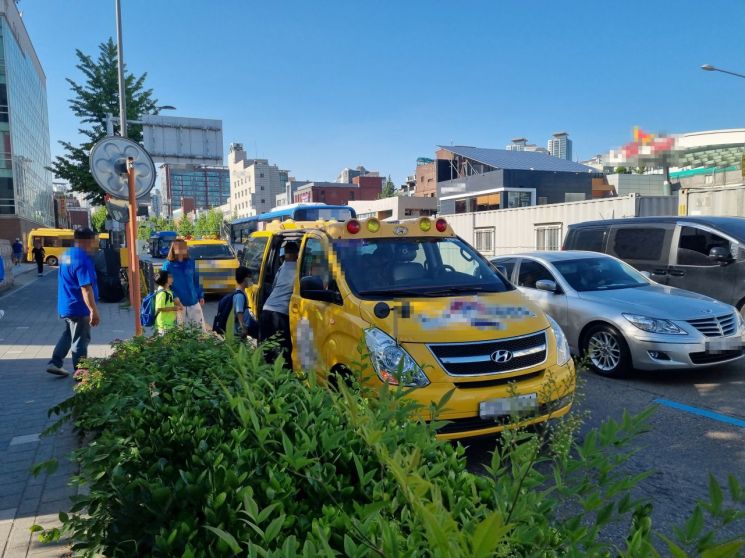 At around 4:30 PM on the 14th, a private academy vehicle was picking up students in front of an elementary school in Jongam-dong, Seongbuk-gu, Seoul. A car passed quickly in the lane right next to the children's school bus without slowing down.
 [Photo by Sim Seong-a]
Unlike adults, children have a narrower field of vision and lack awareness of road conditions, and their short height makes it difficult for drivers to spot them, making them vulnerable to traffic accidents on the road. According to 2022 data on children's traffic accidents by time, the number of accidents sharply increased to over 2,000 starting from 2 p.m., when school dismissal begins, with the highest number of accidents (2,640 cases) occurring between 4 p.m. and 6 p.m.
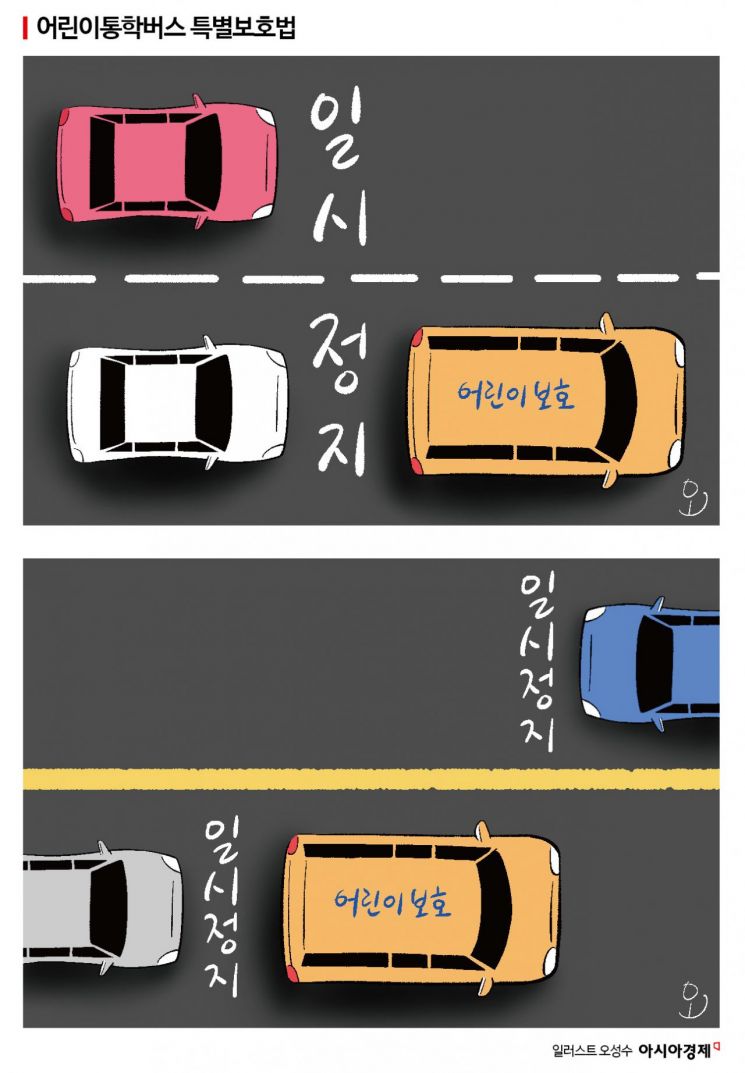
To protect children, the ‘Special Protection for Children's School Buses (Article 51 of the Road Traffic Act)’ was amended in 2014. The main points require general drivers passing near children's school buses to temporarily stop and confirm safety when children are boarding or alighting, then proceed slowly, and prohibit overtaking school buses carrying children. Violations result in 30 penalty points and fines of 100,000 KRW for vans, 90,000 KRW for passenger cars, and 60,000 KRW for motorcycles.
However, even after 10 years since the law was amended, a gap still exists between reality and the law. Ha Jeong-seok (52), who has been driving a children's school bus since January, said, “Especially younger children often cross the road immediately after getting off the vehicle, which is really dangerous, but I have never seen surrounding vehicles stop for them,” adding, “They don’t wait even for that brief moment; 100 out of 100 vehicles overtake.” Kim (57), a school bus driver at an elementary school in Anam-dong, Seongbuk-gu, Seoul, also said, “Because the surrounding road conditions are so complicated, no driver stops when students are boarding or alighting.”
The difficulty in enforcement and punishment is cited as a reason why the situation has not improved. Usually, fines are imposed through on-site enforcement or citizen reports, but the police explain that it is practically impossible to capture the moment when other vehicles overtake the school bus while children are boarding or alighting.
According to data from the National Police Agency, the number of special enforcement cases for children's school bus protection nationwide over the past four years was only 5 in 2020, 9 in 2021, 12 in 2022, and 13 in 2023. Compared to the 1,000,777 signal violation enforcement cases in Seoul in 2022, this is an extremely small number. A police official lamented, “Signal violations or parking violations are easily detected through dedicated enforcement cameras, but there are not many children's school buses, and enforcement is difficult because the moment when surrounding vehicles fail to stop while children are boarding or alighting must be captured.”
Experts point out that social awareness needs to change. Kwak Dae-kyung, a professor in the Department of Police Administration at Dongguk University, said, “It must be recognized that if a law violation is clearly proven, the violator will be punished,” and advised, “Cameras should be installed in front, behind, or on the sides of children's school buses to detect violations, and a system should be established to easily submit this evidence to the police.”
He added, “Just as the culture of yielding to ambulances has recently taken root, social awareness should be changed toward ‘children’s safety is the top priority’ through systematic efforts, even if it takes time.”
© The Asia Business Daily(www.asiae.co.kr). All rights reserved.


















