Government Fiscal Strategy Meeting
Emphasizing Fiscal Sustainability
Comprehensive Reassessment of Budget Project Feasibility
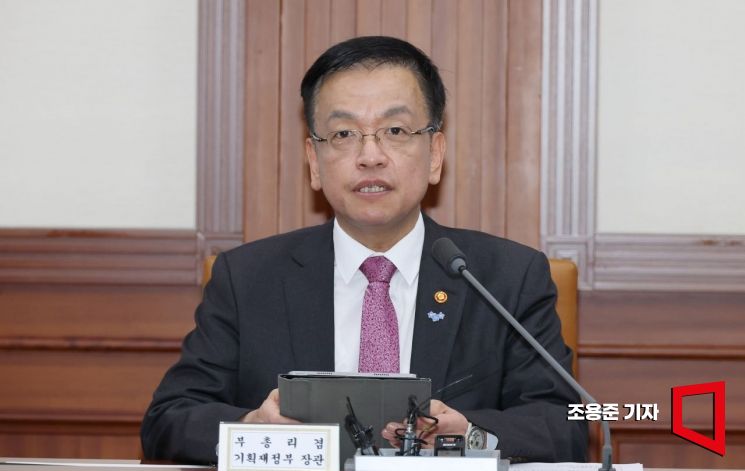 Choi Sang-mok, Deputy Prime Minister for Economy and Minister of Strategy and Finance, is speaking about economic issues at the Economic Ministers' Meeting held on the 13th at the Government Seoul Office in Jongno-gu, Seoul. Photo by Jo Yong-jun jun21@
Deputy Prime Minister and Minister of Economy and Finance Choi Sang-mok stated on the 17th, "Amid recent challenging fiscal conditions, we will secure fiscal sustainability while faithfully investing in urgent livelihood issues and other government responsibilities."
On the same day, Deputy Prime Minister Choi made these remarks during a presentation on medium-term fiscal management and next year's budget formulation direction at the '2024 National Fiscal Strategy Meeting' held at the Government Complex Sejong.
This is interpreted as taking into account the difficult fiscal situation, such as declining tax revenues due to economic sluggishness while expenditures increase. The managed fiscal balance, which reflects the government's actual fiscal status, recorded a deficit of 75.3 trillion won in the first quarter of this year, the highest since monthly fiscal trend statistics began in March 2014.
The meeting, themed "Frugal National Budget, Warm Livelihood," was attended by all Cabinet members including Prime Minister Han Duck-soo, Emergency Response Committee Chairman Hwang Woo-yeo, and ruling party floor leader Choo Kyung-ho, among other key figures.
Deputy Prime Minister Choi emphasized, "It is necessary to first undertake a comprehensive review of the feasibility of projects by each ministry to reduce unnecessary expenditures," and added, "The national debt ratio relative to GDP during the medium-term plan period will be managed stably at the mid-50% level."
Under this fiscal management policy, the strategy meeting discussed major policy tasks in three areas: livelihood stabilization, dynamic economy, and fiscal innovation.
In the livelihood stabilization sector, discussions were held on strengthening welfare for the vulnerable, advancing healthcare reform, supporting youth future advancement, and investing to reduce regional transportation disparities.
In the dynamic economy sector, reforms toward leading-edge research and development (R&D) and support for securing a semiconductor industry super-gap were discussed. In the fiscal innovation sector, discussions focused on responses to low birth rates, enhancing effectiveness, and directions for local education fiscal innovation.
The matters discussed at the meeting will be reflected in the '2024?2028 National Fiscal Management Plan and next year's budget proposal' to be submitted to the National Assembly in early September.
© The Asia Business Daily(www.asiae.co.kr). All rights reserved.

















