Korea Research Institute of Standards Opens Path to Developing New Materials Needed for Space Age
Explains Why New Materials Are Created Using Electrostatic Levitation Device
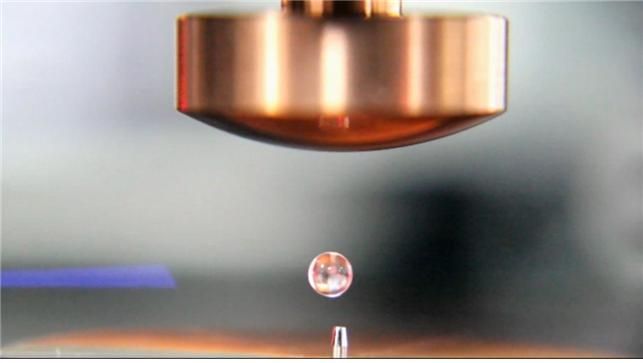 The electrostatic levitation device developed by the Korea Research Institute of Standards and Science is levitating an aqueous solution in the air. Photo by Pyojun Yeon
To pioneer the space age, materials different from those used so far may be required. This is why NASA, the Japan Aerospace Exploration Agency (JAXA), the German Aerospace Center (DLR), and the China Space Agency (CSA) are developing and researching electrostatic levitation devices. Although our research team started late, we have succeeded in discovering why new materials are formed using electrostatic levitation devices.
With the upcoming opening of the Space Aviation Agency on the 27th, there is growing anticipation that we will be able to create new materials capable of withstanding extreme temperatures necessary for the space development era by our own efforts. This implies that new advanced materials, like 'Vibranium,' the material used for the shield of Captain America in Marvel movies, could also emerge.
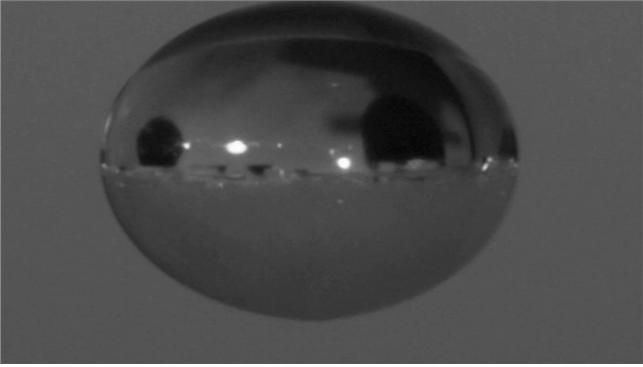
The Korea Research Institute of Standards and Science (KRISS) announced on the 17th that, using a self-developed electrostatic levitation device, they have, for the first time in the world, observed the crystallization process of materials at the molecular level in a supersaturated environment and identified that changes in the symmetry of molecular structures are the cause of the formation of previously unknown new materials.
The Space Extreme Measurement Group at KRISS succeeded in implementing and observing a supersaturation state exceeding 400% by levitating an aqueous solution in the air using an electrostatic levitation device they developed in 2010. The team's achievement is a remarkable breakthrough, surpassing the precision observation level of about 200% saturation concentration achievable by existing technologies held by U.S. and Japanese space agencies.
The electrostatic levitation device applies a strong voltage between two electrodes to levitate an object, overcoming gravity. By levitating materials in the air, the influence of contact is minimized, allowing precise measurement of material properties. Reducing the number of water molecules that interfere with molecular structure measurement enables detailed observation of the crystallization process. The research team reduced the number of water molecules interfering with molecular structure measurement to one or two per solute molecule using the electrostatic levitation device, enabling precise confirmation of the crystallization process.
The phenomenon of new material phases emerging was discovered in the 1890s by German chemist Wilhelm Ostwald. Ostwald found that in a supersaturated aqueous solution, where solutes are dissolved beyond their solubility at a constant temperature, a new metastable material phase forms during crystallization instead of a stable phase. Since then, the hypothesis that changes in the molecular structure of solutes in aqueous solutions are the main cause has been dominant, but proving this by observing at the molecular level has been challenging.
The research team also succeeded in implementing an ultra-high temperature environment exceeding 4000 Kelvin (K·3726°C) using the levitation device and precisely measuring the thermal properties of heat-resistant materials such as tungsten (W), rhenium (Re), osmium (Os), and tantalum (Ta). This achievement is also highly significant. It provides accurate thermal property values for ultra-high temperature heat-resistant materials essential in space launch vehicles, aircraft engines, nuclear fusion reactors, and defense sectors, thereby enhancing the safety and efficiency of design.
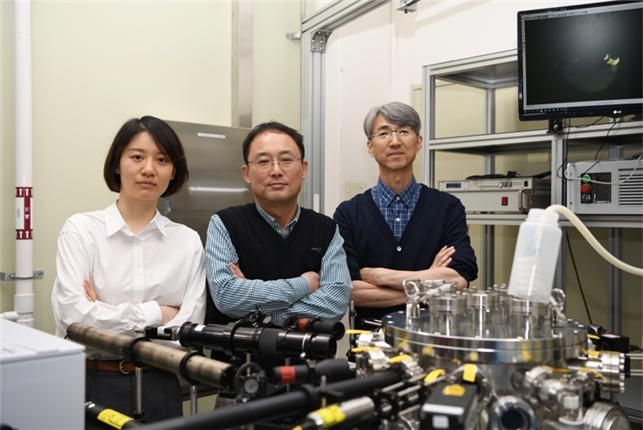 The research team from the Extreme Space Measurement Group at the Korea Research Institute of Standards and Science, who led this study, is posing for a photo. (From left: Wang Lei, Post-doc; Jo Yongchan, Senior Researcher; Lee Geunwoo, Principal Researcher)
The research team plans to establish an ‘Extreme Materials Integrated Measurement Platform’ based on the electrostatic levitation device to precisely measure material properties under extreme conditions of ultra-high temperature, supersaturation, and ultra-high pressure.
Geunwoo Lee, principal researcher leading the Space Extreme Measurement Group at KRISS’s Strategic Technology Research Institute, said, "Using the electrostatic levitation device, we can simulate a microgravity environment similar to space and precisely measure material properties. Advanced aerospace agencies currently conduct various experiments planned for space on the ground using this device to reduce costs and improve research efficiency."
This research was conducted under the National Science and Technology Research Council’s Creative Convergence Research Project and KRISS’s basic project ‘Establishment of Advanced Material Measurement Platform.’ The research results were published in the April issue of the international journal Nature Communications and were also selected as an Editor’s Highlight.
© The Asia Business Daily(www.asiae.co.kr). All rights reserved.
![Clutching a Stolen Dior Bag, Saying "I Hate Being Poor but Real"... The Grotesque Con of a "Human Knockoff" [Slate]](https://cwcontent.asiae.co.kr/asiaresize/183/2026021902243444107_1771435474.jpg)

















