Real Estate Development Association Holds Emergency Meeting on PF Measures
Developers Say "PF Project Feasibility Ratings Do Not Reflect Reality"
#. A housing project site in Seoul has already extended the maturity of its bridge loan three times since the second half of 2022. This is because financial authorities' controls on real estate project financing (PF) have led financial institutions to set shorter bridge loan maturity periods. In the past, it might have been sufficient to extend the maturity only once during the same period, but due to changes in the external environment and demands from the financial sector, it was unavoidable. Therefore, simply evaluating exit decisions based on the number of maturity extensions, such as three or more times, is irrational and reflects a policy perspective from the financial sector that does not understand the field, according to Developer A.
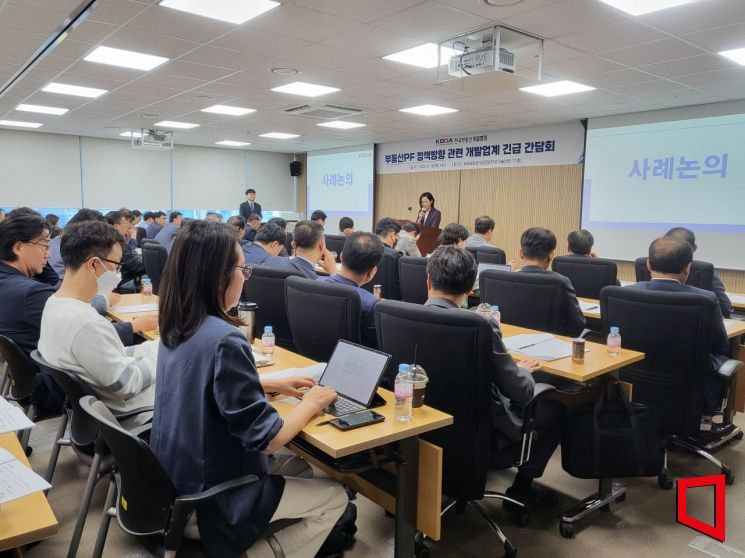 On the afternoon of the 16th, an urgent meeting with the development industry regarding the 'Real Estate Project Financing (PF) Policy Direction' is being held at the main auditorium of the Korea Real Estate Development Association in Gangnam-gu, Seoul. / Photo by Noh Kyung-jo
The real estate development industry has opposed the financial authorities' plan for a soft landing of the real estate PF market, calling it a "half-baked measure that completely excludes the borrower developers from the policy and only reflects the perspectives of financial institutions and construction companies."
On the afternoon of the 16th, the Korea Real Estate Development Association held an emergency meeting at the association's auditorium in Gangnam-gu, Seoul, to discuss the recently announced "Real Estate PF Feasibility Evaluation Criteria" by the Financial Supervisory Service.
Industry representatives attending the meeting collectively criticized the policy as "ignoring the market and the field and lacking rationality," emphasizing that "supplementary measures must be introduced to prevent the destruction of the real estate supply ecosystem." They pointed out that the potential chain bankruptcies caused by the liquidation of a single project site were not considered at all.
Earlier, on the 13th, financial authorities announced an improvement plan to subdivide the current three-tier real estate PF feasibility evaluation grades (Good, Average, Concern for Deterioration) into four tiers (Good, Average, Caution, Concern for Insolvency). The plan includes assigning a "Concern for Insolvency" grade to projects that have failed to repay overdue interest on both bridge loans and main PF loans and have extended maturity four or more times, or projects that have failed to sell at auction three or more times.
However, the industry expressed concerns that applying the new evaluation criteria could lead to unfair assessments resulting in forced restructuring of projects, and that after the Legoland incident, projects have been cross-guaranteeing each other, which could trigger chain bankruptcies. For example, if a developer owns four projects and one receives a "Concern for Insolvency" grade and is liquidated, the other three projects could also be affected.
A representative from Developer B said, "After the Legoland incident, the financial sector has required guarantees for other project revenue rights within 2-3 years, so many have entered into joint guarantees," emphasizing, "A supplementary measure is needed to sever joint guarantees so that projects with insolvency concerns do not negatively impact other projects." They also stressed that normal projects should proceed as usual and policies must accompany the recovery of profits after project completion.
They further pointed out that unavoidable factors such as increased project costs due to rising construction expenses and decreased demand due to market stagnation could cause projects to be rated as "Caution" or "Concern for Insolvency" under the new criteria. A semi-housing project in the metropolitan area is experiencing deteriorating profitability as project costs increased due to the construction company's demand for additional construction expenses during the main PF stage, and despite 18 months since the start of sales, the sales rate remains below 60% due to demand stagnation.
A representative from Developer C said, "Developers earn profits from the difference between the sale price and project costs, but profitability is declining as construction and financial costs continue to rise," adding, "The problem must be solved through policies that support sale prices and increase real estate prices." They also warned, "According to the announced policy, 80-90% of projects will be classified as insolvent. It is unclear how classification will be handled. Only projects that fit certain preferences will survive, which inevitably leads to a hard landing."
While collecting opinions from attendees, the association repeatedly emphasized that "evaluation factors must be reasonably adjusted based on market conditions." They also stated, "Developers must not be excluded from financial authorities' policies, and developers should be allowed to participate in the supplementary and evaluation processes."
Kim Seung-bae, president of the Korea Real Estate Development Association, said, "If the development industry collapses, the supply ecosystem collapses. The supply of non-apartment housing, which contributes to stabilizing the monthly rent and lease market in urban areas, will be cut off, and the supply of various living infrastructure will also stop," adding, "It is questionable whether it aligns with market economy logic to first liquidate suppliers without properly implementing market recovery policies such as tax relief for multi-homeowners."
© The Asia Business Daily(www.asiae.co.kr). All rights reserved.
![Clutching a Stolen Dior Bag, Saying "I Hate Being Poor but Real"... The Grotesque Con of a "Human Knockoff" [Slate]](https://cwcontent.asiae.co.kr/asiaresize/183/2026021902243444107_1771435474.jpg)















