Medical School Professors, Residents, and Examinees' Applications 'Dismissed'
Medical Students' Injunction Request 'Rejected'
Medical Community "Will File a Re-Appeal to the Supreme Court"
Medical school professors, residents, and medical students filed a request for a suspension of enforcement against the government, seeking to halt the effect of the decision to increase and allocate 2,000 medical school admissions. This request was once again dismissed or rejected by the court. As a result, the government's policy to increase medical school admissions has gained momentum.
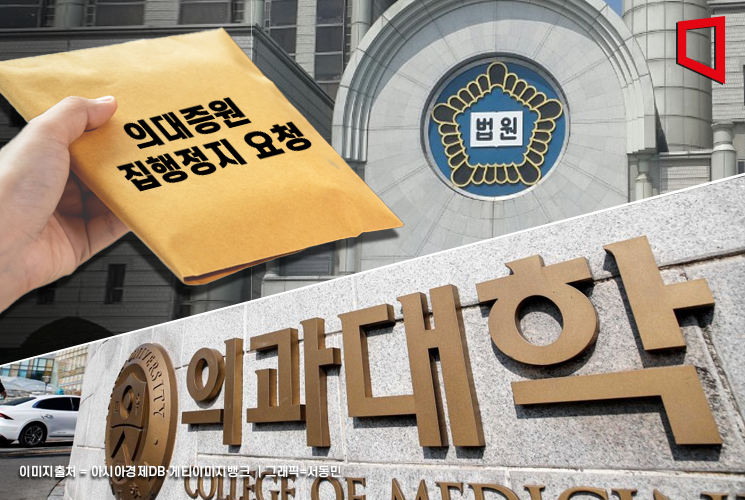
On the 16th, the Administrative Division 7 of the Seoul High Court (Presiding Judges Gu Hoe-geun, Bae Sang-won, Choi Da-eun) dismissed the appeal for suspension of enforcement filed by 18 individuals including examinees, medical students, residents, and medical school professors, who sought to halt the effect of the policy to increase and allocate 2,000 medical school admissions. The court ruled, as in the first trial, that the medical school professors, residents, and prospective medical students were not direct parties to the case but merely third parties, and therefore dismissed their application.
However, regarding the application from current medical students, the court recognized their standing as applicants and the urgent necessity to prevent harm, but dismissed the application on the grounds that the public welfare of medical reform through increasing medical school admissions was more important.
The court stated, "In the case of medical student applicants, according to relevant laws such as the Constitution, the Framework Act on Education, the Higher Education Act, the Enforcement Decree of the Higher Education Act, and university establishment and operation regulations, the learning rights of medical students are guaranteed. However, there is a possibility that special circumstances exist where the current decision effectively blocks participation opportunities in existing educational facilities, thereby limiting equal access to educational facilities," thereby recognizing the applicants' standing.
The court examined the substantive requirements for suspension of enforcement under Article 23 of the Administrative Litigation Act only for the medical student applicants. Article 23, paragraph 2, stipulates that "when there is an urgent necessity to prevent irreparable harm caused by the execution or continuation of the procedure of the disposition, the court may, upon application by a party or ex officio, decide to suspend all or part of the effect or execution or continuation of the procedure of the disposition while the main case is ongoing." Paragraph 3 states that "suspension shall not be allowed if it is likely to have a serious impact on public welfare," allowing refusal of suspension for the public interest.
On this day, the court said, "There is a risk of harm to the medical student applicants, which is of an irreparable nature, and there is an urgent necessity to prevent it."
However, regarding the balancing of public interest, the court concluded, "Although the urgent necessity to prevent irreparable harm such as infringement of the learning rights of medical student applicants can be recognized, suspending the execution of this decision would likely have a serious impact on the public welfare of medical reform through increasing medical school admissions. It is necessary to uphold the latter even at the expense of the former. Therefore, this application does not meet the substantive requirements for suspension of enforcement."
This case was filed together with an administrative lawsuit by medical school professors, university hospital residents, and medical students against the Ministers of Health and Welfare and Education, requesting the cancellation of the increase of 2,000 medical school admissions for the 2025 academic year. Suspension of enforcement refers to a court decision to temporarily halt the execution or continuation of administrative procedures when an administrative disposition cancellation lawsuit is filed.
Previously, the Seoul Administrative Court, which handled the first trial, dismissed the suspension of enforcement application itself, questioning the plaintiffs' "standing." Dismissal means ending the trial without examining the merits when the lawsuit does not meet requirements or the claim is not subject to judgment. For the same reason, seven out of eight suspension of enforcement applications filed by the National Council of 33 Medical School Professors Associations (Jeonui Gyohyeop), medical school professors, residents, medical students, and examinees at the Seoul Administrative Court were consecutively dismissed.
However, during the hearing on the 30th of last month, the appellate court pointed out, "If no one is recognized as having standing, it means that when the state increases medical school admissions, there is no one to challenge it, implying that such state decisions cannot be judicially reviewed or controlled," raising the possibility of a different conclusion from previous courts.
The court ordered the government to submit additional materials related to the increase in medical school admissions. The government submitted a total of 49 documents, including agenda items and minutes from the Health and Medical Policy Deliberation Committee (Bojeongshim), and results from the subordinate Medical Personnel Expert Committee. After the government's submission, disputes arose between the government and the medical community over whether these materials could be considered grounds for the increase.
However, the court urged, "If the medical school admissions are increased by 2,000 students annually from 2025 as originally planned, there is a possibility that the learning rights of medical students, protected under the Constitution, the Framework Act on Education, the Higher Education Act, and other relevant laws, will be seriously infringed. It is necessary to respect the opinions of universities each year and ensure that the number does not exceed the figures calculated by the universities themselves to minimize infringement on medical students' learning rights."
Immediately after the court's decision, Lee Byung-chul, the attorney representing the medical school professors, stated, "We will do our best to prepare for the Supreme Court re-appeal process."
However, even if a re-appeal is filed, it is physically difficult for the Supreme Court to make a judgment by the end of this month, so it is expected that the decision on whether to increase medical school admissions this year will be determined based on this ruling. Each university must finalize the number of medical school admissions by reflecting it in the 2025 academic year's early admission guidelines by the end of this month.
Nonetheless, Attorney Lee said, "The Supreme Court is the highest court responsible for protecting fundamental rights and has the final review authority over government administrative dispositions. Therefore, we expect the Supreme Court to hear and finalize the re-appeal case before May 31." This implies that given the seriousness and urgency of the matter and the well-known issues, the Supreme Court can promptly hear and make a decision.
© The Asia Business Daily(www.asiae.co.kr). All rights reserved.
![Clutching a Stolen Dior Bag, Saying "I Hate Being Poor but Real"... The Grotesque Con of a "Human Knockoff" [Slate]](https://cwcontent.asiae.co.kr/asiaresize/183/2026021902243444107_1771435474.jpg)
















