China ETF Recent One-Month Returns 10~30%
China Stock Market '↑' on China Stimulus Policies
The returns of exchange-traded funds (ETFs) related to China and Hong Kong are outperforming other ETFs. This is interpreted as the Chinese government's stock market stimulus measures boosting the China and Hong Kong stock markets.
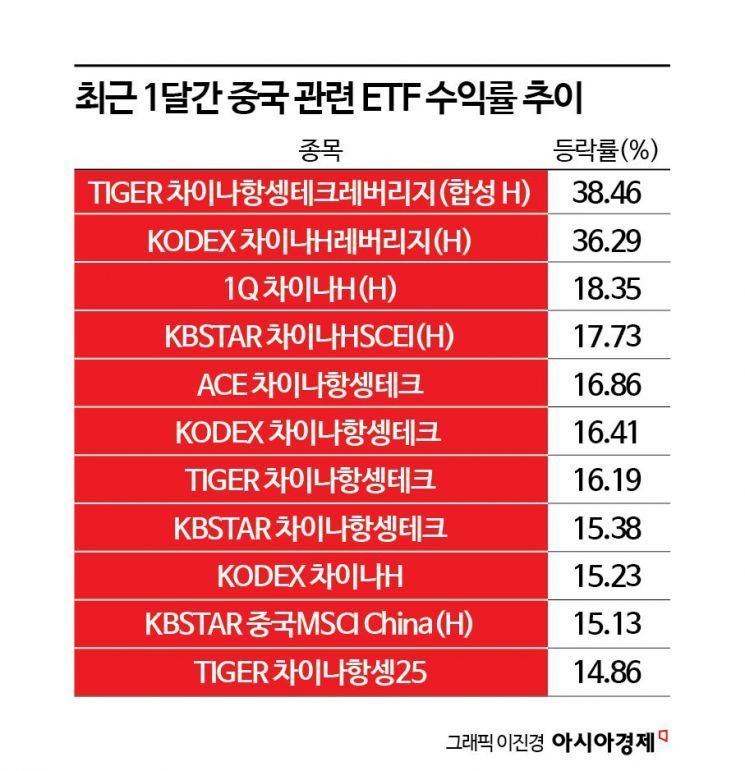
According to the Korea Exchange on the 17th, the 'TIGER China Hang Seng Tech Leverage' ETF by Mirae Asset Global Investments closed at 6,480 won the previous day. This marks a 38.46% increase from 4,680 won on the 15th of last month. The TIGER China Hang Seng Tech Leverage is a leveraged product that tracks twice the daily return of the Hang Seng Tech Index, which consists of three Chinese technology companies listed on the Hong Kong stock exchange.
Additionally, solid returns have been recorded by other funds such as Samsung Asset Management's KODEX ChinaH Leverage (36.29%), Hana Asset Management's 1Q ChinaH (18.35%), KB Asset Management's KBSTAR China HSCEI (17.73%), Korea Investment Management's ACE China Hang Seng Tech (16.86%), KODEX China Hang Seng Tech (16.41%), and TIGER China Hang Seng Tech (16.19%).
The same trend applies to funds. According to KG Zeroin fund evaluation data, as of the 13th of this month, the average return of domestic asset management companies' China funds investing in the Chinese stock market is 10.5%. Among them, the KCGI China Fund rose 18.2% compared to the beginning of the year.
Recently, the Chinese stock market has rebounded from its previous slump. The Shanghai Composite Index fell to 2,635.09 in February but has surpassed the 3,100 mark this month. The Hong Kong H Index (Hang Seng China Enterprises Index, HSCEI) also dropped to 4,943.24 in January but has continued its upward trend by exceeding the 6,700 level this month.
Several reasons are cited for the recent rebound in the Chinese stock market. A key factor is the outlook that the Chinese economy and stock market are currently at their bottom. Other factors include the Chinese version of the value-up program called the 'New National 9 Measures (capital market guidelines)' and the Chinese government's domestic demand stimulus policies.
Park Sang-hyun, a researcher at Hi Investment & Securities, explained, "The Greater China stock market, which had been in a sharp decline until mid-January, has since shifted to a strong rebound. This can be attributed to signals of economic improvement, the Chinese version of the value-up program, expectations for economic stimulus such as the 'Igu Hwan Shin,' and the effects of promoting a high-quality development strategy."
However, there are differing opinions on whether the upward trend will continue. Although the Chinese economy is recovering recently, some analysts argue it is difficult to say it has fully entered a recovery trend. Over the past few years, China's economy has slowed, and large real estate developers have faced financial crises, leading to a downturn in the Chinese real estate market. Ultimately, the recovery of the real estate market is considered crucial.
Heo Jin-wook, a researcher at Samsung Securities, stated, "I do not believe the Chinese economy has entered a trend recovery. Considering the influence of the housing market, it is difficult to expect a meaningful rebound in the Chinese economy solely based on the recovery of manufacturing dependent on global demand and policies."
© The Asia Business Daily(www.asiae.co.kr). All rights reserved.

















