①Pro-Government Traffic Control Theory Seems to Have Backfired Within the Democratic Party
②Underlying 'Non-Discussion' Hindered Chu Mi-ae
③Woo Won-sik's Walking Campaign Advantage Shakes Elected Officials' Voter Sentiment
An 'upset' occurred in the Democratic Party of Korea's National Assembly Speaker candidate primary. Initially, the political circles expected candidate Chu Mi-ae to win comfortably, but the victor was Representative Woo Won-shik. Interpretations from the political sphere range from a backlash against the so-called Myeongism (Lee Jae-myung party leader's intention) controversy that arose from the floor leader primary to the Speaker election, to concerns about candidate Chu, and analyses that Woo's campaign strategy of meeting voters (elected members) by traveling around the members' office building and nationwide paid off.
After the vote count ended in the National Assembly Speaker election held at the National Assembly on the 16th, Jin Sun-mi, the election management committee chairperson for the primary, announced, "Candidate number 4, Representative Woo, was elected by securing the majority of the total members." The Democratic Party decided not to disclose the vote count following the election committee's decision. For the vice-chairperson candidate, Representative Lee Hak-young, who will be serving his fourth term, was elected.
1. The Backlash from the Pro-Myeong Traffic Arrangement Theory
Initially, many in the political circles predicted candidate Chu's victory. Chu would become a six-term member in the next National Assembly, making her the most senior member, and among the six-term members, she was the oldest, making her the closest to the Speaker position by convention. She also enjoyed strong support from party members within the Democratic Party, and analyses frequently mentioned that she had the backing of Lee Jae-myung, the Democratic Party leader.
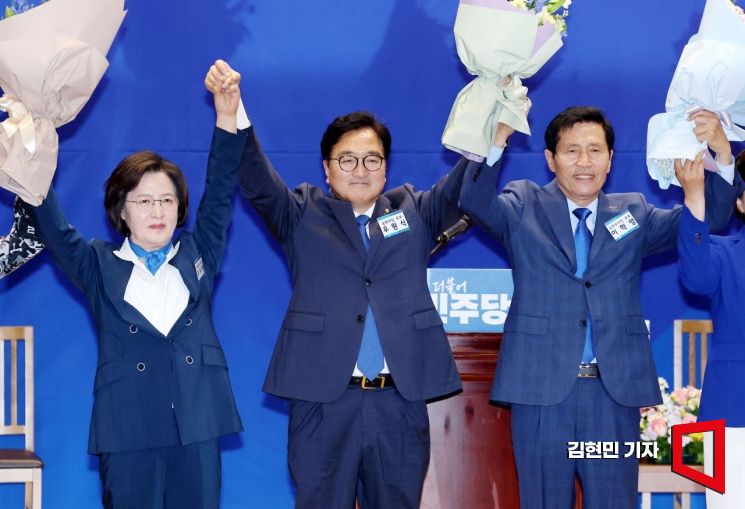 Woo Won-sik (center), who was elected as the Democratic Party candidate for Speaker of the National Assembly, and Lee Hak-young (right), who was elected as the candidate for Deputy Speaker, are raising their arms while holding bouquets at the general meeting of elected members held on the 16th at the National Assembly Members' Office Building to select the candidates for the first half of the 22nd National Assembly Speaker group. Photo by Kim Hyun-min kimhyun81@
However, amid the overheated atmosphere surrounding the Speaker primary, the so-called 'traffic arrangement' controversy seemed to have backfired. On the 12th, Representative Jung Sung-ho, known as the leader of the pro-Myeong faction, announced his withdrawal from the race. Shortly after, one of the leading candidates, Representative Cho Jung-sik, declared his support for candidate Chu after having lunch with her and then withdrew. The media interpreted that Democratic Party floor leader Park Chan-dae played a role in this process, making the 'traffic arrangement' theory at the leadership level a fait accompli.
Already, within the Democratic Party, Floor Leader Park was virtually endorsed as the sole candidate for the first time in 19 years. Although many candidates with three or more terms who had won the general election were considered, all candidates except Park withdrew from the primary, leading to criticism that the process was 'not normal.' Furthermore, with two leading candidates withdrawing from the Speaker primary, leaving only Representative Woo and candidate Chu, those opposing the 'traffic arrangement' theory had no choice but to rally behind Representative Woo.
Former National Assembly Secretary-General Yoo In-tae criticized Lee Jae-myung in a CBS radio interview, saying, "It feels like a party serving an emperor." Representative Woo Sang-ho of the Democratic Party also commented on the traffic arrangement theory raised inside and outside the party, stating, "The Democratic Party is a party that values bottom-up nominations and internal democracy, so it is inappropriate for the leader or any representative to intervene in deciding candidates by organizing the structure." Moreover, since the election was conducted by anonymous voting, it is believed that the free will of the members was reflected, making the upset possible. It is highly likely that neutral-leaning members voted according to their conscience.
2. Did the Underlying Veto Against Chu Mi-ae Hamper Her?
There are also criticisms that there was significant resistance against candidate Chu. In the past, Chu, recognized for her combativeness and nicknamed 'Chu the Dark,' gained support from the 'Democratic Innovation Meeting,' which was elevated to the party's largest parliamentary group, and the hardline faction 'Cheoreomhoe.' However, this strong image is interpreted as having increased resistance against her. Additionally, during her rebuttal against criticisms that she was the top contributor to the rise of the Yoon Seok-youl administration, she pointed fingers at former President Moon Jae-in and others, which may have provoked backlash from so-called pro-Moon lawmakers close to the former president. Secretary-General Yoo said, "(Because of this incident) she became an enemy to the pro-Moon faction."
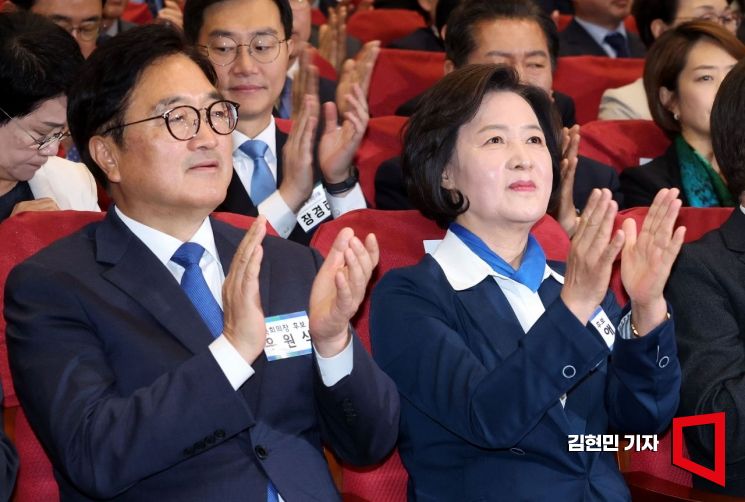 Choo Mi-ae and Woo Won-shik, candidates for the Speaker of the National Assembly, are applauding at the elected members' general meeting held on the 16th at the National Assembly Members' Office Building to select the candidates for the 22nd National Assembly's first half Speaker team. Photo by Hyunmin Kim kimhyun81@
In the past, candidate Chu's support for the impeachment of former President Roh Moo-hyun, and her autocratic actions during the Lee Myung-bak administration, such as blocking her party's lawmakers from entering during the labor relations law process and pushing the bill through, also seem to have undermined trust. Regarding the Democratic Party's Speaker primary, there were remarks in political circles that the ruling People Power Party preferred candidate Chu to become the Speaker. This was because if the hardline Chu took charge of the National Assembly, biased parliamentary management could provoke public backlash, potentially reviving the 'opposition party judgment theory.' Within the Democratic Party, concerns about candidate Chu were raised due to this trend, which was confirmed by the voting results this time.
3. Woo Won-shik’s Foot Soldier Campaign as a Former Floor Leader
The difference in election methods also seemed to have a significant impact. Representative Woo, who had experience winning the floor leader election conducted among lawmakers, ran a floor leader-style campaign for this election, which is selected by the same method, by meeting and persuading individual lawmakers. Introducing himself as the 'Yeouido foot soldier,' he traveled to Chungcheong, the metropolitan area, Honam, and other regions where most Democratic Party elected members reside, meeting and persuading them directly. On social media (SNS), Woo said, "Visiting and meeting in the regions increased mutual understanding and allowed me to convey sincerity, which was good." He also chose to visit the rooms of voter-elected members in the National Assembly to appeal for support. Moreover, his multi-layered relationships with incumbent lawmakers through the Basic Social Committee and Euljiro Committee were strengths. Despite analyses favoring candidate Chu, Woo's confidence in media interviews seemed to stem from confirming grassroots support through this 'face-to-face campaign.'
On the other hand, candidate Chu, who had served as the Democratic Party leader, engaged in a high-profile or public opinion battle-style election, such as unifying candidates or having 21,054 party members urge her nomination as Speaker. This 'party convention'-style election targeting party members appeared to be less effective compared to the election targeting the actual voters, the elected lawmakers.
© The Asia Business Daily(www.asiae.co.kr). All rights reserved.
![Clutching a Stolen Dior Bag, Saying "I Hate Being Poor but Real"... The Grotesque Con of a "Human Knockoff" [Slate]](https://cwcontent.asiae.co.kr/asiaresize/183/2026021902243444107_1771435474.jpg)
















