Securing Regular Local Customers Advantageous
'Ulmyeo Gyeojameokgi' Discount Strategy
On the afternoon of the 15th around 6 p.m., I visited the food alley near Isu Station in Dongjak-gu, Seoul. Many restaurants in this alley had banners displaying “Soju·Beer 1,500 won” or “Alcohol 2,000 won.” Most of the restaurants offering these alcohol discount events were packed with customers. Citizen Jeong Jaehyun (29) said, “When I meet friends or hang out, I tend to look for places where alcohol is cheaper,” adding, “I hope more places like this appear to reduce the burden of dining out.”
As prices soar to the point where “a glass of soju with samgyeopsal” becomes a burden, more restaurants are boldly discounting alcohol prices to attract regular customers. Offering alcohol prices that go against the trend of high inflation is interpreted as a “last-ditch strategy” by restaurants seeking an escape route in this high-price era.
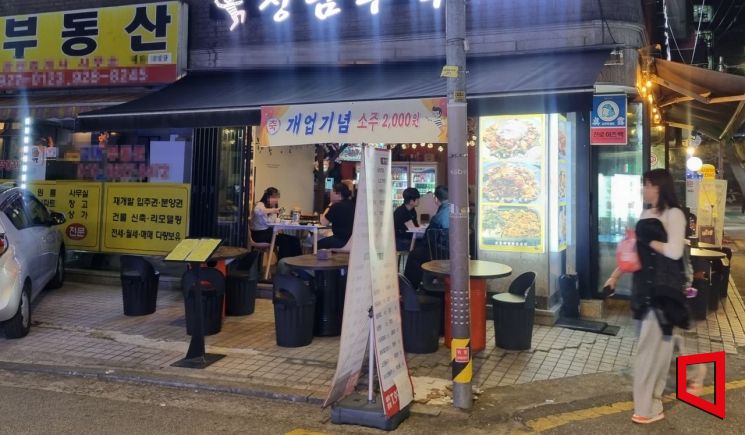 A banner reading "Soju Beer 2000 won" is hung at the entrance of a meat restaurant in Sadang-dong, Dongjak-gu, Seoul.
 [Photo by Shim Seong-ah]
According to Statistics Korea, the consumer price index for soju rose significantly from 100.58 in 2021 to 108.64 in April this year, and for beer from 100.17 to 112.46. In fact, in Seoul, it is not difficult to find bars or restaurants in the so-called Gangnam 3 districts such as Gangnam or Songpa selling a bottle of soju for 8,000 to 9,000 won. Moreover, as the high inflation phenomenon continues, consumption is shrinking. In the “April 2024 Consumer Sentiment Survey” conducted by the Bank of Korea, the consumer sentiment index for April was 100.7, the same as the previous month, but it is analyzed that consumption capacity has weakened due to prolonged price and interest rate burdens.
Meanwhile, in areas where local residents are the main customers rather than busy downtown areas with heavy foot traffic, alcohol prices are showing a trend that goes against the times. Mainly in places such as Yangcheon-gu and Dongjak-gu in Seoul, as well as Incheon and Gyeonggi Province, more restaurants are selling a bottle of soju or beer for 1,500 to 2,000 won. These alcohol discount events are being used as a strategy to secure regular customers.
Song (26), the owner of a meat restaurant in Dongjak-gu, Seoul, explained, “As many places have started discounting alcohol prices, we recently lowered our alcohol prices to stay competitive. We have been selling at 2,000 won for a month, and the customer response has been good, so it seems we will continue the discount at least until the end of this year.” Another meat restaurant manager, Kim Cheolik (27), said, “Considering the liquor tax, we pay more than 1,500 won per bottle to bring in alcohol, so there is almost no profit,” but he smiled and added, “Residents who didn’t know our restaurant come after seeing the advertisement that ‘soju is sold cheaply,’ and they spread the word to acquaintances.”
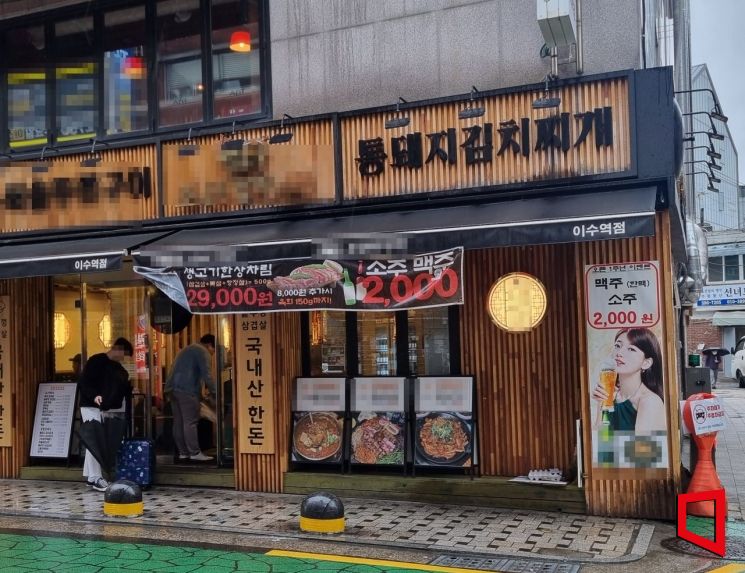 A banner reading "Opening Celebration Soju 2000 won" is hung at the entrance of a bar in Anam-dong, Seongbuk-gu, Seoul.
 [Photo by Sim Seong-a]
Citizens’ reactions are also positive. Lee (27), whom I met in Jegi-dong, Dongdaemun-gu, Seoul, said, “Everything seems expensive these days,” adding, “Since meat prices are high, I want to save on alcohol costs, so I often visit places with discount events.” Son (34) also said, “I have seen places in Gangnam where a bottle of soju costs 10,000 won,” and added, “Neighborhood restaurants competitively sell soju for about 1,500 or 2,000 won, so naturally, I come here.”
Experts explain that this phenomenon is a clear example of the difficult situation in the high inflation era. Professor Hwang Jinju of Seoul National University’s Department of Consumer Science said, “As alcohol prices at restaurants rise, residents may decide it’s better to buy alcohol at a mart rather than visit neighborhood restaurants,” adding, “Therefore, neighborhood eateries and bars seem to have devised a strategy to maintain sales by gathering customers even if it means sacrificing profits.”
Professor Lee Eunhee of Inha University’s Department of Consumer Science also said, “Consumers have long suffered from high inflation,” adding, “There is a tendency to chase ultra-low prices to the extent of purchasing ingredients from Chinese companies like AliExpress and Temu, which have been evaluated as low quality.” She diagnosed, “From a business perspective, it seems they are trying to attract customers by leaving almost no margin.”
© The Asia Business Daily(www.asiae.co.kr). All rights reserved.
![Clutching a Stolen Dior Bag, Saying "I Hate Being Poor but Real"... The Grotesque Con of a "Human Knockoff" [Slate]](https://cwcontent.asiae.co.kr/asiaresize/183/2026021902243444107_1771435474.jpg)
















