Foreign Minister Cho Tae-yul, who visited China for the first time since taking office, described the main outcome of this visit as "frankly sharing differences of opinion (with the Chinese side)." He explained that starting with open dialogue about each other's positions and differences in views could open a new chapter in bilateral relations.
At a press briefing held on the 14th at the Embassy of the Republic of Korea in Beijing for Beijing correspondents, Minister Cho spoke about the meeting held the previous day with Wang Yi, Director of the Foreign Affairs Office of the Communist Party of China and Foreign Minister. He said, "We freely discussed mutual concerns, everyone expressed what they wanted to say, listened carefully, and sought both differences and commonalities. Overall, while acknowledging that there are differences, the most important agreement and achievement was to create new momentum for the development of Korea-China relations and to cooperate going forward."
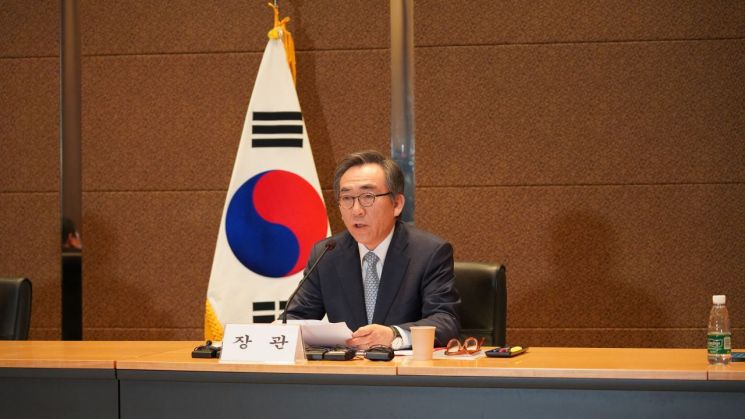 Foreign Minister Cho Tae-yeol is speaking at a press briefing for Beijing correspondents held on the 14th at the Embassy of the Republic of Korea in Beijing, China. (Photo by the Joint Coverage Team of Beijing Correspondents)
He explained, "We also discussed frankly and honestly some issues where there are differences of opinion, reached a consensus on continuing the strategic cooperative partnership based on mutual respect, reciprocity, and common interests, and agreed to maintain strategic communication, including at the high-level, going forward." He also mentioned that he requested Minister Wang Yi to visit Korea within the year.
Regarding the specifics of the 'differences of opinion,' he elaborated, "On a broad level, it concerns conflicts arising between the Korea-U.S. alliance and the Korea-China strategic partnership. More narrowly, we did not hide the gaps between our and China’s core interest issues, discussing the background of each side’s fundamental positions and domestic and international challenges."
When asked about the possibility of a summit between the two heads of state, including Chinese President Xi Jinping’s visit to Korea or President Yoon Suk-yeol’s visit to China, he avoided a direct answer. He said, "The meeting did not specifically mention President Xi’s visit to Korea; it was only discussed at the level of the necessity of mutual visits between the two heads of state. Rather than who visits first, it will proceed in a way that maintains and activates momentum, including the upcoming Korea-Japan-China summit at the end of this month."
Regarding economic cooperation, he explained that he directly conveyed issues such as intellectual property rights raised during a meeting with Korean businesspeople the previous day to Minister Wang. He also mentioned concerns about the Counter-Espionage Law, which could target businesspeople, journalists, and research institutions operating in China, along with investment environment issues.
On sensitive issues with significant differences between the two countries, such as the North Korean nuclear issue, the repatriation of North Korean defectors, and the Taiwan issue, he evaluated that a foundation was laid for future coordination of differences. Minister Cho said, "We said everything we wanted to say regarding the defector issue," and emphasized, "Just as the Taiwan issue is sensitive to China, North Korea and North Korean nuclear-related security issues are core interests for us, so China needs to respect and support our core interests."
In particular, regarding China’s expected 'role' in the North Korean nuclear issue, the Korean government’s stance, he said, "There is a big difference between four to five years ago and now," explaining, "With China’s cooperation, the United Nations Security Council was able to pass four strong North Korea sanctions resolutions led by the U.S. in one year." He added, "At least on the North Korean nuclear issue, cooperation was possible in the past, but now there is the problem of strategic competition between the U.S. and China, so we cannot even adopt a chairman’s statement. The North Korean nuclear issue directly reflects the geopolitical situation in Northeast Asia, so it is difficult to expect much from China’s role."
© The Asia Business Daily(www.asiae.co.kr). All rights reserved.
![Clutching a Stolen Dior Bag, Saying "I Hate Being Poor but Real"... The Grotesque Con of a "Human Knockoff" [Slate]](https://cwcontent.asiae.co.kr/asiaresize/183/2026021902243444107_1771435474.jpg)















