Top 1st and 2nd ETFs Lower Fees
Under 10,000 KRW Fee for 100 Million Investment
Leading and Lowest Fees Spark 'Marketing Keyword Battle'
As the exchange-traded fund (ETF) market rapidly grows, competition among asset management companies to claim the 'lowest fee title' is intensifying. Samsung Asset Management and Mirae Asset Global Investments, which rank first and second in ETF market share, have sparked a fee reduction debate by lowering fees on some ETFs. Small and mid-sized asset managers are concerned that since they already charge the lowest fees, excessive fee cuts could lead to a decline in service quality. They believe that excessive reductions could damage the industry's ecosystem. However, some argue that the fee cuts on specific ETFs by certain asset managers are part of marketing strategies and caution against overinterpretation.
Marketing Keyword Battle for Market Domination
According to the financial investment industry on the 16th, Samsung Asset Management reduced the total expense ratio of four 'KODEX U.S. Representative Index ETFs' from 0.05% per annum to 0.0099% last month on the 19th. This means that when investing 100 million KRW, the fee decreases from 50,000 KRW to 9,900 KRW.
Samsung Asset Management plans to actively encourage long-term installment investments within individual investors' pension accounts by lowering fees. TR-type ETFs, which automatically reinvest dividends, tend to perform better over the long term compared to PR-type ETFs that distribute dividends. They explained that applying the lowest fees to TR-type ETFs, which automatically reinvest dividends, can enhance long-term returns. ETFs related to major U.S. indices such as the S&P 500 and Nasdaq 100 are preferred by institutional investors and individuals as long-term investment products.
Mirae Asset Global Investments lowered the total expense ratio of the 'TIGER 1-Year Bank Negotiable Certificate of Deposit (NCD) Active (Synthetic) ETF' from 0.05% to 0.0098% on the 9th. This ETF calculates the 1-year NCD interest rate on a daily basis and applies compound interest daily. Even investing for just one day allows investors to earn the daily interest of a 1-year NCD. Unlike equity ETFs, interest rate ETFs have lower expected return volatility, so fees and other costs have a significant impact on returns.
A representative from Mirae Asset Global Investments said, "Interest rate cuts have been delayed more than expected, increasing interest in interest rate ETFs," adding, "We expect investors to anticipate higher returns due to fee reductions." They also explained, "Only two large firms have launched 1-year NCD ETFs," emphasizing, "This is not a product competing with small and mid-sized asset managers."
An industry insider said, "There will be no fee reduction competition spreading to thematic ETFs," and explained, "Lowering fees on index and parking-type ETFs is interpreted as an intention to apply fee cuts selectively to passive products with low portfolio manager involvement." They added, "It can be seen as a marketing strategy by large asset managers to increase awareness of overseas products through long-term installment investments."
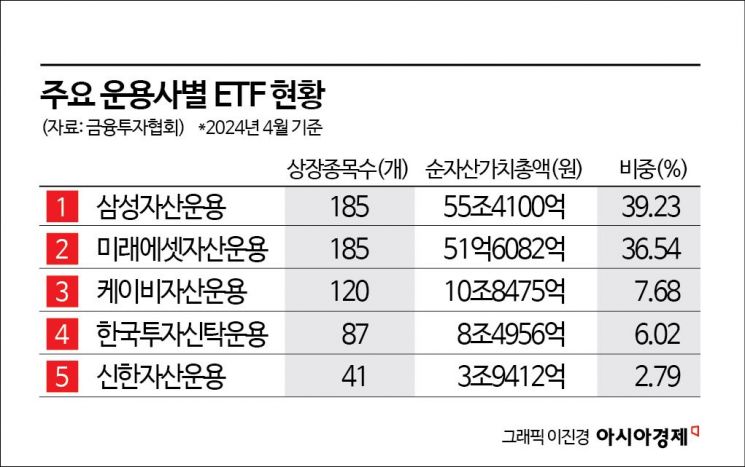
Samsung Asset Management and Mirae Asset Global Investments account for about 76% of the domestic ETF market based on net asset value. Samsung Asset Management leads with a 39% market share, narrowly ahead of Mirae Asset Global Investments at 37%. Being the top asset manager and offering the lowest fees are powerful marketing keywords in the fiercely competitive ETF market.
ETF Market Grows to 140 Trillion KRW... Focus Needed on Product Development
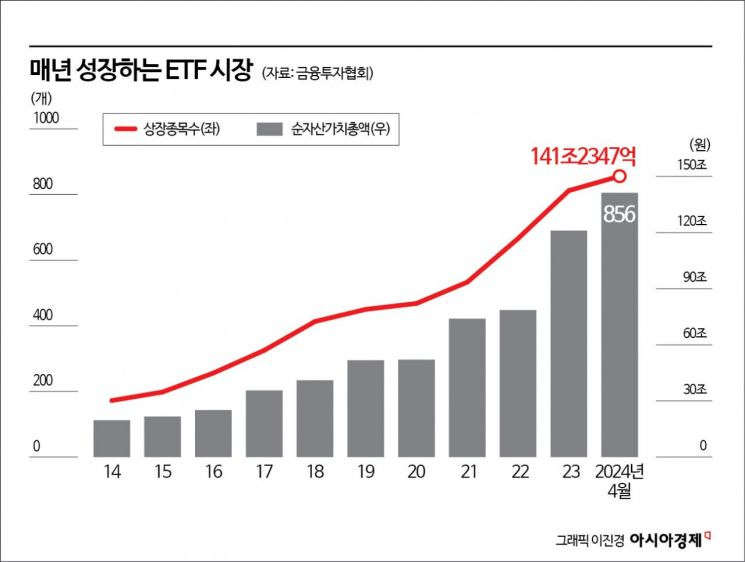
The ETF market size continues to grow day by day. As awareness of ETFs increases, the growth rate has accelerated. The net asset value was below 20 trillion KRW in 2014 but surpassed 140 trillion KRW in April this year. With the public fund market shrinking, asset managers desperately seek new revenue sources by increasing their ETF market share. Although a duopoly has been established, KB Asset Management, Korea Investment Management, and Shinhan Asset Management are raising awareness through aggressive marketing and thematic ETFs.
As competition intensifies, the value of ETF management personnel has increased. Costs to launch various ETF products desired by investors faster than competitors have also risen. This is why there are concerns that fee reduction competition could lead to a decline in service quality. With rising fixed costs including labor costs, if fees charged to investors decrease, the industry may have no choice but to respond with restructuring and launching undifferentiated products. An industry insider pointed out, "The essence of asset management is to create good products through active market research and enhance customer satisfaction through long-term returns," adding, "If leading ETF managers continue fee reduction competition, the foundation of the asset management business itself could be damaged." They further noted, "The average return on equity (ROE) of asset management companies is 11.1%, which has halved compared to the previous year," and expressed concern, "The average ETF fee has already reached a level that sacrifices profits, and lowering it further could lead to a decline in service quality."
Another insider explained, "First-mover advantage is important in the ETF market," and said, "Brand awareness has a significant impact on market share." They added, "Large asset managers have justified fee cuts by promoting long-term investment and improving customer returns," but cautioned, "Since there is precedent, other asset managers may also use the 'fee reduction' card to raise awareness of their flagship products."
As ETFs pursue low-cost, low-volatility products suitable for relatively long-term investment compared to direct investments, fee reductions are expected to be an inevitable trend. The more intense the competition, the more efforts will be made to improve service quality and lower fees. While excessive fee cuts purely for marketing purposes could threaten the industry ecosystem, gradual fee reductions can help the market grow.
The securities industry is also engaged in ongoing competition to lower brokerage commissions. In 2008, many new securities firms emerged rapidly, aggressively lowering fees. At that time, some securities firms even waived selling commissions for customers who incurred losses from stock investments. In 2010, a fee reduction competition occurred to capture the early mobile trading system (MTS) market. Recently, with the increase in overseas stock investors, many securities firms have held events waiving U.S. stock trading fees.
A financial investment industry official said, "There are no signs yet that fee reduction competition will spread across the entire industry," and explained, "Among the approximately 800 ETF products, there is no need to overinterpret fee reductions on some products." They added, "Marketing competition is good, but efforts to develop various ETF products that can expand the overall market are necessary," and urged, "It is time for the asset management industry to engage in fair competition to attract bank deposits into the capital market."
© The Asia Business Daily(www.asiae.co.kr). All rights reserved.


















