Jeju Island Strives to Quell 'Bigae Samgyeopsal' Controversy
"Committed to Enhancing Quality and Safety to Restore Pork's Reputation"
Official Request to Government to Improve Grading System for Black and White Pigs
Controversy has erupted after it was revealed that some meat restaurants in Jeju were selling 'fatty samgyeopsal' filled with excessive fat. In response, Jeju Province announced that it will prepare countermeasures to restore its image.
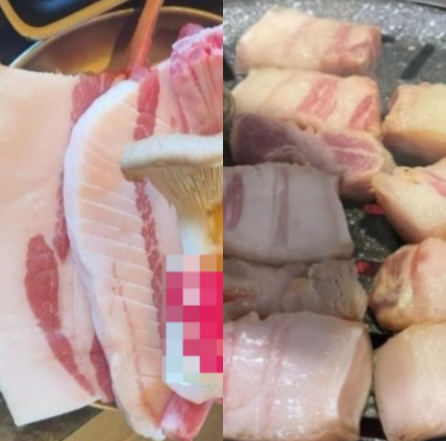 Jeju Island's 'Fatty Samgyeopsal' that sparked controversy among netizens. [Photo by Online Community]
On the 14th, Jeju Province held a briefing to announce measures to regain its reputation regarding the 'Jeju fatty samgyeopsal' controversy. Previously, on the 29th of last month, an online community publicized that a tourist visiting Jeju received samgyeopsal filled with fat, which sparked a series of issues concerning the quality of Jeju samgyeopsal, leading to widespread debate.
Kang Jae-seop, Director of Jeju Province's Agriculture, Livestock, and Food Department, stated, "We will strive to enhance the quality and safety of Jeju pork to restore the reputation of Jeju pork." He added, "In particular, we will work to improve the system so that grading standards for black pork meet consumer expectations." The pork quality management manual, which was previously a recommendation, will now include guidelines on removing excess fat from raw samgyeopsal, packaging samgyeopsal in small portions, and fat trimming to prevent such mistakes by local restaurants and distributors. They also pledged to actively educate stakeholders to adhere to standards at every stage of production, distribution, and sales.
Jeju Province also reported that it recently completed administrative guidance for 274 local pork-selling restaurants, butcher shops, and meat processing companies. At the production stage before distribution, they plan to encourage livestock farms to provide finishing feed during the late fattening period before shipment. Efforts will be made to produce uniform, high-quality livestock products through standardized weight shipments. During distribution, meat processing companies will be managed to properly remove excess fat from samgyeopsal before supplying to restaurants or retail stores. At the sales stage, restaurants and butcher shops will check for excess fat and remove it thoroughly before delivering to consumers. They also emphasized to merchants the importance of actively assisting with exchanges and refunds if consumer complaints arise.
The pork mainly sold in Jeju is black pork. Since black pork genetically has a higher fat ratio than white pork, grading based on the same carcass weight results in thicker fat layers, posing a challenge. To address this, Jeju Province stated, "Because black pork has a lower rate of first-grade appearance compared to regular pork, it is necessary to adjust grading standards reflecting genetic characteristics," and announced plans to officially request the government to improve the pig grading system. Additionally, Jeju Province added that starting next month, they will hold events and tasting sessions promoting Jeju pork consumption among residents to restore consumer trust.
Earlier, Jeju Governor Oh Young-hoon also expressed an apology regarding the fatty samgyeopsal issue. Governor Oh said, "There is a need to strengthen guidance and supervision by the hygiene and livestock departments, which have authority over restaurants," and added, "We are considering measures such as enhancing publicity to prevent such problems from recurring." However, he also noted, "It is difficult to excessively intervene in business operations conducted at the private level," and argued, "We must also consider that there may be differences in food culture itself."
Jeju Samgyeopsal at 17,000 KRW 'Nationwide No.1'... Cheapest in Ulsan
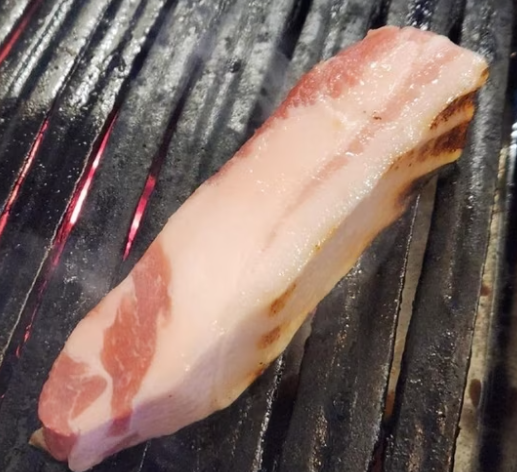 Samgyeopsal sold at a meat restaurant in Daegu. The fat is visibly abundant.
 [Photo by Online Community]
Meanwhile, the price of samgyeopsal in Jeju, which is suffering from the fatty samgyeopsal controversy, was found to be the highest nationwide. According to the Ministry of the Interior and Safety's dining price information on the 10th, as of the most recent statistics in March, the average price of one serving (100~250g) of samgyeopsal in Jeju was set at 17,000 KRW. This is the highest price among all cities and provinces nationwide, marking a 1.5% increase from 16,750 KRW recorded in December last year, four months earlier.
The nationwide average price for samgyeopsal is 13,086 KRW, with Seoul ranking second highest after Jeju at an average of 16,615 KRW. The region selling samgyeopsal at the lowest price is Ulsan, with an average price of 10,000 KRW.
However, if the price is calculated based on a fixed serving size of 200g, the rankings between Jeju and Seoul change. Seoul's price is 19,981 KRW, while Jeju's is 17,444 KRW. This means that when selling samgyeopsal portions under 200g, Jeju sells at a higher price than Seoul.
© The Asia Business Daily(www.asiae.co.kr). All rights reserved.


















