10th Place Drops One Rank in Top 500 Performance Rankings
Impact of KISTI Unit 6 Introduction Delay
China Reluctant to Disclose Information, Resulting in Rank Decline
Amid fierce global competition to secure supercomputers, it has been revealed that we have failed to make progress.
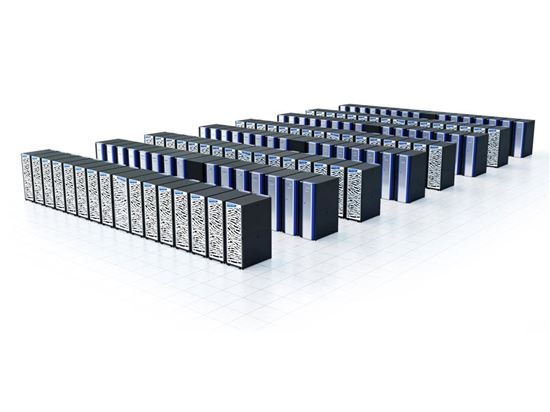 ▲Perspective view of Supercomputer No. 5.
 [Photo by KISTI]
According to the Korea Institute of Science and Technology Information (KISTI), the 'TOP500' global supercomputer ranking announced on the 13th (local time) showed that the 'Frontier' at Oak Ridge National Laboratory (ORNL), under the U.S. Department of Energy, secured first place for the third consecutive year. Frontier, based on AMD CPUs, has a measured performance of 1.206 exaFLOPS (EF), capable of performing 12.06 quadrillion calculations per second.
Also under the U.S. Department of Energy, the Argonne National Laboratory's Aurora maintained its second place from last year, recording a measured performance of 1.012 exaFLOPS (EF), officially becoming the second supercomputer to surpass the exascale barrier. Aurora is built with Intel CPUs.
Third place was taken by Microsoft Azure's 'Eagle,' while Japan's RIKEN and Fujitsu jointly developed 'Fugaku' and Finland's CSC (Finnish IT Center for Science) 'LUMI' ranked fourth and fifth respectively again this year.
A new face in the top 10 was the Swiss National Supercomputing Centre (CSCS)'s 'Alps,' which ranked sixth.
The rankings of domestic supercomputers all declined. Naver's Sejong, which ranked 22nd in November last year, dropped to 25th; Samsung Advanced Institute of Technology's SSC-21 fell from 32nd to 82nd, SSC-21 Scalable Module ranked 470th; Korea Meteorological Administration's GURU dropped from 47th to 58th and MARU from 48th to 59th; KISTI's 5th supercomputer Nurion fell from 61st to 75th; KT's KT DGX SuperPOD dropped from 72nd to 90th. Kakao Cloud entered the rankings newly with two units at 44th and 70th, but IBS's supercomputer fell out of the rankings.
In the TOP500 rankings, the U.S. accounted for 53.6% of performance, Japan 8.2%, and Finland 4.8%, together making up 66.6% of total performance. In terms of quantity, the U.S. had 169 units (33.8%), China 80 units (16.0%), and Germany 40 units (8.0%).
South Korea ranked 7th in the number of supercomputers owned by country with a total of 13 units, and 10th in total performance with 186.4 petaFLOPS (PFlops). Compared to the announcement in November last year, the number of units increased by one, but the performance ranking dropped by one place. The introduction of the country's 6th national supercomputer has faced difficulties due to rising GPU prices, causing delays in prompt response, raising concerns that the decline in domestic supercomputer rankings will continue for the time being.
KISTI National Supercomputing Center Director Lee Sik said, “Currently, supercomputers are essential for the continuous advancement of science and technology, strengthening industrial competitiveness, and enhancing national competitiveness,” adding, “KISTI will continue to provide stable national supercomputer services and do its best for the development of science and technology in the Republic of Korea.”
Meanwhile, although Chinese supercomputers performed poorly in this ranking, the prevailing analysis is that this cannot be taken at face value. Due to U.S. semiconductor export restrictions, China is reluctant to disclose detailed information and is developing supercomputers using domestically developed CPUs and GPUs, according to industry-wide views. There are already concerns that China may have surpassed the exascale barrier as well.
© The Asia Business Daily(www.asiae.co.kr). All rights reserved.
















