The Korea Forest Service is advancing its landslide prediction and response activities. The core of this effort is to integrate and manage landslide risk slope information, which had been separately managed by each ministry, to eliminate blind spots in landslide prediction and to secure the golden time for resident evacuation by refining prediction information.
On the 14th, the Korea Forest Service announced the "2024 Landslide Prevention Measures" with these details.
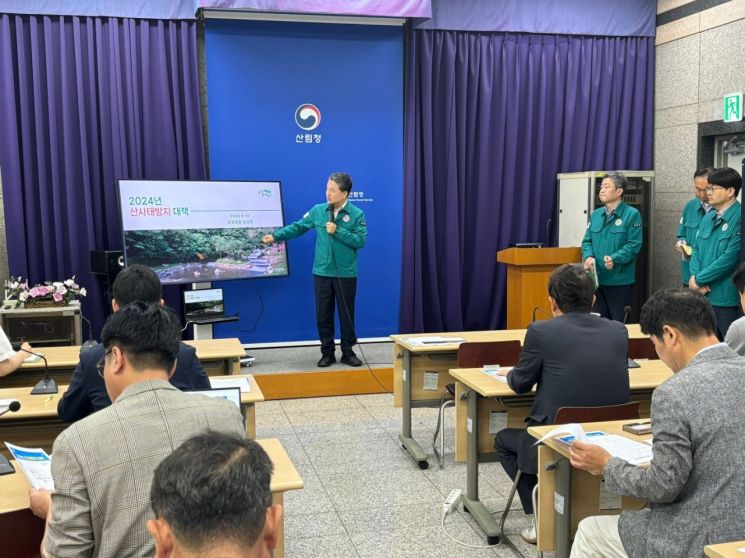 Nam Seong-hyun, the Commissioner of the Korea Forest Service, is announcing the '2024 Landslide Prevention Measures' at the Government Complex Daejeon on the 14th. Photo by Jeong Il-woong jiw3061@
This year's landslide prevention measures focus on ▲establishing a digital-based integrated multi-ministry risk slope management system ▲securing additional evacuation time for residents based on forest science ▲eliminating observation blind spots and improving landslide prediction accuracy ▲expanding landslide vulnerable areas and preemptively preventing risk factors.
According to the landslide prevention measures, the Korea Forest Service will integrate and manage risk slope information, which had been individually managed by ministries such as the Ministry of the Interior and Safety (steep slopes), Ministry of Land, Infrastructure and Transport (road slopes), Ministry of Agriculture, Food and Rural Affairs (farmland), Ministry of Trade, Industry and Energy (power facilities), and Cultural Heritage Administration (cultural assets), into the "Digital Slope Integrated Landslide Information System."
Based on this system, the Korea Forest Service established the "Digital Landslide Response Team" last month together with the Ministry of the Interior and Safety, Ministry of Land, Infrastructure and Transport, and Ministry of Agriculture, Food and Rural Affairs to build an integrated multi-ministry risk slope management system. The response team will operate until March 2026.
Starting this year, "landslide prediction information" will be subdivided from two stages (advisory and warning) to three stages (advisory, preliminary warning, and warning). Additionally, about one hour of extra evacuation time will be secured, and prediction information, which was previously provided via text messages, will also be sent through KakaoTalk to enable rapid evacuation of residents in landslide risk areas.
Separately, through the landslide information system, a system will be established to automatically send landslide prediction information to local officials when soil moisture reaches a certain level.
The system will determine landslide risk levels based on the maximum amount of water the soil can hold, notifying the situation as "advisory" when the soil moisture index reaches 80%, "preliminary warning" at 90%, and "warning" at 100%.
The Korea Forest Service plans to increase the number of mountain weather observation equipment installation sites nationwide from 480 to 496 by the end of this year. This aims to enhance the accuracy of landslide prediction by strengthening mountain weather data collection.
Furthermore, to monitor and respond in real time to the shape of forest valleys and the amount of water flowing through them, the Korea Forest Service emphasized that it will sequentially establish forest watershed digital maps and flow observation networks by 2027.
Landslide vulnerable areas will also be expanded, focusing on residential zones. By expanding landslide vulnerable areas around residential zones, it will be possible to conduct intensive management such as on-site inspections more than twice a year, safety measures, and prioritizing prevention projects. Currently, about 29,000 landslide vulnerable areas are designated nationwide.
Nam Sung-hyun, Administrator of the Korea Forest Service, stated, "We will minimize landslide damage by strengthening multi-ministry collaboration such as integrated risk slope management, sharing disaster management resources, and joint inspections of landslide-prone areas. We ask the public to evacuate without hesitation when receiving emergency disaster alerts during typhoons, heavy rains, and other risk periods."
© The Asia Business Daily(www.asiae.co.kr). All rights reserved.

















