US Conveys Concerns Over Military Use of AI to China
On the 14th (local time), the United States and China will meet in Geneva, Switzerland, to discuss for the first time measures to mitigate risks arising from the development of artificial intelligence (AI) technology. As the two countries compete for AI technological supremacy, the purpose is to discuss military risks and other concerns before AI reaches a level that threatens humans. This is significant as the first meeting between the two major powers (G2) aimed at reducing the risk of misjudgments related to AI technology.
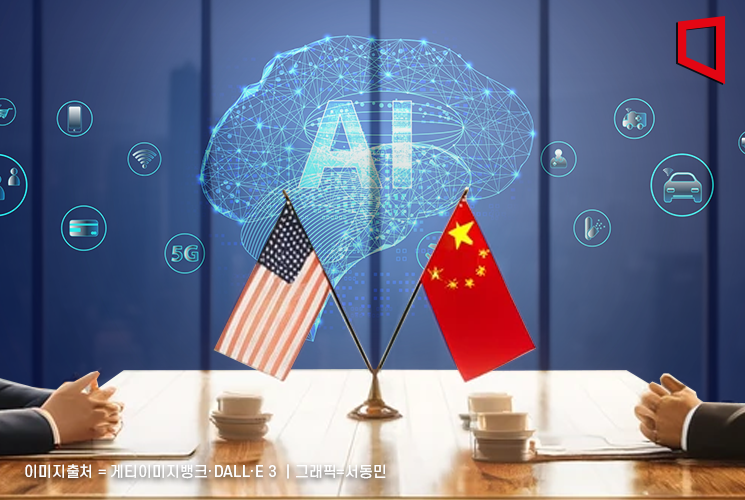
On the 13th, the White House announced that U.S. and Chinese government officials will meet in Geneva on the 14th to exchange views on solutions to the risks posed by advanced AI systems.
This meeting is the first since U.S. President Joe Biden and Chinese President Xi Jinping agreed last November to establish an AI consultation mechanism. In this regard, U.S. Secretary of State Antony Blinken and Chinese Foreign Minister Wang Yi also met last month in Beijing to agree on holding the first official bilateral talks on AI.
From the U.S. side, Tarun Chhabra, Special Assistant to the President and Senior Director for Technology and National Security at the White House, and Seth Centner, Acting Special Representative for Critical and Emerging Technology at the State Department, will lead an interagency delegation including officials from the White House, State Department, and Department of Commerce.
The U.S. plans to convey concerns about the military use of AI to China during the meeting. Previously, the U.S. has pressured China and Russia to join its declaration that only humans can make decisions regarding the deployment of nuclear weapons. The U.S. has particularly raised concerns that China is attempting to use AI in the development of advanced weapons, including nuclear arms.
A U.S. government official said in a pre-briefing, "China is rapidly deploying AI capabilities across civilian, military, and national security sectors, often undermining the security of the U.S. and its allies," adding, "Through this meeting, the U.S. will be able to directly communicate these concerns." The official further emphasized, "It is clear that talks with China are not focused on any form of technological cooperation or enhancing advanced research collaboration," and reiterated, "Our technology protection policies are not subject to negotiation."
The U.S. is also strengthening AI regulations targeting China. Following controls on exports of advanced AI semiconductors to China, it is considering establishing guardrails to prevent the sale of key AI software (SW) such as ChatGPT to China.
However, since this is the first AI meeting between the U.S. and China, it is uncertain whether concrete agreements or outcomes will be reached. It is likely that the talks will conclude at the level of broad exchanges of views and the establishment of communication channels regarding AI.
Another U.S. government official stated, "Both the U.S. and China are competing to create AI regulations while also wanting to see if these regulations can be accepted by all countries," emphasizing, "Although there is not agreement on many AI discussions, we believe that communication about significant AI risks can make the world safer."
© The Asia Business Daily(www.asiae.co.kr). All rights reserved.
![Clutching a Stolen Dior Bag, Saying "I Hate Being Poor but Real"... The Grotesque Con of a "Human Knockoff" [Slate]](https://cwcontent.asiae.co.kr/asiaresize/183/2026021902243444107_1771435474.jpg)















