Observed in the Dawn Sky of Hwacheon-gun on the 12th
A spectacular space show featuring 'auroras' appeared around the world due to a recent powerful solar storm. It has been confirmed that auroras were observed in South Korea for the first time in over 20 years as a result of this solar storm.
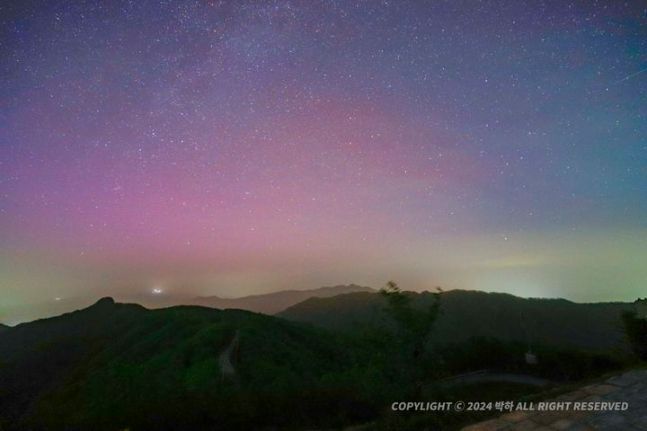 The aurora captured by astronomer Park Jeong-ha from the Yongin Children's Observatory on the 12th in Hwacheon, Gangwon Province.
 [Photo by Korea Astronomy and Space Science Institute, Yonhap News]
On the 13th, Yonhap News reported photos of auroras released by the Korea Astronomy and Space Science Institute. The auroras were photographed the previous day in Hwacheon, Gangwon Province, by amateur experts Park Jeong-ha and Shim Hyeong-seop, members of the Yongin Children's Astronomy Observatory.
In the released photos, the auroras spread widely across the sky against the backdrop of dark mountains. The purple and yellow hues create a picturesque scene. The colors are distinctly different from those of an evening sunset, presenting a magnificent spectacle.
Auroras are rarely visible in mid-latitude regions like the Korean Peninsula, which are far from the polar areas. The last time auroras were captured in South Korea was about 21 years ago, on October 30, 2003, when red auroras were observed at Bohyeonsan Optical Astronomy Observatory. At that time, a powerful solar storm also struck the Earth.
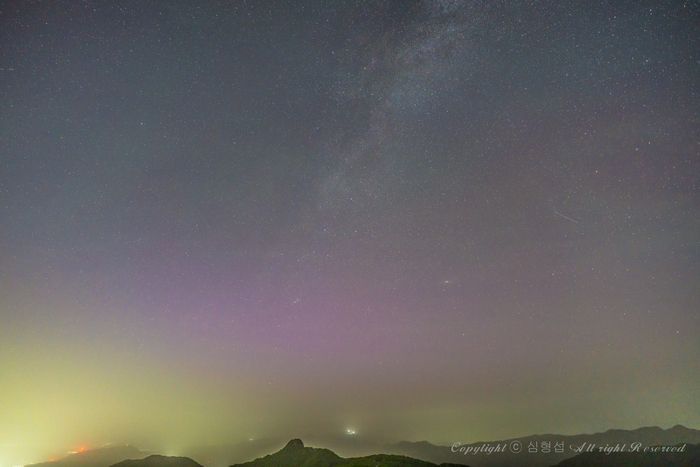 Aurora photographed by Shim Hyung-seop from Yongin Children's Observatory in Hwacheon-gun, Gangwon Province on the 12th.
 [Photo by Korea Astronomy and Space Science Institute, Yonhap News]
Auroras are colorful lights produced when high-energy particles ejected from solar surface explosions are guided by Earth's magnetic field toward the polar regions and interact with the Earth's atmosphere. They occur in ring shapes centered around Earth's magnetic poles, known as the 'auroral oval.'
According to the U.S. National Oceanic and Atmospheric Administration (NOAA) Space Weather Prediction Center (SWPC), on the 10th (local time), a G5-class geomagnetic storm?the strongest level?reached Earth, causing auroras displaying purple, green, yellow, and pink colors to appear worldwide in countries including Germany, Switzerland, China, the United Kingdom, Spain, and New Zealand. On the 10th, OWL-Net Unit 4 located at Mount Lemmon in the United States captured the aurora, and on the 11th, Unit 1 in Mongolia also recorded it.
The Korea Astronomy and Space Science Institute also photographed the auroras using its own space object electro-optical surveillance system (OWL-Net) operated at Mount Lemmon, Arizona, USA. Additionally, red auroras were observed with an all-sky camera for atmospheric light observation installed at the ionosphere and upper atmosphere observation system (TIMOS) at Bohyeonsan Optical Astronomy Observatory.
The institute explained, "One of the reasons for the frequent observation of auroras is solar activity," adding, "Solar activity follows an average 11-year cycle of intensification and weakening, and it is predicted that solar activity will reach its peak next year."
© The Asia Business Daily(www.asiae.co.kr). All rights reserved.
![Clutching a Stolen Dior Bag, Saying "I Hate Being Poor but Real"... The Grotesque Con of a "Human Knockoff" [Slate]](https://cwcontent.asiae.co.kr/asiaresize/183/2026021902243444107_1771435474.jpg)
















