Successful Shooting by Private Astronomers in Hwacheon
Celes. Res. Equip. Also Observed
Our research team and astronomers also observed the aurora that occurred globally in an unusual event. While expectations are growing that the aurora can be seen directly in Korea, the possibility is not expected to be high.
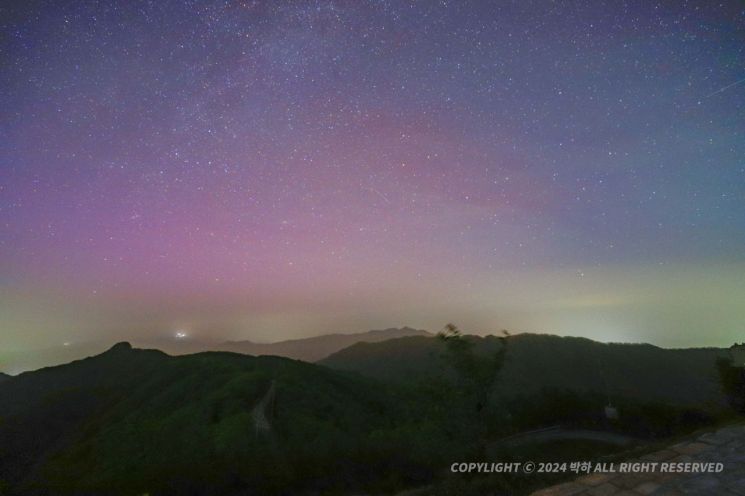
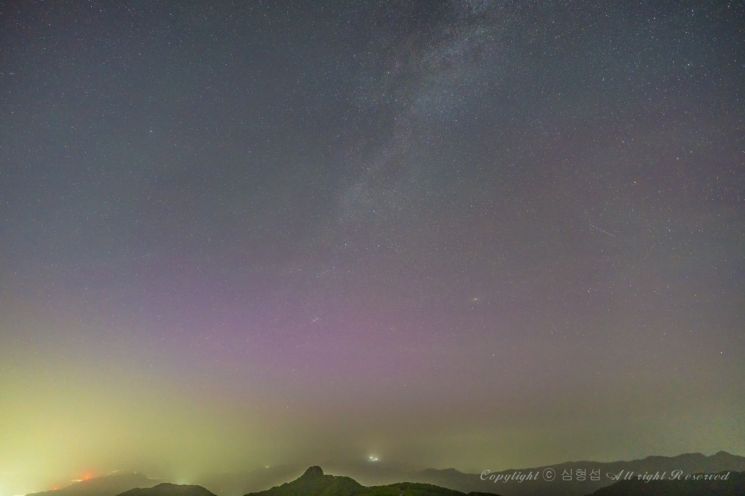
On the 13th, the Korea Astronomy and Space Science Institute reported that Park Jeong-ha and Shim Hyeong-seop from the Yongin Children's Observatory succeeded in photographing the aurora that spread over the Korean Peninsula on the 12th in Hwacheon, Gangwon Province. This is the first time an aurora has been observed over the Korean Peninsula since October 30, 2003.
Due to a powerful solar storm that occurred after 21 years, auroras were observed in mid-latitude regions worldwide, not just in polar areas, and the aurora was visible domestically as well.
The Korea Astronomy and Space Science Institute's space object electro-optical monitoring system (hereafter OWL-Net, Optical Wide-field patroL Network) also captured and photographed the aurora. OWL-Net Unit 4, located at Mount Lemon in the United States, observed the aurora on the night of May 10 (local time), and OWL-Net Unit 1, located in Mongolia, observed it on the night of May 11 (local time).
The all-sky camera for atmospheric light observation of the Thermosphere-Ionosphere-Mesosphere Observing System (hereafter TIMOS), installed at Bohyunsan Optical Astronomy Observatory of the Korea Astronomy and Space Science Institute, also captured red auroras in the northern high-latitude direction.
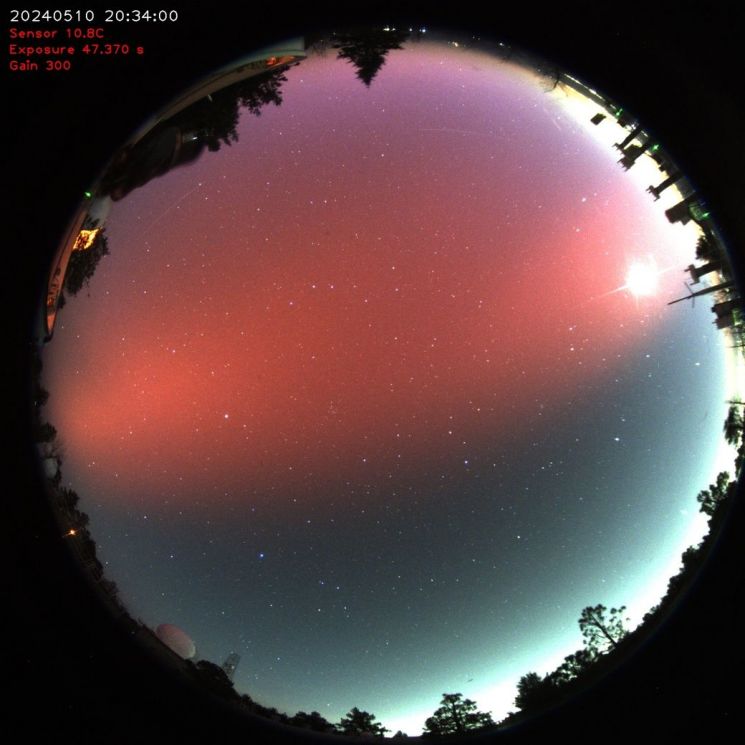 Aurora observed by the Space Object Electro-Optical Surveillance System (OWL-Net) Unit 4 located in Lemon San, USA. Photo by Korea Astronomy and Space Science Institute
On the early morning of the 10th, the Korea Astronomy and Space Science Institute confirmed a sharp decrease in cosmic ray levels using the neutron monitor located at Gamaksan Mountain. The neutron monitor is equipment that observes cosmic rays entering from outside the Earth on the ground, and the stronger the solar activity, the more the influx of cosmic rays decreases.
The aurora is light emitted when high-energy particles ejected by explosions on the sun's surface are trapped by Earth's magnetic field and guided down to the polar regions, reacting with Earth's atmosphere. Green and red auroras are light emitted by oxygen atoms, and occasionally, the purple aurora seen at the very bottom is light emitted by nitrogen molecules.
The Korea Astronomy and Space Science Institute predicted that since the amount of solar particles is decreasing, it will be difficult to observe the aurora from the night of the 13th. They explained that even if the aurora occurs, it will likely only be visible through photography.
© The Asia Business Daily(www.asiae.co.kr). All rights reserved.
![Clutching a Stolen Dior Bag, Saying "I Hate Being Poor but Real"... The Grotesque Con of a "Human Knockoff" [Slate]](https://cwcontent.asiae.co.kr/asiaresize/183/2026021902243444107_1771435474.jpg)

















