Restaurants subject to the Food Sanitation Act are illegal
Illegal street stalls become legal if road occupancy fees are paid
Near Exit 4 of Jongno 3-ga Station in Jongno-gu, Seoul, around 9 p.m. on the 12th, shouts of "Watch out for cars!" could be heard everywhere. At the makeshift tables spread out on the sidewalks, many people of all ages were sitting in groups, drinking. Behind them, cars were passing by precariously. Vehicles swerved over the center line to avoid pedestrians and tables, performing nerve-wracking maneuvers. Citizen Han Ji-seon (21) said, "Even elderly people with mobility difficulties were passing by, and it looked dangerous." Hyun Ah-young (21) added, "I came here after seeing it on Instagram and thinking the atmosphere was nice, but I didn't expect it to be such a dangerous environment."
The area around Jongno 3-ga Station has become famous for its 'pojangmacha culture' through social networking services (SNS), attracting more visitors. Meanwhile, as the sidewalks have been filled with makeshift tables, pedestrian pathways have disappeared, forcing people to walk on the road, creating a daily hazardous situation.
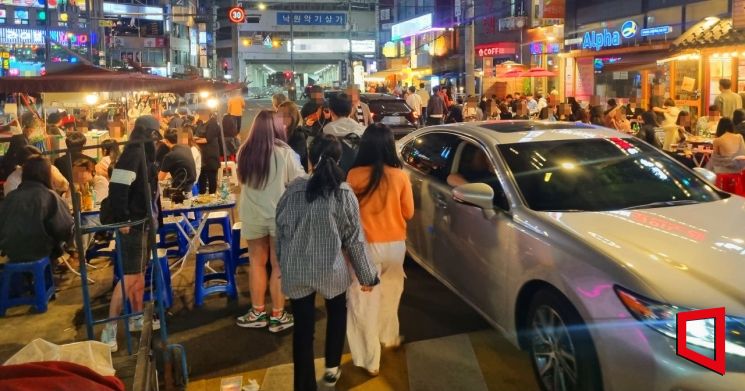 Around 9 p.m. on the 12th, the pojangmacha street located near Jongno 3-ga Station in Jongno-gu, Seoul. Pedestrians and vehicles are moving mixed together, avoiding the pojangmacha tables occupying the road.
 [Photo by Seongah Sim]
This pojangmacha street began to form in 2010 when street vendors along Jongno Boulevard were relocated according to Seoul city policy. The city allowed businesses to operate under agreements permitting up to four tables per pojangmacha. However, as visitors increased, nearby restaurants also began setting up makeshift tables outside, causing problems.
Most of the sidewalks in this area have been occupied by pojangmacha and restaurant tables, leaving no space for pedestrians. As a result, many visitors have been forced to walk on the road instead of the sidewalk, creating daily dangerous situations. According to Jongno District Office on the 14th, there were 22 online complaints about traffic inconvenience caused by outdoor tables from January to March this year, 75 in April, and 24 from May 1 to 10. Additionally, about three phone complaints per day were recorded.
In response, Jongno District has started intensive crackdowns from May to June to secure safe passageways in the pojangmacha street. Under the current Food Sanitation Act, restaurants are prohibited from outdoor operations on rooftops, terraces, platforms, or outdoor tables that are not registered as business spaces. If these rules are violated, resulting in complaints or violations of other laws such as the Road Traffic Act, administrative actions are taken sequentially: correction orders → 7-day business suspension → 15-day → 30-day → business license cancellation, regardless of legal penalties.
However, these regulations do not apply to pojangmacha, leading to criticism that the rules are only half-hearted. A pojangmacha vendor who has been operating here for 15 years said, "As long as we follow the rules set by the local government (allowing up to four tables per pojangmacha), there is no problem," and added, "The real problem is restaurants spreading dozens of tables on the sidewalks." In fact, if a pojangmacha registers with the district office, it can pay a fixed annual fee as a road occupancy charge and install tables within regulations without issues.
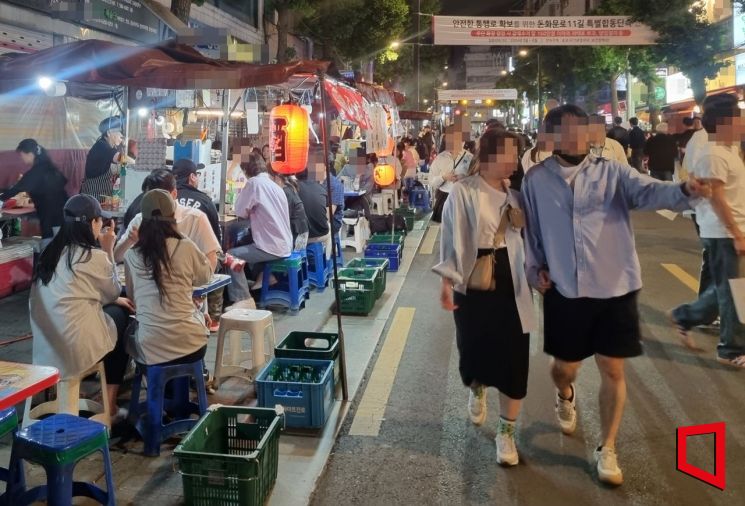 Around 9 p.m. on the 12th, the sidewalk near Jongno 3-ga Station in Jongno-gu, Seoul, was filled with street vendor stalls and makeshift tables, causing people to walk on the road.
 [Photo by Seong-A Shim]
This is why restaurant owners’ complaints never cease. In the spring, when customers flock to the street famous for 'Yajang' (outdoor table drinking establishments), there is growing resentment over crackdowns targeting only restaurants. Jongno District plans to promote a 'coexistence street creation project' after the crackdown period, including turning one lane into a 'car-free road,' but this remains a 'distant story' for restaurants.
A pub owner said, "We have revitalized this street over several years, but if crackdowns continue like this, the street's commercial district will inevitably die and be difficult to revive," and questioned fairness, saying, "Unlike restaurants that pay taxes, pojangmacha do not pay taxes and are not subject to crackdowns." Jang Mo, who has operated a bar here for over 30 years, also pointed out, "Leaving pojangmacha as they are while killing self-employed business owners is unacceptable," and added, "Even two months of crackdowns will spread through SNS among young people, reducing foot traffic. Calling this a 'coexistence street' is actually an act to kill the commercial district."
Experts emphasize the need to secure pedestrian safety while finding ways to coexist with merchants. Lim Jae-kyung, senior researcher at the Korea Transport Institute, said, "First, we need to secure minimum pedestrian safety and gradually manage pedestrian obstacles within the institutional framework." Kim Ui-soo, professor of Safety Engineering at Korea National University of Transportation, advised, "We need to institutionalize measures to guarantee at least pedestrian safety and have experts, local governments, and merchants work together to find ways to coexist."
© The Asia Business Daily(www.asiae.co.kr). All rights reserved.
![Clutching a Stolen Dior Bag, Saying "I Hate Being Poor but Real"... The Grotesque Con of a "Human Knockoff" [Slate]](https://cwcontent.asiae.co.kr/asiaresize/183/2026021902243444107_1771435474.jpg)

















