Gwangsan-gu's 21 neighborhoods in Gwangju Metropolitan City will be reborn as 'village governments' that directly envision a better future with residents and implement changes.
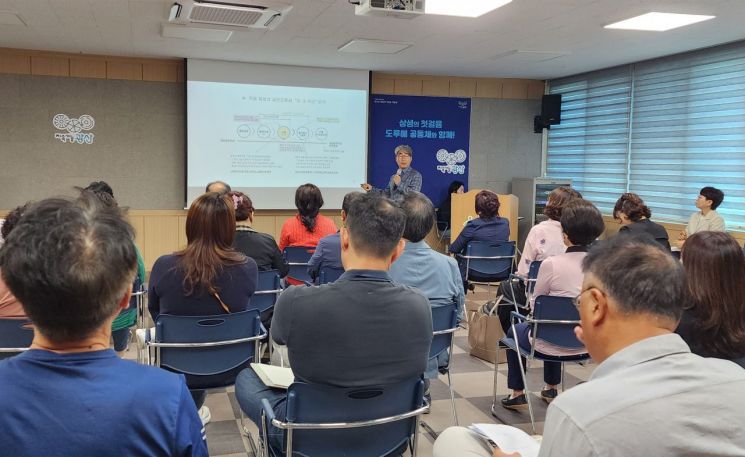
Gwangsan-gu announced that its 21 neighborhoods will actively establish 'Neighborhood Future Development Plans' to autonomously enhance local value and seek development measures that improve residents' lives.
The establishment of the 'Neighborhood Future Development Plan' is the first approval of the year in Gwangsan-gu and a core policy for realizing 'Gwangsan-type decentralized autonomy.' The aim is to elevate neighborhoods, which are the closest entities to residents, to 'village governments,' and to build a cooperative system among residents, village communities, and administration to create mid- to long-term development plans that reflect the characteristics and identity of each neighborhood.
To formulate the plans, each neighborhood is recruiting and organizing resident participation groups. These groups autonomously set the neighborhood’s future vision and develop action plans through lectures, thematic discussions, and joint training (workshops). The resident participation groups are open to anyone living in the neighborhood, including members of various social organizations, village communities, and local activists.
Among the 21 neighborhoods in Gwangsan-gu, Dosan-dong has completed the formation of its resident participation group and began activities on the 13th. Sinchang-dong and Cheomdan 1-dong will also start establishing their Neighborhood Future Development Plans, beginning with expert training.
Gwangsan-gu plans to form an expert advisory group to support the smooth operation and activities of the resident participation groups in each neighborhood. The focus will be on laying the foundation to identify the characteristics and identity of each neighborhood and linking tasks for improving living environments to policies. In particular, the goal is to secure connectivity between the Neighborhood Future Development Plans and district administration, establishing a system where the mid- to long-term visions of the 21 neighborhoods expand into Gwangsan-gu’s policies and projects.
Park Byeong-gyu, Mayor of Gwangsan-gu, stated, “The Neighborhood Future Development Plan will serve as a model of bottom-up decentralized autonomy where residents’ ideas are realized as district policies,” and added, “We will do our best to implement Gwangsan-type decentralized autonomy, where the 21 neighborhoods become ‘living district offices’ that encourage residents to contemplate their future and directly create change.”
© The Asia Business Daily(www.asiae.co.kr). All rights reserved.
![Clutching a Stolen Dior Bag, Saying "I Hate Being Poor but Real"... The Grotesque Con of a "Human Knockoff" [Slate]](https://cwcontent.asiae.co.kr/asiaresize/183/2026021902243444107_1771435474.jpg)















