"Yen-Dollar Exchange Rate Below 150 Yen Attracts Foreign Investors Back"
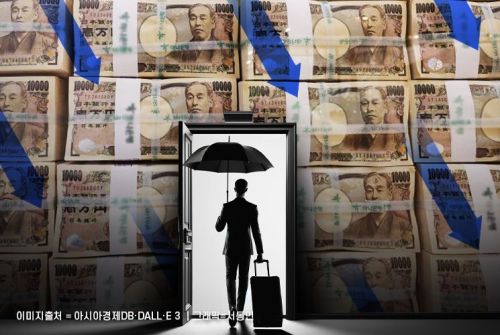
As the yen continues to weaken, foreign investors are withdrawing from the Japanese stock market, BlackRock, the world's largest asset management firm, revealed on the 12th (local time).
The Nikkei 225, the representative index of the Japanese stock market, has risen 14% this year. However, for dollar-based investors, Bloomberg reported that the gains were limited to 3% due to the yen's value falling to its lowest level against the dollar in 34 years. In contrast, the S&P 500 index rose 9.5% this year, and the Hong Kong Hang Seng index posted an 11% return in dollar terms.
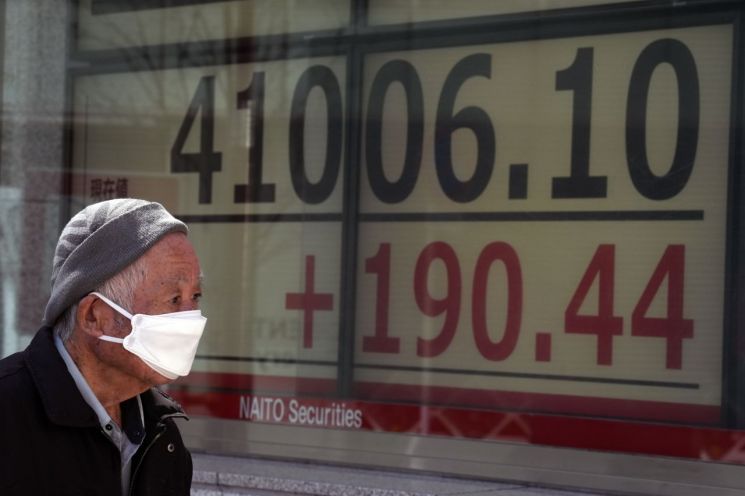 On March 22, a passerby was looking at a stock market ticker board installed in downtown Tokyo, Japan. On that day, Japan's representative stock index, the Nikkei 225 average price (Nikkei index), surpassed the 41,000 mark during trading hours. [Image source=Yonhap News]
Yu? Bamba, Head of Active Investment at BlackRock Japan, said in an interview with Bloomberg, "If the currency continues to weaken, investing in Japanese stocks becomes more difficult," adding, "When talking to global investors about Japan, everyone definitely prioritizes foreign exchange (FX)."
The yen's weakness has traditionally boosted the profits of export companies that have driven the Japanese stock market. However, concerns that the weak yen increases the burden of consumer spending and corporate import costs in Japan have caused the Nikkei index to fall more than 6% from its peak.
Recently, signals that the U.S. Federal Reserve's (Fed) rate cuts will be delayed have caused the yen's value to decline. Bamba said the future value of the yen will be influenced more by the Fed than by the Bank of Japan (BOJ). He predicted that if the Fed does not cut rates, the yen-dollar exchange rate could retreat to around 170 yen per dollar. However, if the Fed cuts rates, a level of 130 to 135 yen is also possible. A decline in the yen-dollar exchange rate means an appreciation of the yen.
On the 10th, the yen-dollar exchange rate was around 155.4 yen. Bamba said the yen is undervalued and that its appropriate value is much higher than the current level. He stated, "Simply put, the appropriate level is in the 130 yen range," and added, "If the yen-dollar exchange rate falls below 150 yen, overseas investors will return to the market."
With the yen recently falling to its lowest level in 34 years, there is speculation that the Japanese government intervened in the market twice. Bamba believes that the yen's weakness is a "political headache" because it negatively affects the country and consumer living costs, so efforts to maintain the yen's value may continue. He also sees the possibility of the BOJ raising interest rates in July or October. Bamba forecasted that the timing of rate hikes could be brought forward due to a clear shift in the BOJ Governor Kazuo Ueda's recent stance on monetary policy.
Other investors also expect the BOJ to raise rates to support the yen's appreciation. Vanguard Group predicts Japanese interest rates will rise to 0.75% by the end of the year. Pacific Investment Management expects three hikes of 0.25% each. On the other hand, hedge funds are betting on a weak yen.
Bamba holds a long-term positive view on Japanese stocks. Although macro factors such as Middle East geopolitical conflicts and the Fed's hawkish stance have weakened risk asset appetite, he explained that market fundamentals remain strong due to corporate reforms, domestic investment in Japan, and wage increases.
© The Asia Business Daily(www.asiae.co.kr). All rights reserved.
![Clutching a Stolen Dior Bag, Saying "I Hate Being Poor but Real"... The Grotesque Con of a "Human Knockoff" [Slate]](https://cwcontent.asiae.co.kr/asiaresize/183/2026021902243444107_1771435474.jpg)
















