Last Month's Exchange Rate Reached 1,400 Won Intraday, Now Down to 1,370 Won Range
Influenced by Expectations of US Interest Rate Cuts and Foreign Exchange Authorities' Intervention Willingness
Forecasted to Drop to Early to Mid 1,300 Won Range in Second Half of the Year
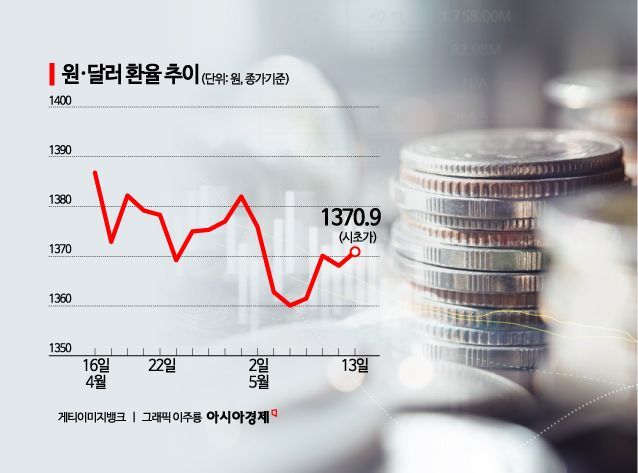
The won-dollar exchange rate, which once approached 1,400 won, has recently been stabilizing in the mid-to-high 1,300 won range. This is due to a pause in the dollar's strength and a stronger commitment from foreign exchange authorities to stabilize the exchange rate. While the market expects the exchange rate to stabilize further in the second half of the year, uncertainties such as delayed U.S. interest rate cuts and expanding geopolitical risks remain significant.
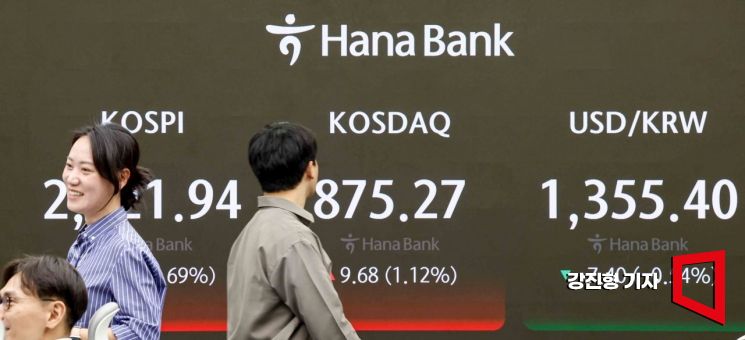
On the 13th, the won-dollar exchange rate opened at 1,370.9 won, up 2.8 won from the previous trading day, in the Seoul foreign exchange market. As of 9:55 a.m., it was trading at 1,372.39 won.
The won-dollar exchange rate surpassed 1,400 won intraday on the 16th of last month, marking the highest level in 17 months. This was due to strong U.S. economic indicators, which reduced expectations for an interest rate cut, and the intensification of the Middle East conflict surrounding Israel and Palestine, which strengthened the safe-haven dollar.
However, the dollar's strength has since eased, and the won-dollar exchange rate found some stability, dropping to the 1,350 won range intraday last week. The dollar index, which shows the value of the U.S. dollar against six major currencies, fell from 106.22 at the end of the previous month to 105.30 on the 10th. The dollar index had been moving around 100 at the end of last year but showed steady strength this year.
Dollar Strength Pauses as U.S. Employment Data Weakens
The dollar has weakened somewhat recently because some U.S. economic indicators fell short of expectations, increasing the possibility of an interest rate cut within the year.
According to the U.S. Department of Labor, in the week ending on the 4th, new unemployment claims in the U.S. totaled 231,000, an increase of 22,000 from the previous week. This is the highest figure in eight months since the last week of August last year. The U.S. nonfarm payrolls for April, released on the 3rd (local time), increased by 175,000 compared to the previous month, falling short of market expectations of 238,000. The slowdown in employment data strengthened expectations that the U.S. Federal Reserve (Fed) might consider cutting interest rates. Unlike Korea, employment stability is included among the Fed's primary mandates.
The easing of geopolitical risks in the Middle East surrounding Israel also had an impact. The cessation of armed clashes between Israel and Iran reduced the likelihood that the conflict between Israel and Hamas would spread across the Middle East.
Intervention by Korean foreign exchange authorities is also a factor limiting the rise of the won-dollar exchange rate. According to the Bank of Korea, as of the end of April, Korea's foreign exchange reserves stood at $413.26 billion, down $5.99 billion (8.2 trillion won) from the end of the previous month. The Bank of Korea stated that these dollars were used to stabilize the foreign exchange market. Previously, the Ministry of Economy and Finance and the Bank of Korea announced that excessive foreign exchange market imbalances are undesirable for the Korean economy and that they would intervene in the event of abnormal exchange rate increases.
Expectations for U.S. Interest Rate Cuts Raise Outlook for Exchange Rate Stability in Second Half
Experts predict that considering the downward trend in U.S. inflation, the possibility of interest rate cuts, the Korean foreign exchange authorities' commitment to market stabilization, and improvements in the domestic economy, the won-dollar exchange rate will stabilize further as the second half of the year progresses.
Yang Seoyoung, Senior Researcher at KDB Future Strategy Institute, said, "This year, the won-dollar exchange rate rose due to strong dollar preference amid high U.S. interest rates and the Middle East conflict, but it is expected to decline in the second half with the stabilization of U.S. interest rates." Yang added, "In the second half, as market interest rates fall due to reduced inflationary pressures in the U.S., the exchange rate is expected to drop to the low-to-mid 1,300 won range."
Korea Investment & Securities expects the won-dollar exchange rate to fall to the low 1,300 won range in the second half of this year. Moon Daun, a researcher at Korea Investment & Securities, analyzed, "The trade surplus has continued for 11 consecutive months, which improves domestic dollar supply and acts as a factor lowering the exchange rate."
Lee Juwon, an economist at Daishin Securities, also predicted, "Recent weak U.S. employment data and reduced consumer spending power contribute to downward inflationary pressure, which could lead to expectations of interest rate cuts and dollar weakness. In the long term, the exchange rate will show a trend of lowering its level."
However, risks remain. Senior Researcher Yang said, "Due to weak recovery in exports to China and the possibility of expanding geopolitical conflicts, dollar preference could reemerge. Uncertainty factors persist."
© The Asia Business Daily(www.asiae.co.kr). All rights reserved.
![Clutching a Stolen Dior Bag, Saying "I Hate Being Poor but Real"... The Grotesque Con of a "Human Knockoff" [Slate]](https://cwcontent.asiae.co.kr/asiaresize/183/2026021902243444107_1771435474.jpg)
















