After the anti-government protest song in Hong Kong, "Glory to Hong Kong" (Glory to Hong Kong·Yeonggwang-i Dasi Ogil), was recently banned by the Hong Kong Court of Appeal, the Hong Kong Secretary for Justice demanded that Google, which operates YouTube, remove the song.
According to the South China Morning Post (SCMP) on the 12th, Secretary for Justice Paul Lam appeared on a radio program that day and said, "All companies must abide by what they say, and we eagerly await their (Google's) response," adding, "We are all quite anxious and hope to see action taken as soon as possible."
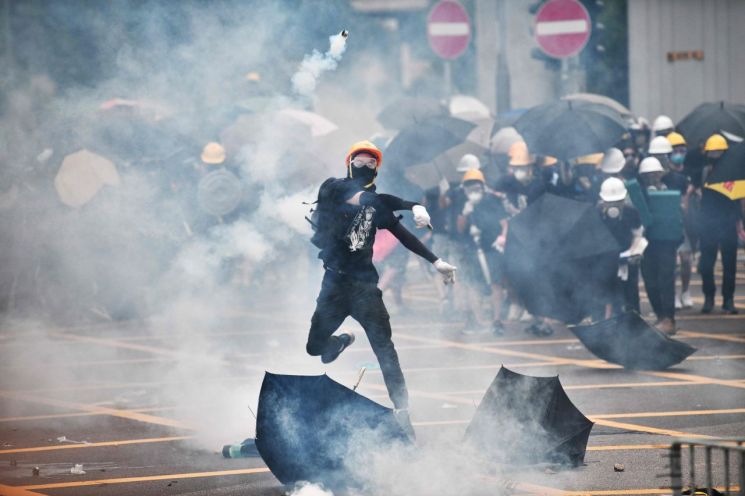 On July 27, 2019, during a protest condemning 'white terror' in the Yuen Long area of Hong Kong, a protester is throwing back a tear gas canister fired by the police. [Image source=AFP Yonhap News]
Earlier, in June last year, the Hong Kong Department of Justice filed an application with the Hong Kong High Court to prohibit individuals with seditious intent or those inciting others to independence from performing or reproducing "Glory to Hong Kong."
This included a request to ban performances of "Glory to Hong Kong" in a manner that could cause it to be mistaken as the national anthem of Hong Kong or imply that Hong Kong is an independent country with its own national anthem.
"Glory to Hong Kong" is an anonymous song created during the anti-government protests in Hong Kong in August 2019, supporting Hong Kong's independence. After the enactment of the Hong Kong National Security Law in June 2020, people singing "Glory to Hong Kong" or shouting "Liberate Hong Kong, Revolution of Our Times" in public places have been arrested or punished, effectively making it a banned song. On various information technology (IT) services such as Google and YouTube, when searching for "Hong Kong's national anthem," "Glory to Hong Kong" often appears at the top instead of the Chinese national anthem.
However, the Hong Kong High Court dismissed the Department of Justice's application in August last year, citing that the ban order would infringe on freedom of expression and could cause a chilling effect. In contrast, the Court of Appeal overturned the High Court's dismissal on the 8th and ruled in favor of the Department of Justice. The current panel set exceptions for academic and journalistic purposes but stated that "a ban order is necessary to persuade internet platform operators (such as Google and Spotify) to remove problematic videos related to the song."
Secretary Lam stated that he contacted online platform companies such as Google to raise awareness about the new order and notified them regarding the new directive.
© The Asia Business Daily(www.asiae.co.kr). All rights reserved.
![Clutching a Stolen Dior Bag, Saying "I Hate Being Poor but Real"... The Grotesque Con of a "Human Knockoff" [Slate]](https://cwcontent.asiae.co.kr/asiaresize/183/2026021902243444107_1771435474.jpg)















