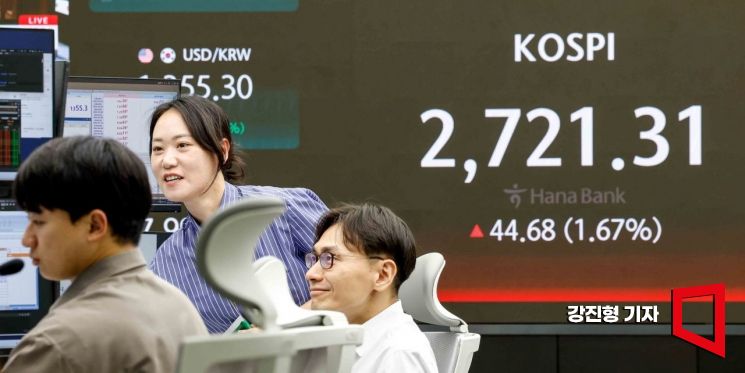
Expectations for a recovery in the global semiconductor market continue, and as anticipation grows for corporate value-up programs, foreign investors' buying of domestic stocks is ongoing.
According to the Bank of Korea on the 12th, the net inflow of foreign investment funds into domestic stocks in April reached 1.92 billion USD. Net inflow means that the amount of foreign investment funds entering the domestic stock market last month exceeded the amount withdrawn.
The net inflow trend has continued for six consecutive months since November last year (2.64 billion USD), December (2.52 billion USD), January this year (2.51 billion USD), February (5.59 billion USD), and March (3.84 billion USD). The total net inflow amounts to 19 billion USD. The increase in net inflow since February this year is due to financial authorities announcing support measures for corporate value-up programs in February, which heightened interest among major foreign investors in domestic stocks.
According to the Korea Exchange, foreign investors have net purchased stocks worth 20.5447 trillion KRW in the KOSPI market from the beginning of this year through the 10th of this month. The net buying trend has continued this year with January (3.4828 trillion KRW), February (7.8583 trillion KRW), March (4.4285 trillion KRW), and April (3.3727 trillion KRW).
In particular, buying has persisted centered on traditional export stocks such as semiconductors and automobiles, as well as value-up beneficiary stocks. Among the top stocks net purchased by foreign investors from the beginning of this year through the 10th are Samsung Electronics (8.3069 trillion KRW), Hyundai Motor (2.9149 trillion KRW), Samsung Electronics Preferred Shares (1.3104 trillion KRW), SK Hynix (1.2629 trillion KRW), Samsung C&T (1.2165 trillion KRW), and KB Financial Group (701.3 billion KRW).
A Bank of Korea official explained, "Despite concerns over the US Federal Reserve's (Fed) delayed policy rate cuts and geopolitical risks in the Middle East, foreign stock funds flowed in due to expectations of a recovery in the semiconductor market."
Meanwhile, the won-dollar exchange rate (end of period) in April was 1,382 KRW, up 34.8 KRW from March. This was influenced by expectations of delayed rate cuts by the US Fed, concerns over the expansion of Middle East conflicts, and yen weakness. However, recently, as tensions in the Middle East eased and investment sentiment recovered following the Federal Open Market Committee (FOMC) meeting, the won-dollar exchange rate stabilized at 1,361.5 KRW on the 8th.
© The Asia Business Daily(www.asiae.co.kr). All rights reserved.
![Clutching a Stolen Dior Bag, Saying "I Hate Being Poor but Real"... The Grotesque Con of a "Human Knockoff" [Slate]](https://cwcontent.asiae.co.kr/asiaresize/183/2026021902243444107_1771435474.jpg)















