"Exports Are Recovering"
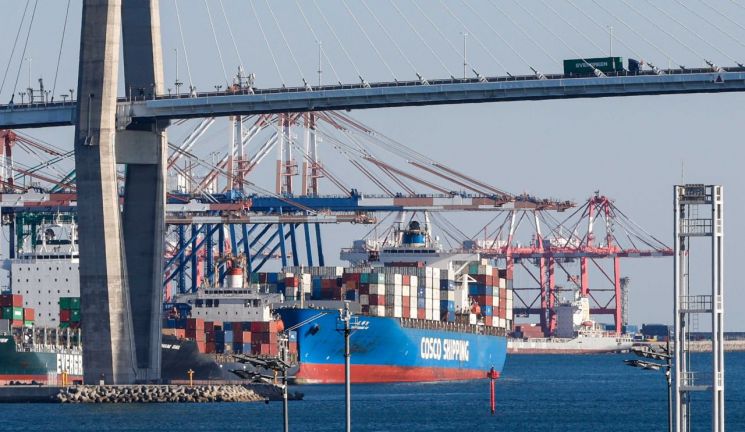 Export containers are being loaded onto a ship at Busan North Port. Photo by Jinhyung Kang aymsdream@
An analysis by a government-funded research institute revealed that despite the surprise economic growth in the first quarter of this year, domestic demand remains sluggish.
The Korea Development Institute (KDI) stated in the May issue of 'Economic Trends' published on the 12th, "Recently, our economy has maintained a trend of easing economic downturn, supported by a favorable recovery in exports."
Although production in March was somewhat adjusted, it was judged that the overall first quarter showed a gradual increase in production due to the semiconductor industry's upswing.
Industrial production in March increased by 0.2% compared to the same month last year, showing a slight slowdown from the previous month (1.7%).
Despite a high growth rate in semiconductors (30.3%), major industries such as automobiles (-9.0%), metal processing (-10.0%), and electrical equipment (-22.6%) were sluggish, causing the manufacturing production growth rate to drop from 4.6% in February to 0.7% in March.
Exports continue to show a favorable recovery centered on semiconductors. April exports increased by 13.8%, marking seven consecutive months of positive growth.
KDI viewed that while the economic downturn is easing mainly due to exports, domestic demand remains weak.
In March, goods consumption decreased in most categories, especially passenger cars and shoes/bags, influenced by the high-interest rate trend and a reduction in working days.
Retail sales fell by 2.7% compared to the same month last year. Clothing (-0.9%) and food and beverages (-1.5%) declined, and durable goods such as domestic passenger cars (-11.3%) and communication devices/computers (-12.7%) also contracted.
Service industry production, which reflects service consumption, rose by 1.0% compared to a year ago, but wholesale and retail trade (-5.9%) and accommodation and food services (-3.7%), closely linked to private consumption, saw significant decreases.
Facility investment is somewhat recovering from severe sluggishness but remains at a low level due to the high-interest rate environment, according to KDI.
Facility investment in March decreased by 4.8% compared to the same month last year, with the decline widening from the previous month (-0.9%).
Construction investment also continues to slow down. Construction output (constant) in March reversed from a 0.4% increase in the previous month to a 2.1% decrease, adjusting from the temporarily high growth at the beginning of the year.
KDI stated that the trend of slowing inflation due to weak demand continues. In particular, it explained that "the core inflation rate, which reflects the underlying price trend, is gradually declining and approaching the inflation target (2.0%)."
Consumer prices in April rose by 2.9% compared to the same month last year. Although price increases in volatile items such as agricultural products (20.3%) continued, the core inflation rate recorded 2.3%, slowing down from the previous month (2.4%).
However, it pointed out that the rise in international oil prices due to geopolitical instability could pose some burden in the future.
Earlier, the Ministry of Economy and Finance, in reference materials released on the 25th of last month when the first quarter real Gross Domestic Product (GDP) was announced to have grown by 1.3% quarter-on-quarter, evaluated that "there is a clear green light on the growth path of our economy," and "domestic demand is rebounding, showing a balanced recovery between exports and domestic demand."
© The Asia Business Daily(www.asiae.co.kr). All rights reserved.
![Clutching a Stolen Dior Bag, Saying "I Hate Being Poor but Real"... The Grotesque Con of a "Human Knockoff" [Slate]](https://cwcontent.asiae.co.kr/asiaresize/183/2026021902243444107_1771435474.jpg)















