Farmers' Groups Protest... Concerns Over Expansion to Other Livestock Such as Cattle
The Australian government will ban the live sheep export by ship starting four years from now to improve animal welfare.
On the 11th, Yonhap News, citing Australia's AAP news agency, reported that Agriculture Minister Murray Watt announced in a statement that the Australian government will prohibit live sheep exports by ship from May 2028.
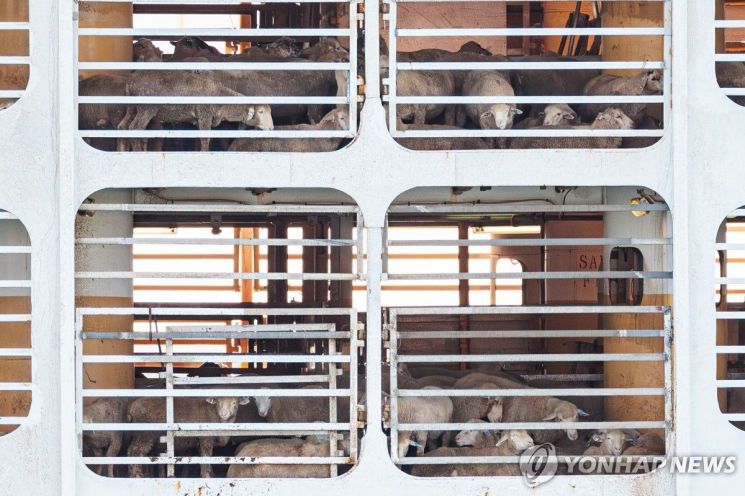
Last year, due to an oversupply of lamb, prices plummeted in Australia, leading some farmers to give away sheep for free to cut costs. At that time, the number of sheep in Australia reached 78.75 million, the largest since 2007, causing lamb prices to drop by 70% over the past year.
Other livestock such as cattle are excluded from this measure. Exports by airplane remain allowed. To support farms and related businesses affected by this policy, the Australian government plans to provide AUD 107 million (approximately KRW 97 billion) over five years.
Australian farmers have opposed the move. The National Farmers' Federation (NFF) criticized, saying, "Minister Watt has decided to put us on a fast train to disaster." They expressed concerns that this measure, which affects live sheep exports worth AUD 143 million (about KRW 130 billion) annually, might be extended to other livestock such as cattle.
In fact, Australia is the world's largest livestock exporter. Mainly sheep and cattle are exported to the Middle East and Indonesia, where they are either raised on farms or slaughtered according to halal practices in compliance with Islamic law. However, the transportation process has caused stress to the animals, leading to mass deaths and sparking controversy. For years, animal welfare groups have demanded legislation to ban long-distance livestock transport (exports).
In particular, in 2018, about 2,400 sheep exported from Australia to the Middle East died en masse due to heat and stress. Because of this, the Labor Party, then the opposition, included a ban on live sheep exports as an election pledge ahead of the 2019 and 2022 general elections.
In January, tensions around the Red Sea trade route escalated, causing about 15,000 Australian cattle and sheep bound for the Middle East to wait at sea for nearly a month. Animal protection groups argued that the livestock were exposed to extreme heat inside the ships and demanded they be unloaded promptly.
As these controversies continued, live sheep exports from Australia have been steadily declining. According to the Australian government, in the early 2000s, about 5 million live sheep were exported annually, but last year, the number dropped to 684,000.
Meanwhile, the issue of long-distance livestock transport has been debated in the UK for over 20 years. In 1995, in the eastern port city of Brightlingsea, citizens opposing livestock exports staged protests for nearly ten months. Eventually, last year, the King's Speech outlining the government's major policy agenda included a permanent ban on livestock exports for slaughter or fattening purposes from an animal welfare perspective.
According to King Charles III, who delivered the speech at the opening of Parliament for the first time since his accession, the UK plans to completely ban the export of live livestock such as cattle, sheep, goats, pigs, and horses for slaughter or fattening purposes abroad in the future.
© The Asia Business Daily(www.asiae.co.kr). All rights reserved.
![Clutching a Stolen Dior Bag, Saying "I Hate Being Poor but Real"... The Grotesque Con of a "Human Knockoff" [Slate]](https://cwcontent.asiae.co.kr/asiaresize/183/2026021902243444107_1771435474.jpg)















