Soju Tops Alcohol Category, Bibimbap Leads Korean Ready Meals
Reasons for Trying: "Delicious and Frequently Featured in Content"
Soju Awareness Especially High at 62.7% in Southeast Asia
The number one Korean alcoholic beverage recognized by overseas consumers was 'soju,' and the most desired Korean ready-to-eat meal was 'bibimbap.'
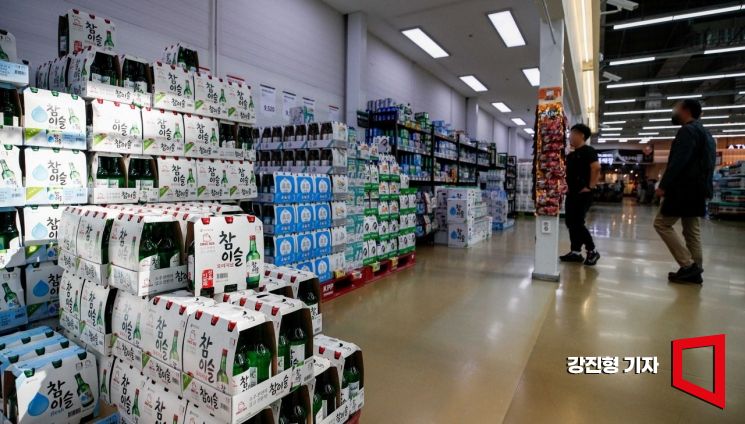 Riding the Korean Wave, soju exports have significantly increased, and a variety of soju bottles are displayed at the Hanaro Mart Yangjae branch in Seocho-gu. Photo by Jinhyung Kang aymsdream@
The Korean alcohol best known to foreigners is 'soju'... High recognition of Korean alcoholic beverages in the Asian region
On the 10th, the Korea Food Promotion Institute announced the results of the "Overseas Korean Food Consumer Survey," conducted from August to October 2023, targeting 9,000 local residents aged 20 to 59 in 18 major cities overseas, including Beijing, Ho Chi Minh City, and New York. When asked "Are you aware of any Korean alcoholic beverages?" 41.1% of all respondents answered "soju," followed by ▲beer (31.6%) ▲fruit wine (22.8%) ▲cheongju (17.9%) ▲takju (14.5%).
Regarding recognition of alcoholic beverages by continent, Korean alcoholic beverages showed generally high recognition in the Asian region, especially with soju recognition in Southeast Asia at 62.7%, which was higher than other regions. The second most recognized alcoholic beverage, beer, had the highest recognition in Northeast Asia at 38.1%. Consumers in Europe showed higher recognition of beer than Korean soju.
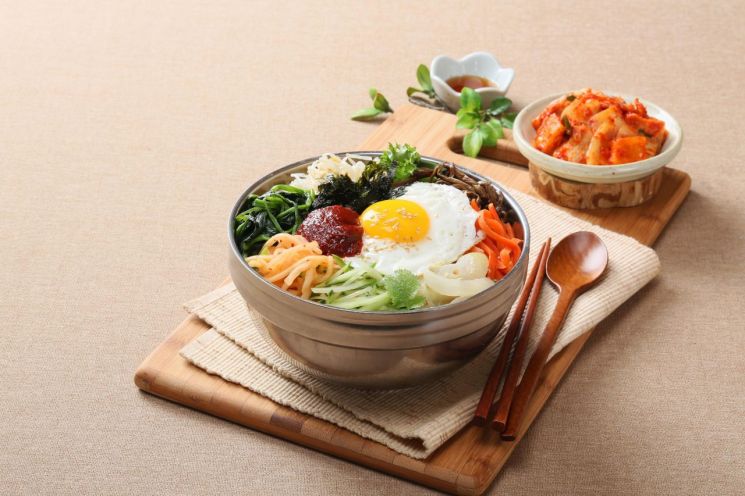
The most consumed alcohol by foreigners is also 'soju'... More than half express willingness to consume 'Korean alcoholic beverages'
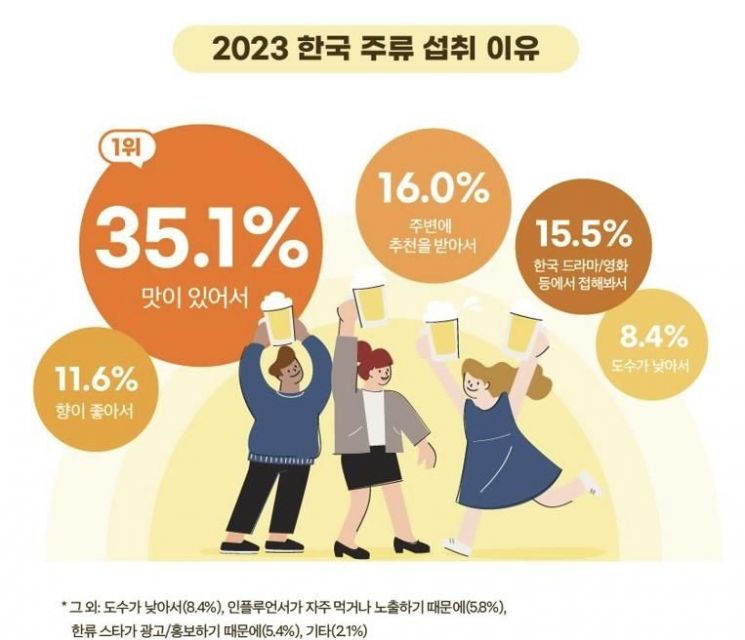 Reasons Why Foreigners Consume Korean Alcoholic Beverages.
 [Image Source=Korean Food Promotion Institute]
In the past two years, the Korean alcoholic beverage most consumed by foreigners was soju at 47.9%, ranking first. This is a 1.4 percentage point increase compared to the previous year's soju consumption rate of 46.5%. Next was beer at 36.2%, followed by ▲fruit wine (24.1%) ▲cheongju (18.1%) ▲takju (13.2%). The main reason for consuming Korean alcoholic beverages was overwhelmingly "because it tastes good" (35.1%). Other reasons included ▲recommendations from others (16.0%) ▲exposure through Korean dramas and movies (15.5%) ▲pleasant aroma (11.6%) ▲low alcohol content (8.4%).
When asked about their willingness to consume Korean alcoholic beverages in the future, 57.7% of all respondents answered "willing." This is a 4.3 percentage point increase compared to the previous year (53.4%). Notably, in North America, the percentage of respondents who wanted to experience Korean alcoholic beverages increased by 12.1 percentage points from 47.2% the previous year, showing a remarkable upward trend.
The most desired Korean ready-to-eat meal is 'bibimbap'... Various other Korean dishes also mentioned
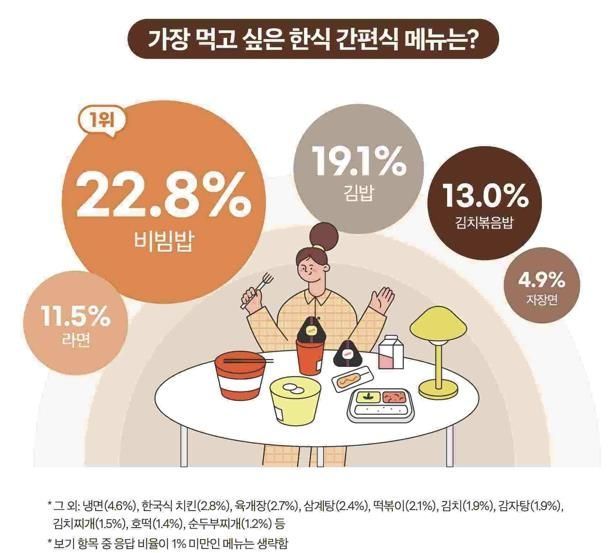 Korean convenient meal menus that foreigners want to eat.
 [Image source=Korean Food Promotion Institute]
Meanwhile, the most desired Korean ready-to-eat meal was bibimbap at 22.8%, ranking first. This was followed by ▲gimbap (19.1%) ▲kimchi fried rice (13.0%) ▲ramyeon (11.5%) ▲jajangmyeon (4.9%). Other responses included ▲naengmyeon (4.6%) ▲Korean-style fried chicken (2.8%) ▲yukgaejang (2.7%) ▲samgyetang (2.4%) ▲tteokbokki (2.1%) ▲kimchi (1.9%) ▲gamjatang (1.9%) ▲kimchi jjigae (1.5%) ▲hotteok (1.4%) ▲sundubu jjigae (1.2%). The most important factor foreigners consider when purchasing Korean ready-to-eat meals was taste (21.0%), followed by price (13.5%).
© The Asia Business Daily(www.asiae.co.kr). All rights reserved.
![Clutching a Stolen Dior Bag, Saying "I Hate Being Poor but Real"... The Grotesque Con of a "Human Knockoff" [Slate]](https://cwcontent.asiae.co.kr/asiaresize/183/2026021902243444107_1771435474.jpg)

















