Cabbage Released Daily at 110 Tons
Over 35,000 Tons of Directly Imported Fruits Introduced
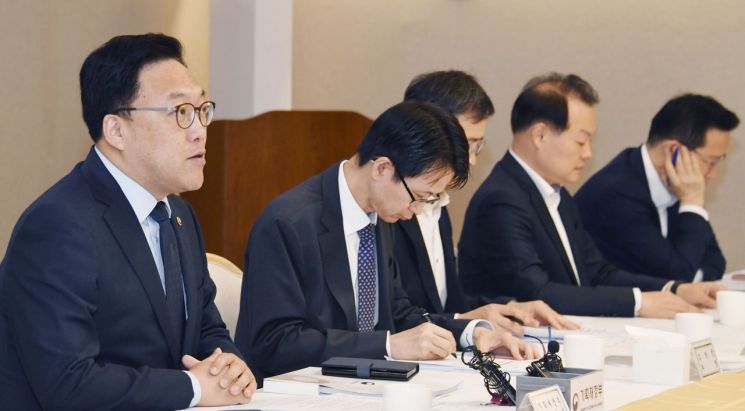 Kim Byung-hwan, Vice Minister of Strategy and Finance, is delivering opening remarks at the "40th Emergency Economic Vice Ministers' Meeting and 20th Price-Related Vice Ministers' Meeting" held on the morning of the 10th at the Government Seoul Office in Jongno-gu, Seoul.
As prices of agricultural and marine products in the shopping basket continue to soar, Kim Byung-hwan, the 1st Vice Minister of the Ministry of Economy and Finance, stated on the 10th, "We will make every effort to stabilize prices, the most important indicator of people’s livelihood." The government will newly apply tariff quotas on cabbage, carrots, and gim (seaweed) starting today.
At the '40th Emergency Economic Vice Ministers' Meeting and the 20th Price-Related Vice Ministers' Meeting' held at the Government Seoul Office, chaired by Vice Minister Kim, discussions were held on strengthening the competitiveness of regional growth support services, reviewing the implementation of support measures for innovative procurement companies, and checking the price stabilization response status by ministries.
Vice Minister Kim mentioned, "The current account surplus in the first quarter of this year reached $16.8 billion, rapidly expanding considering the government's annual forecast of $50 billion, and exports in April continue to show a favorable trend," adding, "We will make every effort to stabilize prices, the most important indicator of people’s livelihood, through the Livelihood Price Task Force and the Livelihood Stability Support Group so that the public can feel the economic recovery reflected in the indicators."
To stabilize shopping basket prices, the government plans to continuously release 110 tons of cabbage and 80 tons of radish daily this month, and import more than 35,000 tons of directly imported fruits such as bananas and kiwis by next month.
Starting today, tariff quotas will be newly applied to seven items including cabbage, carrots, and gim. Tariff quotas are a system that temporarily adjusts tariff rates for a certain quantity of imported goods during a specified period. Additionally, the Ministry of Oceans and Fisheries, the Fair Trade Commission, and the Coast Guard will jointly inspect the domestic gim distribution market status and develop 2,700 hectares of new gim farms.
Earlier, President Yoon Suk-yeol, at a press conference marking his second anniversary in office, identified price stabilization as the top priority in the economic sector for the remainder of his term, stating, "Price management is the number one priority in managing economic indicators, and the government will mobilize all capabilities to curb shopping basket prices and dining-out prices." The government has been increasing discount support and expanding tariff quota items as measures to counter high prices, mainly focusing on agricultural and marine products.
© The Asia Business Daily(www.asiae.co.kr). All rights reserved.
![Clutching a Stolen Dior Bag, Saying "I Hate Being Poor but Real"... The Grotesque Con of a "Human Knockoff" [Slate]](https://cwcontent.asiae.co.kr/asiaresize/183/2026021902243444107_1771435474.jpg)















