SK Geocentric Advances Waste Plastic Recycling Business
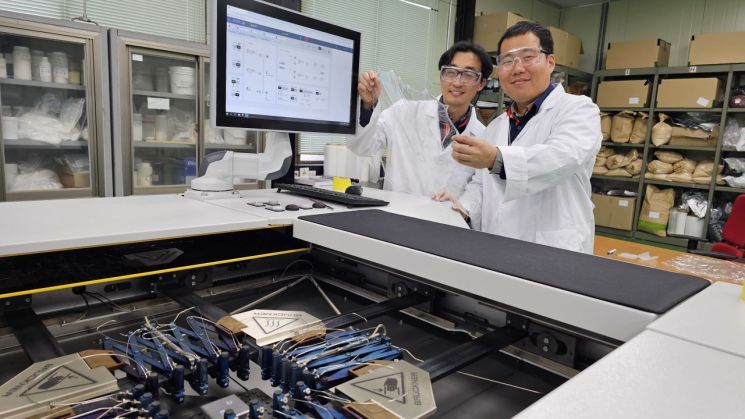 At the SK Innovation Environmental Science and Technology Institute in Yuseong-gu, Daejeon, company researchers are verifying the stretching performance of polyethylene (PE) materials that replace conventional PET and nylon materials. Packaging made of heterogeneous materials such as PET and nylon is difficult to recycle, but when composed of PE materials, mechanical recycling (MR) of plastic materials becomes easier. Photo by SK Innovation
On the 7th, at the SK Innovation Environmental Science and Technology Institute pilot plant (test factory) located in Yuseong-gu, Daejeon, about 20 clamps of the 'stretching' equipment grip the edges of PE (polyethylene) pieces measuring 10 cm by 10 cm and pull them. The PE pieces stretch up to 50 cm in length and width, and while the previously opaque PE material becomes transparent, its rigidity actually increases. It is reborn as a PE material with strong properties that does not tear easily and no longer stretches when pulled.
The SK Innovation Environmental Science and Technology Institute conducts experiments, quality verification, and research and development for SK Innovation’s subsidiaries such as SK Geocentric, SK Energy, and SK On. About 1,700 R&D personnel in eco-friendly materials and battery sectors work in this research complex. The transformation of the plastic material PE witnessed here was remarkable. Packaging materials have traditionally been made by layering multiple materials such as nylon and PET (polyester) to block moisture and oxygen and provide thermal insulation. Because these multiple materials like nylon are bonded with adhesives, recycling them has been technically and commercially difficult.
By stretching only recyclable PE material through a 'stretch' process, it can be reborn as a material that replaces plastic bags. Since PE is used as a single material, it is recyclable while also meeting the physical properties and performance required by customers, according to SK Innovation.
SK Geocentric’s 'Pack Solution Task' focuses on developing high-performance packaging materials that implement multiple functions of composite packaging materials into a single material, making them tougher and stronger even at the same thickness as composite packaging materials. The high-performance packaging materials developed in this way are used and produced in products such as Aekyung Industrial’s 'Spark' laundry detergent, Kurly’s 'Market Kurly' ice packs, Dongwon F&B’s 'Myeonbalui Sin', and pet product brand 'Pethroom’s' waste disposal products.
SK Geocentric is gaining attention for its plastic recycling technology based on its development and mass production capabilities of basic materials such as PE and PP (polypropylene). In particular, it is building a recycled plastic cluster (ARC) in Ulsan. The technology observed through the researchers on this day is 'physical recycling.' Physical recycling has been considered to have technical limitations due to restricted recycling cycles and potential weakening of material properties. However, SK Geocentric explains that these drawbacks can be overcome by using AI technology and existing new PE and PP materials. When the physical properties required by customers and the characteristics of collected waste plastics are input, AI trained on existing research results suggests the most suitable recycling blend ratios and processes.
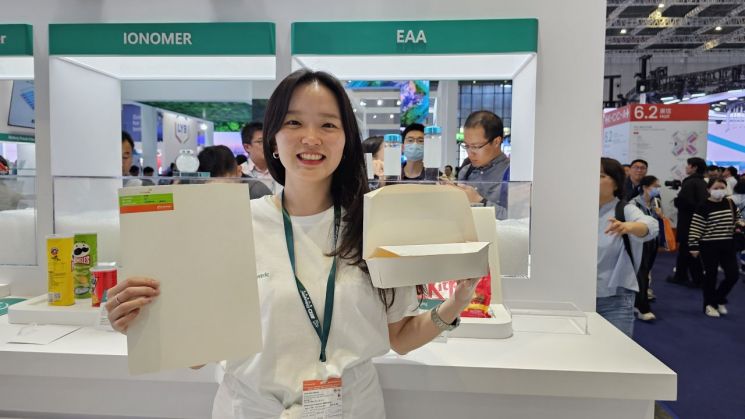 An SK Geocentric official is introducing a prototype that uses ethylene acrylic acid (EAA) material to bond different materials such as paper and plastic. Photo by SK Innovation
Song Kanghyun, leader of SK Innovation Environmental Science and Technology Institute, explained, "We are overcoming the physical recycling drawbacks of weakened material properties and limited recycling cycles. The materials developed by mixing recycled plastics such as polyethylene and polypropylene with virgin plastics in certain ratios are reused in household goods, electronics, and automotive parts." SK Geocentric is particularly focusing on securing technology to recycle waste plastics such as polyethylene and polypropylene collected from daily life and vehicles after use. High-crystallinity polypropylene (HCPP) for reducing plastic usage has been commercialized in three types for automotive interior and exterior materials, and more than ten types are being developed for commercialization.
Globally, demand for plastic recycling is increasing. Europe announced plans to raise the recycling rate of plastic packaging materials to 50% by 2025, the United States aims for at least 30% recycled plastic use by 2030, and South Korea also announced a target of 30% recycled plastic raw material use by 2030.
Accordingly, demand for recycled materials from companies is also increasing. Samsung Electronics declared it will use recycled materials in all products by 2025, Kia set a goal to use 20% recycled plastic by 2030, and Coca-Cola announced a target of 50% recycled material use in packaging by 2030. Global market research firm MarketsandMarkets forecasts the global recycled plastic market to grow from $69.4 billion (about 94 trillion KRW) in 2023 to $120 billion (about 164 trillion KRW) by 2030, with an annual growth rate (CAGR) of 8.1%.
© The Asia Business Daily(www.asiae.co.kr). All rights reserved.
![Clutching a Stolen Dior Bag, Saying "I Hate Being Poor but Real"... The Grotesque Con of a "Human Knockoff" [Slate]](https://cwcontent.asiae.co.kr/asiaresize/183/2026021902243444107_1771435474.jpg)

















