Reflecting Strong Financial Capabilities, etc.
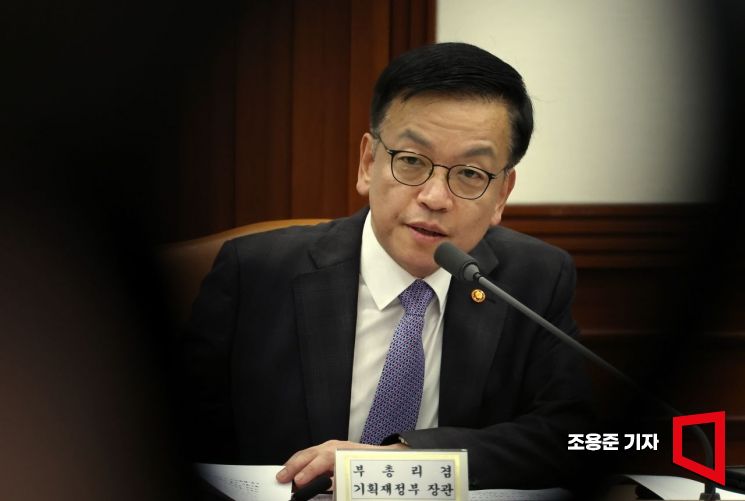 Choi Sang-mok, Deputy Prime Minister for Economic Affairs and Minister of Economy and Finance, is speaking about the response direction to the escalating tensions in the Middle East at the Emergency Economic Ministers' Meeting held at the Government Seoul Office in Jongno-gu, Seoul on the 15th. Photo by Jo Yong-jun jun21@
International credit rating agency Moody's has maintained South Korea's sovereign credit rating at 'Aa2', the same as before. The rating outlook was also assessed as 'stable', unchanged from the previous evaluation. Due to favorable conditions in the semiconductor industry, the economic growth rate for this year is expected to rise to 2.5%.
On the 9th, Moody's announced in its sovereign credit rating report for South Korea that both the credit rating and the rating outlook would be maintained at the previous levels. The Aa2 rating assigned to South Korea is the third highest among Moody's ratings, following Aaa and Aa1. South Korea shares this rating with countries and regions such as France, Abu Dhabi, and the United Arab Emirates.
Moody's explained the rationale behind the rating decision as reflecting "a diversified and competitive economy, agile policy responses, strong fiscal capacity, as well as challenging aspects of the Korean economy such as aging population, productivity slowdown, and risks related to North Korea."
Moody's projected South Korea's real Gross Domestic Product (GDP) growth rate for this year at 2.5%. It stated, "This year, the Korean economy is expected to improve its GDP growth rate from 1.4% last year to 2.5%, supported by a semiconductor boom and recovery in facility investment." However, it predicted that over the coming years, growth will remain around 2%, similar to other advanced economies, due to factors such as productivity slowdown.
Despite the US-China trade conflicts centered around the semiconductor industry, Moody's forecasted that South Korea's position in the global supply chain will not be significantly affected, attributing this to South Korea's innovation capabilities and competitiveness.
Changes in population structure, such as aging, are factors that hinder potential growth and productivity. Moody's emphasized the importance of government policy efforts to address productivity gaps between small and large enterprises, between manufacturing and service sectors, and to improve the dual structure of the labor market.
Moody's also evaluated that South Korea's national debt remains at a level similar to or lower than other advanced countries. It assessed that fiscal capacity for future economic responses is being maintained. Although it pointed out increased expenditures in healthcare and social welfare due to population aging as fiscal burden factors, it noted that fiscal deficits are comparable to other Aa2-rated countries, and that substantial fiscal resources such as the Korea Investment Corporation (KIC) and social security funds serve as buffers.
Geopolitical risks related to North Korea continue to be a rating burden factor, but Moody's viewed that the actual impact on South Korea's economy, fiscal system, and payment systems is not significant.
Prior to Moody's announcement of the credit rating, the government held several meetings with Moody's representatives. In March, Shin Jung-beom, Director General of the International Finance Bureau at the Ministry of Economy and Finance, met with Assi Shes, Moody's Chief Credit Officer (CCO), in New York, USA. On the 29th of last month, they continued close communication through an annual video conference, explaining South Korea's economic performance to Moody's.
© The Asia Business Daily(www.asiae.co.kr). All rights reserved.
![Clutching a Stolen Dior Bag, Saying "I Hate Being Poor but Real"... The Grotesque Con of a "Human Knockoff" [Slate]](https://cwcontent.asiae.co.kr/asiaresize/183/2026021902243444107_1771435474.jpg)















