Yoon "If Financial Investment Tax Is Not Abolished, Our Stock Market Will Suffer Massive Damage"
Market Voices "It Will Discourage Investment Willingness" Concerns
Only 1% Subject... Also Rebuttal That There Is No Market Impact
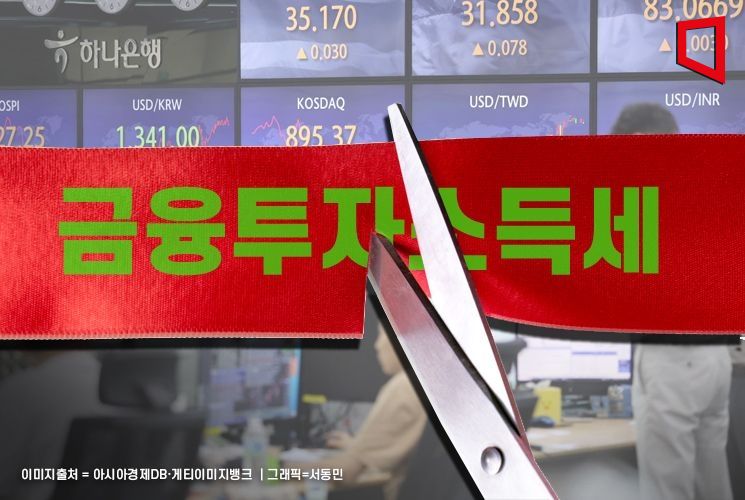
President Yoon Suk-yeol has once again emphasized his intention to abolish the Financial Investment Income Tax (FIIT) for the first time since the general election, drawing renewed market attention to whether the FIIT will be implemented. The capital market industry is concerned that while the introduction of the FIIT may not immediately lead to capital outflows from the Korean capital market, it could dampen investors' willingness to invest.
On the 10th, Park Hye-jin, senior researcher at Daishin Securities, pointed out, "The introduction of the FIIT contradicts the Yoon administration's attitude toward the capital market, which aims to help citizens grow their assets through investment," adding, "There are investors who receive dividends or seek moderate returns, but if taxes are uniformly imposed on dividends and other income, it could act as an obstacle that discourages investment."
The FIIT is a system that imposes a capital gains tax of 20-25% on profits exceeding 50 million KRW annually from investments in financial investment products such as stocks, bonds, funds, and derivatives. For other financial products, the threshold is 2.5 million KRW or more. For example, if an investor earns 80 million KRW in profits from stocks, they would have to pay 16 million KRW in taxes, which is 20% of the gains. Countries like the United States, the United Kingdom, and Japan impose capital gains taxes, while China, Taiwan, and Hong Kong do not apply such taxes.
There are also opinions that the introduction of the FIIT would eliminate the merits of the domestic capital market and could lead to capital outflows. A representative from a major securities firm said, "Despite the fact that investors must pay a 22% capital gains tax on profits exceeding 2.5 million KRW from U.S. stock investments, the number of investors investing in U.S. stocks is increasing. If the same tax is applied in Korea, there would be no merit in investing in the Korean capital market, which could lead to capital outflows."
There are also counterarguments that the impact of the FIIT on the capital market will be minimal. According to the April issue of the Fiscal Forum recently published by the Korea Institute of Public Finance, even if the FIIT is implemented, wealthy households bear a similar tax burden regardless of the type of tax.
There is also controversy over tax cuts for the wealthy. This is because only about 1% of all investors (approximately 150,000 people) are subject to the FIIT. Professor Ahn Chang-nam of the Taxation Department at Gangnam University said, "Abolishing the FIIT breaks the principle of taxing where income exists," adding, "The problem lies with some individual investors who earn capital gains exceeding 50 million KRW and thus pay the FIIT, but they account for only about 1% of the approximately 14 million domestic stock investors, so the impact on the market will not be significant."
Concerns that the FIIT will cause capital outflows are considered excessive, especially since foreign and institutional investors, who move the Korean stock market, are not subject to the FIIT. According to the Ministry of Economy and Finance, institutions are taxed through corporate tax, and foreigners do not have to pay separate taxes domestically due to tax treaties.
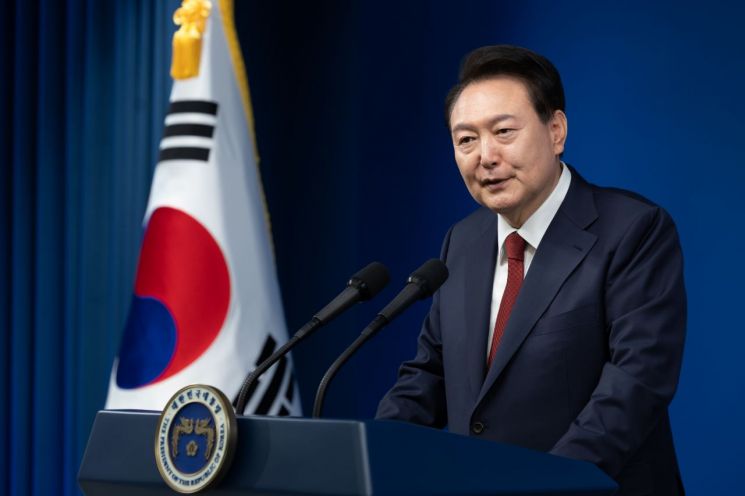
Meanwhile, the FIIT is scheduled to be implemented in January next year as planned, but with the opposition party opposing it as a "tax cut for the wealthy," it seems difficult to reach a consensus between the two sides. On the 9th, President Yoon reaffirmed the policy to abolish the FIIT during the "Yoon Suk-yeol Government 2nd Year National Report and Press Conference," stating, "If the FIIT is not abolished, a massive amount of capital will leave our stock market," which he had announced earlier this year. He also pointed out, "There will be a huge impact on 14 million individual investors," adding, "Compared to advanced countries, Korea has very high taxes on financial investment and stock investment, including dividend income tax, and if the FIIT is added on top, there is little left for investors."
As concerns grew in the market that the opposition party, having become the majority in the National Assembly after the general election, would block policies such as the abolition of the FIIT, this appears to be an attempt to ease those concerns. President Yoon seemed aware that the opposition party's consent is essential to nullify the FIIT implementation, saying, "We will strongly request cooperation from the National Assembly on this issue, especially seeking the cooperation of the opposition party." In response to President Yoon's remarks, the opposition party only expressed a general stance of communicating with the public. On the same day, Park Chan-dae, floor leader of the Democratic Party of Korea, said regarding President Yoon's request for opposition cooperation on the 'abolition of the FIIT,' "Public opinion is divided," adding, "We will carefully review and respond by understanding the justice of taxation and what the people want. There are many misunderstandings about the FIIT, so we will communicate with the public."
© The Asia Business Daily(www.asiae.co.kr). All rights reserved.
![Clutching a Stolen Dior Bag, Saying "I Hate Being Poor but Real"... The Grotesque Con of a "Human Knockoff" [Slate]](https://cwcontent.asiae.co.kr/asiaresize/183/2026021902243444107_1771435474.jpg)

















