Fecal Disorder Causes Hardening Like Calcium in the Colon
Belly Protrudes Like Pregnant with Triplets
A story has been revealed about a man who was unable to use the bathroom for a staggering three months, causing hardened stool to accumulate inside his abdomen. Dr. Justin Shafa, a radiology specialist in Los Angeles, recently shared a CT scan image of the abdomen of a man identified as Mr. A, whose intestines were filled with stool, on his TikTok channel and the American information-sharing community 'Reddit.'
Dr. Shafa explained that Mr. A visited the emergency room after not having a proper bowel movement for three months, and the CT scan showed his abdomen was completely filled with feces. Dr. Shafa said, "Mr. A's belly was swollen to the size of a woman pregnant with triplets." This appears to be a case of fecal impaction, a condition where hard stool becomes stuck in the intestines.
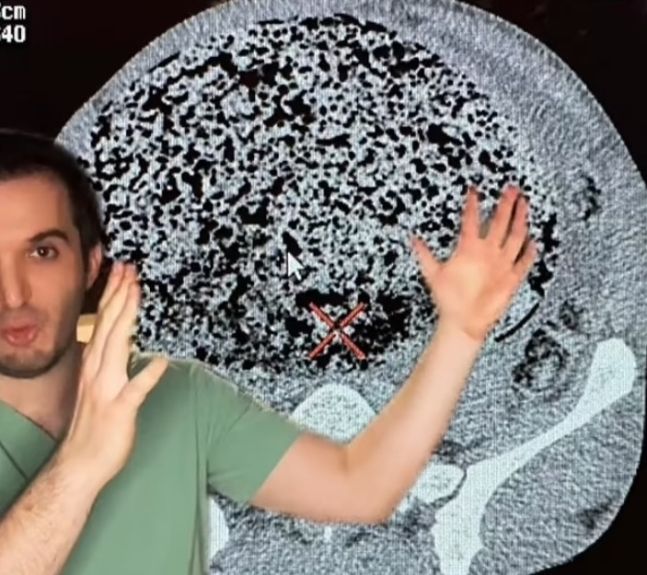 The large, round area mixed with black and white that the doctor is pointing to with their hand is stool filling the abdomen.
 [Photo by Daily Mail]
Dr. Shafa stated, "The constipation was so severe that waste hardened and became trapped in the colon," adding, "In such cases, methods like enemas to remove the stool or inducing fluid movement toward the colon to soften the stool and help it exit the body can be used." Netizens responded in the comments with reactions such as, "It's amazing the stool didn't come out of the mouth," "It must have been really painful not having a bowel movement for about 100 days," and "Only those who have experienced severe constipation know the pain."
If bowel movements are not made for three months, fecal impaction can occur, with up to approximately 43 kg of stool accumulating in the body. Fecal impaction usually results from slow-transit constipation. Slow-transit constipation occurs when the nerve cells that move the intestinal muscles decrease. When nerve cells decrease, the colon's motility declines, preventing stool from being pushed into the rectum. There is no abdominal pain for 1 to 2 weeks until the stool completely fills the colon.
When lying down and pressing the upper abdomen with the hand, the stool can be felt as hard and full. If slow-transit constipation is left untreated, it can lead to loss of appetite and nutritional imbalance or fecal impaction like Mr. A’s case. Treatment involves enemas at the hospital or taking gastrointestinal motility stimulants, which are prescription medications, for about two weeks.
© The Asia Business Daily(www.asiae.co.kr). All rights reserved.
![Clutching a Stolen Dior Bag, Saying "I Hate Being Poor but Real"... The Grotesque Con of a "Human Knockoff" [Slate]](https://cwcontent.asiae.co.kr/asiaresize/183/2026021902243444107_1771435474.jpg)















