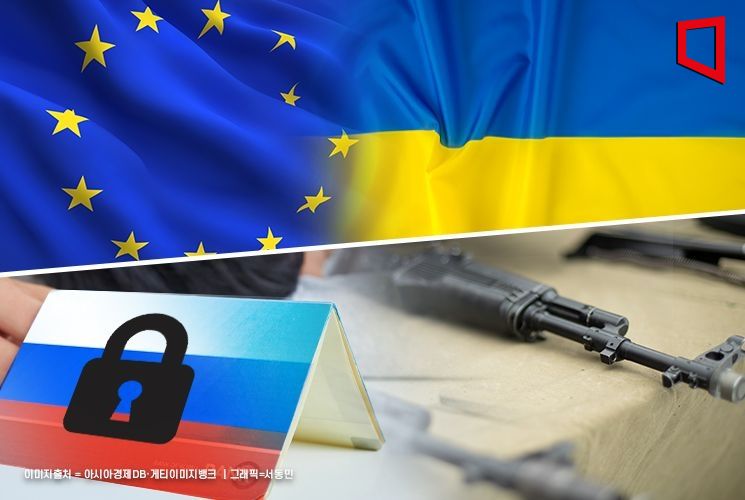
On the 8th (local time), the European Union (EU) decided to support Ukraine by purchasing weapons with the approximately 4 trillion won in profits generated from frozen Russian assets within the region.
Belgium, the EU's rotating presidency for the first half of the year, announced via X (formerly Twitter) in the afternoon that "EU (27 countries) ambassadors have reached a principled agreement on measures related to special revenues generated from frozen Russian assets." They added, "This money will be used to support Ukraine's reconstruction and military defense amid Russia's invasion."
This provisional agreement came about a month and a half after the European Commission, the EU's executive body, proposed on March 20 to use the profits from managing frozen assets as aid for Ukraine. The provisional agreement reached at the ambassador-level meeting is expected to be officially confirmed as early as the 15th after detailed review. The EU anticipates starting implementation from July.
In response to Russia's invasion of Ukraine in February 2022, the EU froze Russian central bank assets within the region amounting to 210 billion euros (approximately 305 trillion won). Most of these are tied up in Euroclear, the central securities depository (CSD) located in Belgium.
Once the agreement is executed, 90% of the annual profits of 2.5 to 3 billion euros (approximately 3.6 to 4.4 trillion won) generated by Euroclear through additional management of the frozen assets will be transferred to the European Peace Facility (EPF), the EU's special fund for military support to Ukraine. The remaining 10% of the profits will be invested in Ukraine's reconstruction projects.
Member states will purchase weapons and deliver them to Ukraine, then recover part of the payment through the EPF. However, for neutral member states that do not provide military support, such as Austria, Ireland, Malta, and Cyprus, reimbursement will be possible for humanitarian aid payments instead of weapon payments.
This agreement is separate from the United States' plan, pursued at the Group of Seven (G7) level, to confiscate the entire principal of frozen Russian assets for use in supporting Ukraine. The EU remains skeptical about touching the principal of frozen assets due to insufficient legal grounds and other reasons.
© The Asia Business Daily(www.asiae.co.kr). All rights reserved.
![Clutching a Stolen Dior Bag, Saying "I Hate Being Poor but Real"... The Grotesque Con of a "Human Knockoff" [Slate]](https://cwcontent.asiae.co.kr/asiaresize/183/2026021902243444107_1771435474.jpg)















